
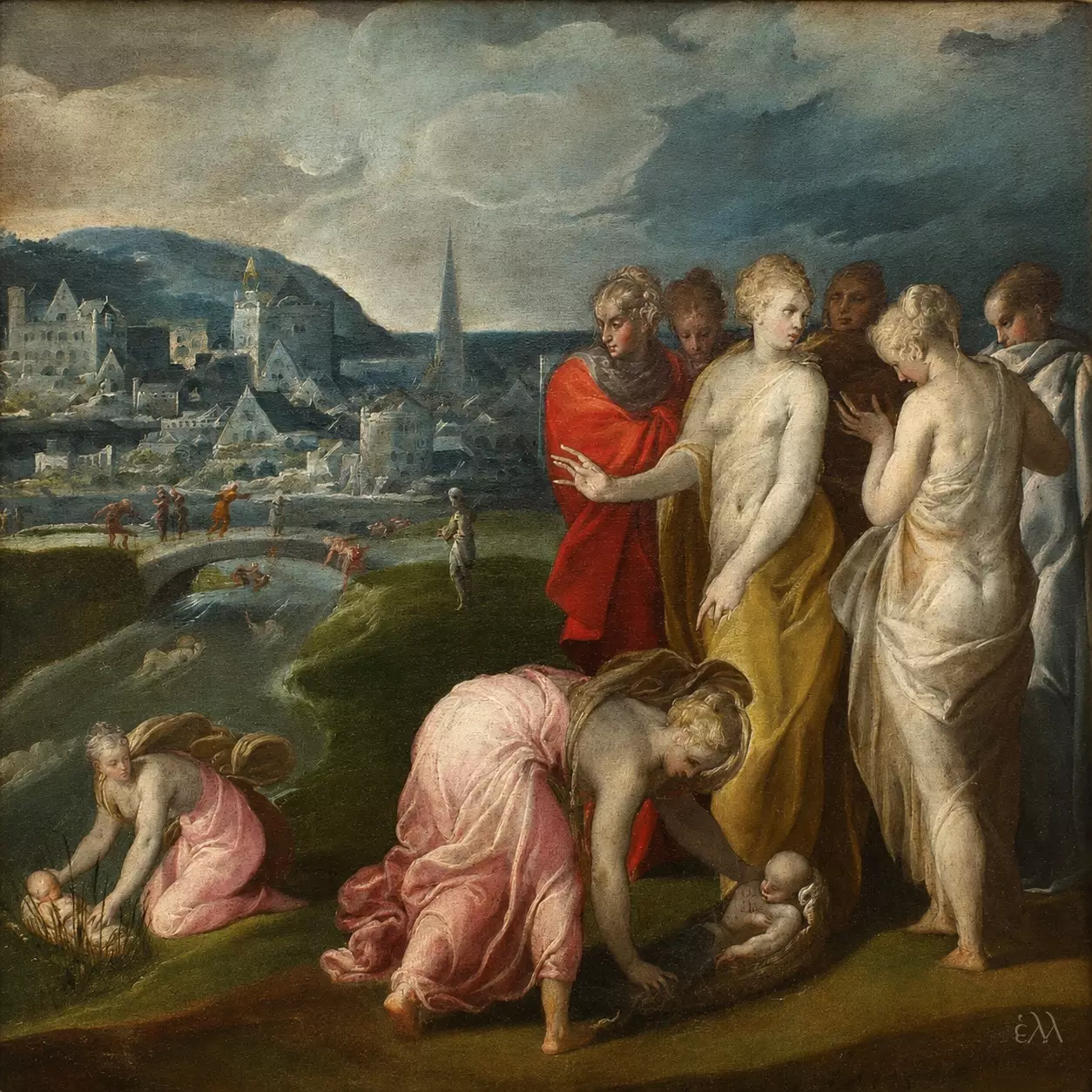
Niccolò dell’Abbate’s Moses Rescued from the Nile, usually dated around 1560, transforms the biblical discovery of the infant Moses into a sophisticated courtly narrative, populated by elongated female figures and set before an unexpectedly expansive European landscape. Executed in oil on canvas and measuring approximately 82.5 by 83 centimetres, the painting belongs today to the Département des Peintures of the Musée du Louvre, where it is catalogued as RF 3937. The Louvre assigns the work more broadly to the third quarter of the sixteenth century, between 1550 and 1575.
The subject comes from Exodus (2:1–10): the Hebrew child Moses, placed in a basket among the reeds to escape Pharaoh’s decree, is discovered by Pharaoh’s daughter and her attendants. Dell’Abbate retains the narrative essentials, yet the visual emphasis falls elsewhere. The infant occupies only a small portion of the foreground, while the women who have gathered around him command the composition through their scale, gestures, drapery and pale, carefully modelled bodies. Beyond them stretches a river landscape containing bridges, buildings, towers, distant hills and numerous diminutive figures. Biblical Egypt has become a setting filtered through the visual culture of sixteenth-century Europe.
Moses Rescued from the Nile: Composition and Mannerist Style
Across the square canvas, dell’Abbate establishes an asymmetrical composition with two very different kinds of pictorial activity. The foreground is dominated by the monumental group of women. Behind and beside them the landscape recedes in successive stages, passing from dark grassy banks to water, architecture and a blue-grey horizon beneath a turbulent sky. The controlled alternation of large bodies and minute distant figures gives the painting an unusual spatial elasticity. Human scale changes rapidly. A woman kneeling beside the basket is almost life-sized within the pictorial logic of the foreground; figures crossing the bridge have been reduced to flickering accents of movement.
The arrangement depends heavily upon diagonals. The bent body of the woman nearest the child creates one, the standing figure clothed in yellow another, while the descending slope of the ground directs the eye towards the basket. Yet the narrative centre is deliberately unstable. The viewer may first notice the brilliantly dressed standing women, then the almost sculptural exposed back of another attendant, then the infant below them. Dell’Abbate permits the story to be discovered gradually. His biblical protagonist is physically small, almost vulnerable to the magnificence surrounding him.
Colour strengthens these divisions. Red, yellow, rose and creamy white are concentrated in the garments of the principal figures, set against the deep green earth and the subdued blue-green distance. The saturated red cloak provides one of the strongest chromatic anchors in the painting. Beside it, the golden drapery covering the central woman has a softer luminosity, while the two pink garments in the foreground unfold in broad, complicated masses of fabric. Such chromatic relationships are integral to the composition, separating bodies, establishing depth and continually returning attention to the human group.
Dell’Abbate had entered the artistic world of the French court by 1552, when he arrived at Fontainebleau and worked as an assistant to Francesco Primaticcio. That context matters for Moses Rescued from the Nile. His mature painting belongs to the artistic environment associated with the School of Fontainebleau, in which Italian Mannerist ideas were adapted to a highly cultivated court culture. The canvas carries several characteristics associated with that visual language: elongated proportions, elegant poses, bodies whose movements seem devised as much for formal beauty as for narrative necessity, and draperies that expose and conceal the figure in calculated intervals.
Within Renaissance painting, recourse to classical form had already created a broad language through which biblical and historical subjects could be reimagined. Dell’Abbate pushes that process towards an unmistakably courtly ideal. His women possess the polished physiognomies and elaborate coiffures of an aristocratic world. One figure turns her body almost completely away, allowing the long pale back and twisting torso to become an independent study of form. Another extends an arm horizontally, the hand opening with studied delicacy. The gestures communicate, but they also establish rhythms across the surface.
The landscape introduces a different order of observation. Across the water stands a densely built settlement of pitched roofs, towers and pale masonry. A bridge crosses the river, populated by tiny figures, and further human activity appears along the banks and in the water. Nothing attempts an archaeological reconstruction of ancient Egypt. Dell’Abbate instead allows the Old Testament event to inhabit a landscape familiar to the imaginative geography of Renaissance Europe, although transformed sufficiently to remain detached from any ordinary locality.
That landscape is not passive scenery. Its broad recession counterbalances the compact mass of figures and prevents the foreground from becoming oppressive. Under a sky increasingly dark towards the opposite edge of the canvas, architecture dissolves into atmospheric distance; near the women, bodies retain sharply legible contours and greater tonal contrast. The transition is gradual, sometimes almost abrupt. A narrative occurring within a few metres of the viewer opens suddenly onto a world of bridges, settlements and distant terrain.
The choice is characteristic of an artist whose surviving work repeatedly reveals an interest in landscape, architecture and the placement of elegant figures within extended settings. Getty records dell’Abbate as an Italian painter active in France and associates his work particularly with landscapes, architecture and ruins. In Moses Rescued from the Nile, those interests converge with religious narrative. The landscape enlarges the episode beyond the immediate discovery of the child, while the foreground preserves the intimacy of an encounter involving hands, glances, fabric and the small body in the basket.
Moses Rescued from the Nile: The Courtly Figures in Detail
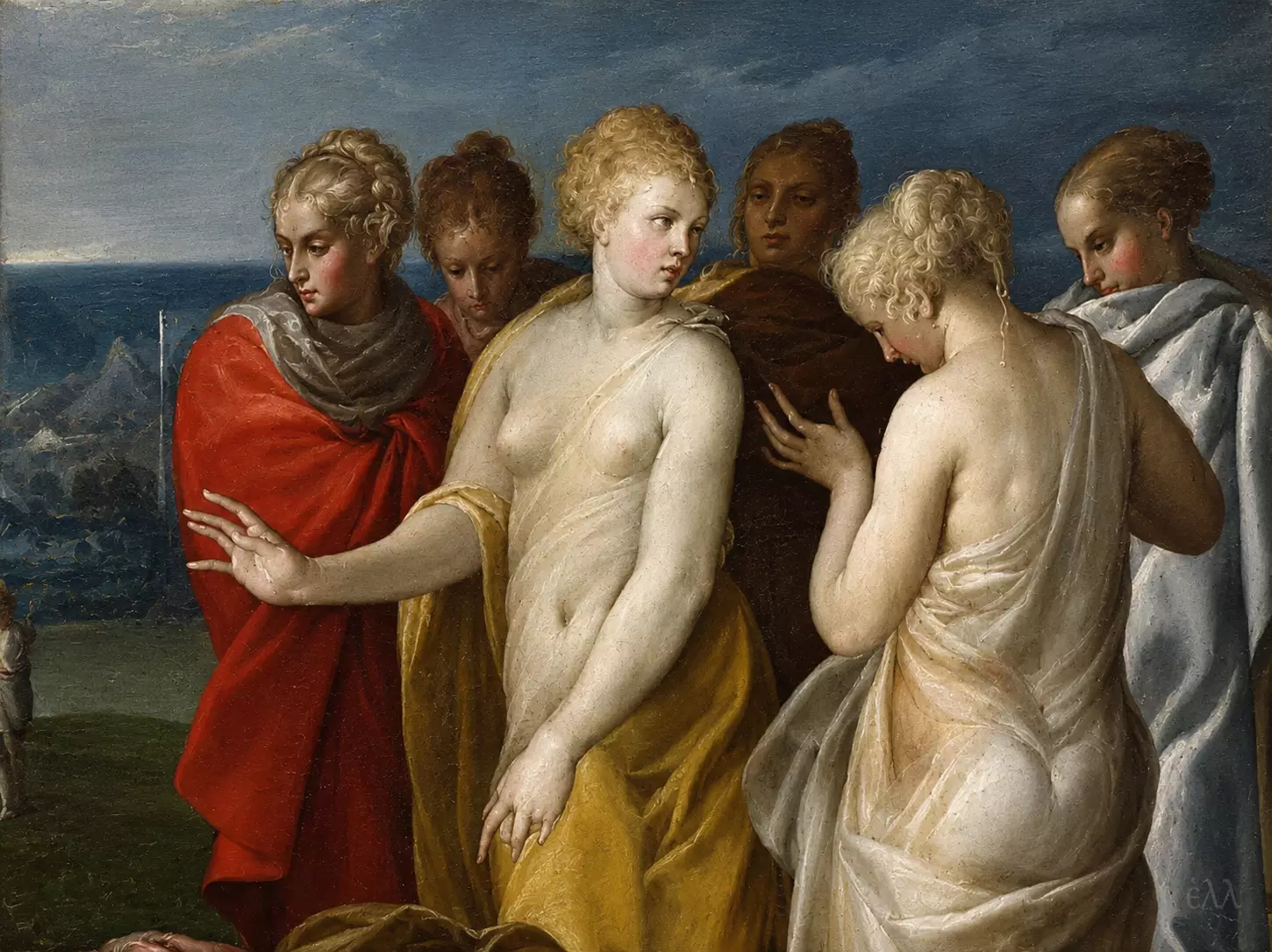
Seen closely, the standing group reveals how carefully dell’Abbate differentiates figures that at first appear to form a single ornamental cluster. The woman wrapped in brilliant red turns her head away from the principal action, her profile framed by intricately arranged hair. Behind her another face emerges from shadow. Near the centre, a pale woman turns while extending one arm across the composition, her light body and yellow drapery creating the most luminous vertical accent. Further back appears a darker-complexioned attendant, partially enclosed by neighbouring bodies and shadow, while another woman presents her exposed back to the viewer, bending her head towards the activity below.
Faces and gestures move in several directions at once. Some attention descends towards Moses, another gaze passes sideways, one figure seems momentarily withdrawn from the event. This fragmentation is important. Dell’Abbate does not arrange the attendants like a static ceremonial procession. Their overlapping bodies generate small interruptions and changes of axis, producing the sensation of a group responding individually within a shared event. An arm, a profile, a hand, a twisting shoulder: each briefly takes control of the eye before yielding it to another form. The variation remains consistent with the controlled figurative vocabulary of the period.
The exposed flesh is rendered with restrained tonal transitions. Pale complexions stand strongly against the dark landscape and the heavier colours of the garments, while the contours remain clear enough to preserve the decorative coherence of the group. Drapery folds behave differently according to material and position: the red cloak forms a broad chromatic surface; the yellow cloth drops more vertically; the pale fabric around the turning figure follows the curvature of the body. No single texture dominates for long.
Such visual refinement shifts the emotional register of the biblical episode. The danger surrounding the infant is present through knowledge of the story, yet dell’Abbate does not intensify it through overt drama. Moses lies quietly within the basket while the adult world gathers above him, elegant, curious, absorbed. The resulting tension is subtle: a child whose future will alter sacred history is almost lost among the splendour of bodies and fabrics.
The Louvre records the painting as a gift from Jean Schmit in 1935 and currently displays it in the Denon Wing. Its place within dell’Abbate’s mature production helps explain the particular character of the work. Italian Renaissance figure design, Mannerist elongation, the decorative sophistication cultivated at Fontainebleau and a pronounced sensitivity to landscape meet within one compact canvas, with the biblical event remaining entirely legible through the refined court culture chosen for its retelling.
(The translation was edited by Jason Papandreou)