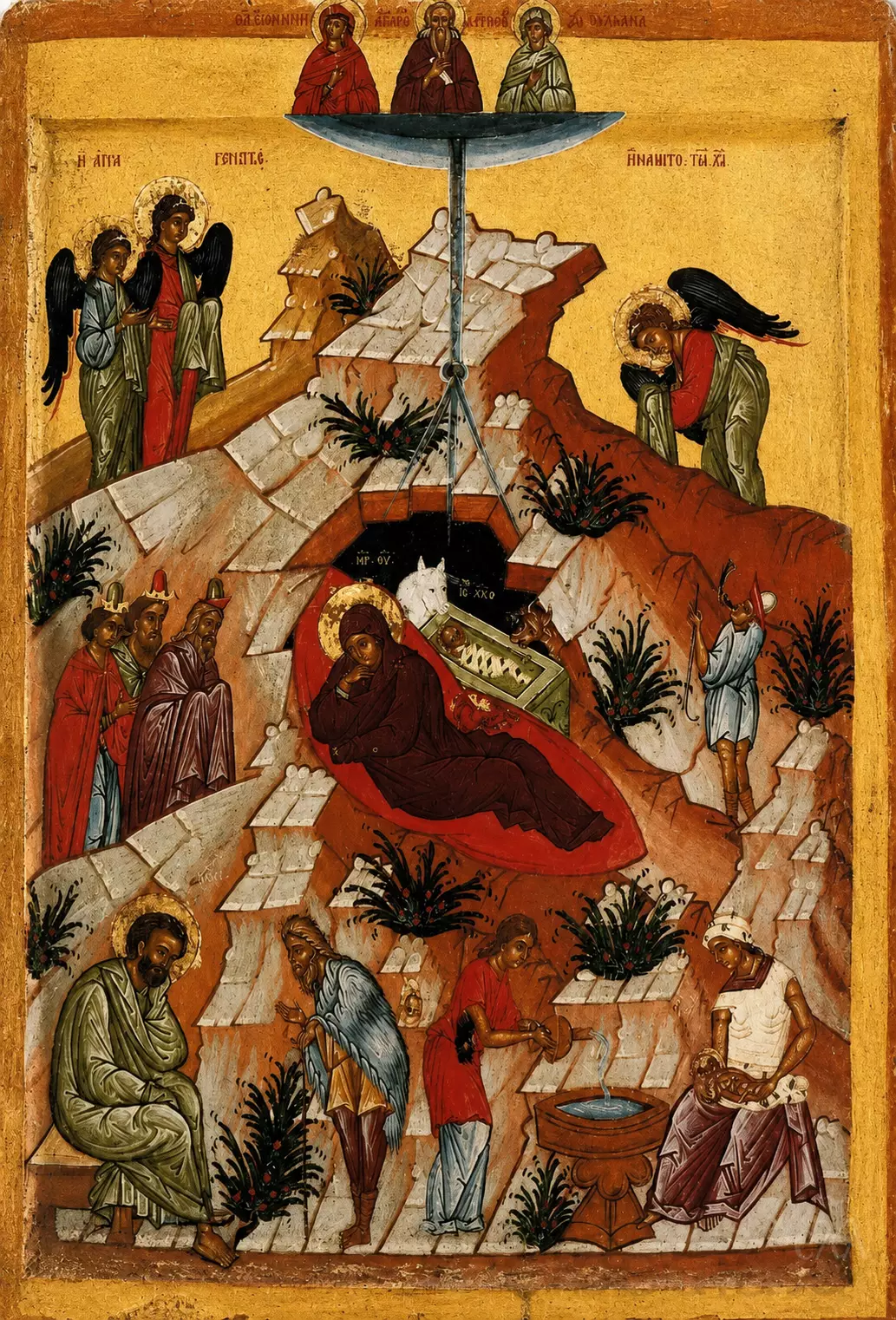
The Nativity of Christ preserved in the State Tretyakov Gallery in Moscow belongs to the Novgorod tradition of Russian icon painting and is generally dated to the first half of the fifteenth century. Painted by an anonymous master, the panel measures about 57 × 42 cm and came to the museum from the collection of Ilya Ostroukhov. Its concentrated narrative brings together the principal events surrounding Christ’s birth within a single mountainous setting, while three selected saints—Eudoxia, John Climacus and Juliana—appear in the upper border. Their inclusion points toward a private commission shaped by the devotional interests, and probably the names, of the original patrons.
Beneath these half-length figures the sacred narrative unfolds in several simultaneous episodes. The swaddled Christ Child lies in the manger inside the dark cave (Luke 2:7); the Theotokos reclines before it on a vivid red couch. Shepherds receive the angelic message (Luke 2:8–20), the Magi approach through the rocky landscape (Matthew 2:1–12), Joseph sits apart in contemplation, and at the lower edge the newborn Christ is bathed by attendants. That final episode comes from the apocryphal tradition associated with the Protoevangelium of James, which supplied medieval Christian art with details absent from the canonical Gospel accounts. The painter does not separate these moments into individual compartments. Paths, slopes, gestures and colour connect them across the surface.
The Novgorod Nativity Icon and its Pictorial Structure
The composition follows an iconographic scheme that had developed in Byzantine and Palaiologan art before being adapted by Russian workshops. At its centre stands the mountain, built from successive angular planes rather than conceived as a naturalistic landscape. Its faceted ridges divide the panel into zones, directing the eye toward one episode and then another while keeping every scene visibly related to the Nativity. The black opening of the cave forms a strong internal focus. Against that darkness, the pale body of the Child and the brilliant red surrounding the Theotokos acquire exceptional visual force.
Above, a ray descends toward the cave from a blue celestial segment. Its geometry creates a narrow visual axis linking the heavenly sphere to the birth below. The three saints in the upper border belong to another scale and another pictorial register, yet remain connected to the event through this vertical organization. John Climacus occupies the centre, wearing monastic dress and holding a scroll, with Eudoxia and Juliana placed to either side. Their individualized inclusion is highly suggestive of donor patronage, although the original commissioners have not been identified.
Colour, Line and the Novgorod School
Strong colour is one of the most recognizable features of Novgorod icon painting. In this panel, reds, greens, blues, olive tones and violet shades are placed beside one another with little interest in atmospheric transition. Vermilion is especially prominent. Across garments and the couch of the Theotokos, red becomes a structural colour, carrying the eye through a composition otherwise divided into numerous incidents. Such brilliant reds are characteristic of Novgorod painting, although attribution depends upon the wider combination of colour, drawing, figure type and compositional habit rather than on any single pigment.
The contours are crisp, the forms compact. Faces are modelled with restrained highlights, while garments are organized by sharply legible folds and blocks of colour. In the mountains, pale linear accents articulate the edges of the rock formations, turning landscape into a system of repeated planes. Small trees and patches of vegetation interrupt the mineral surface, yet the setting remains conventional. Spatial depth is compressed; scale changes according to narrative importance and available pictorial space.
Several times and places therefore coexist without disturbing the internal logic of the icon. The Magi may be journeying while the Child already lies in the manger; the shepherds hear the announcement while the bath takes place below. Through this simultaneous structure, the viewer encounters the Nativity as a complete sacred history rather than as one isolated instant.
The Theotokos, Joseph and the Secondary Episodes
The reclining Theotokos dominates the lower centre through scale, posture and colour. Her body lies diagonally before the cave, creating a broad counterweight to the vertical descent of the celestial ray. The Child, much smaller, occupies the darker recess behind her. This separation between Mother and Child belongs to the established Eastern Christian Nativity type and leaves room for the surrounding episodes to remain legible.
Joseph is positioned apart from the Theotokos, absorbed in thought. In the broader iconographic tradition of the Nativity, his isolation can express the mystery surrounding Christ’s birth and the doubts attached to it in apocryphal narratives. Nearby, the bathing scene introduces a strikingly domestic action. Water, vessel, attendant figures, the tiny body of the Child: modest elements of human care within a highly structured sacred image.
The shepherds and Magi extend the narrative outward. One group belongs to the immediate landscape of the birth, the other to the long journey toward it. Their movement contrasts with the stillness of the central figures, and the mountain becomes the mechanism that arranges these different tempos. Across the compressed surface, figures appear, pause, descend, turn.
Selected Saints and Private Patronage
At the top, Eudoxia, John Climacus and Juliana introduce a more personal dimension. Selected saints placed in the margins or upper fields of an icon frequently reflect the names, family devotions or protective associations of those who commissioned it. In this case their presence sets the universal subject of the Nativity beside a specific act of patronage. The exact identity of the patrons remains unknown, leaving the three saints as the clearest surviving evidence of that original human context.
Within a comparatively small panel, the anonymous Novgorod master assembled a complex image from differentiated episodes, strong contours and a saturated palette. The red couch, black cave, stepped mountains and upper saints remain its decisive visual anchors, each carrying a different part of the icon’s historical and pictorial meaning.
(The translation was edited by K. Pappas)