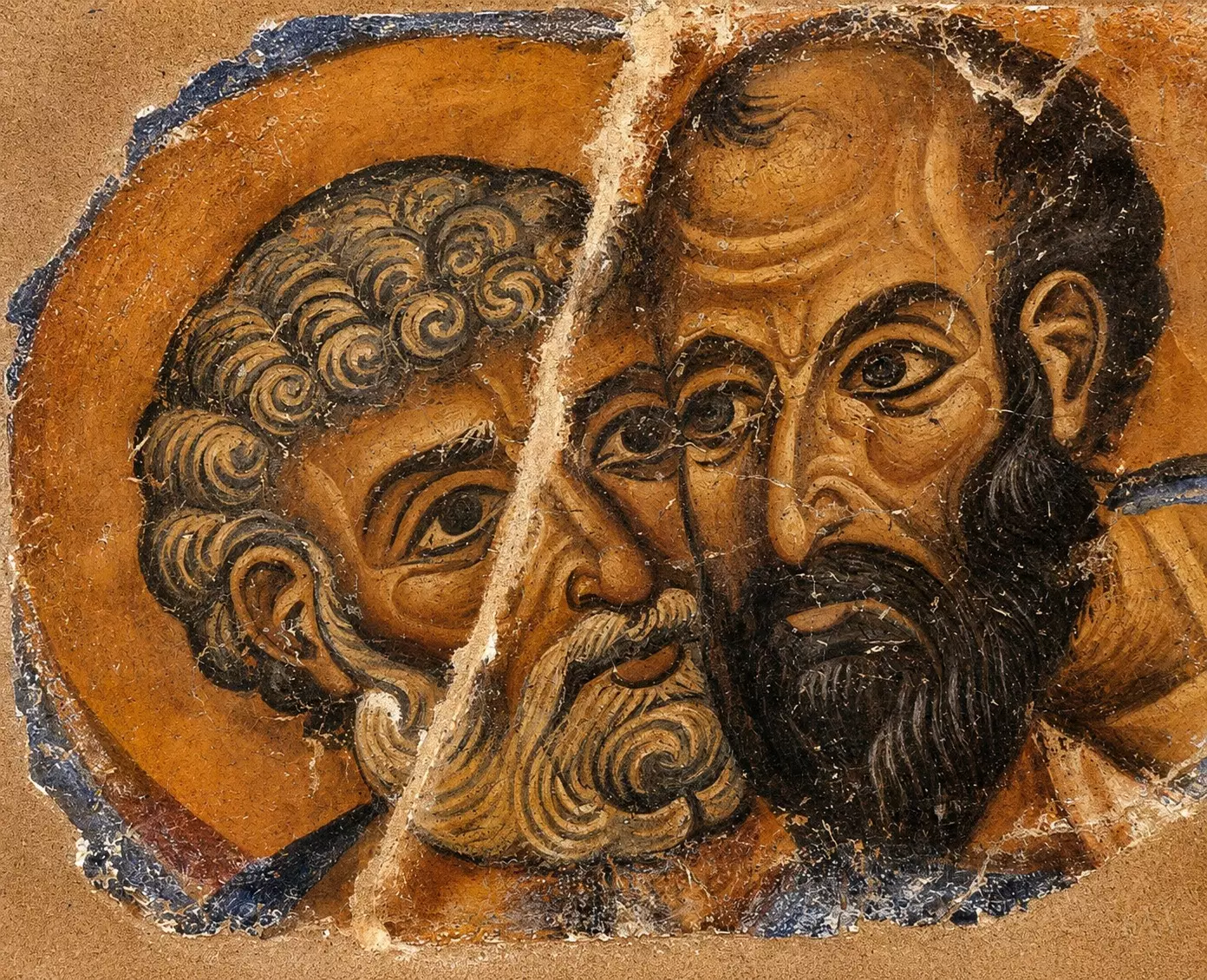
The Peter and Paul Vatopedi fresco, preserved at the Holy Great Monastery of Vatopedi on Mount Athos, belongs to a small group of surviving Late Komnenian wall-painting fragments associated with the monastery. The anonymous work is dated on stylistic grounds to about 1170–1180 and measures approximately 50 × 65 cm. Its original location within Vatopedi remains unknown. The surviving fragment preserves the closely joined heads of the Apostles Peter and Paul from a representation traditionally described as their embrace or kiss.
Much of the composition has disappeared. A broad, irregular loss of plaster descends almost vertically through the centre, cutting between the two faces and continuing across the lower part of the fragment. Abrasions, fine cracking and smaller lacunae run through the painted surface; around the edges, the surviving fresco terminates abruptly against exposed plaster. Yet the essential relationship between the apostles remains immediately legible. Their heads press closely together, the haloes overlap visually, and the compressed space gives the encounter an unusual physical intensity.
Peter and Paul Vatopedi Fresco: Faces and Late Komnenian Style
Peter is identified through the established Byzantine physiognomic type of short, densely curling hair and a similarly curled grey beard. Individual locks have been organized into compact spiral forms, picked out with pale linear highlights over a darker base. Around the forehead and temple, these carefully repeated curls create a textured frame for the large eye, narrow nose and strongly modelled cheek.
Paul presents a markedly different facial type. His high, largely bare forehead rises above dark hair at the sides, while a full black beard encloses the lower face. Deep lines cross the brow, and the modelling around the eyes, nose and cheek is constructed through successive zones of ochre, brown and darker shadow. The forehead, given considerable visual weight by the painter, reinforces the mature, intellectual physiognomy long associated with Paul in Byzantine visual tradition.
Across both heads, modelling has a distinctly sculptural character. The faces are divided into smaller planes of light and shadow, with strong contour lines defining eyebrows, eyelids, noses and mouths. This treatment has been singled out in scholarship as characteristic of the fragment. Comparisons with the wall paintings of Hosios David in Thessaloniki and with the first decorative phase of the Patmos monastery refectory have helped establish the proposed date of about 1170–1180.
The Embrace of the Apostles
The unusual proximity of the two faces belongs to an established iconographic subject: the meeting and embrace of Peter and Paul. Byzantine artists had inherited the theme from Early Christian imagery, and by the Middle Byzantine period it could function as an autonomous representation. Scholarly interpretation associates the motif with ecclesial concord, peace and unity.
In the Vatopedi fragment, very little narrative apparatus survives. No architectural setting can be reconstructed from the remaining surface, while the bodies and most of the gesture have been lost. Almost entirely through physiognomy and proximity, therefore, the painter reaches the modern viewer. Peter’s curling grey forms meet Paul’s darker beard near the centre; the two monumental heads occupy nearly the whole surviving field.
The haloes reinforce this concentration. Both are formed as broad ochre-red discs bordered by a dark blue band, their simple geometry enclosing the elaborately worked faces. Against the warmer background, the blue contours supply a firm visual boundary, repeatedly interrupted by losses and by the exposed plaster cutting through the centre.
Condition and Survival
Damage has substantially altered the visual rhythm of the fragment. The major central lacuna divides an image whose original meaning depended upon union, while numerous scratches and small losses cross Peter’s curls, Paul’s forehead and beard, and both haloes. Even in this fragmentary state, considerable portions of the original facial modelling survive: small highlights along the hair, delicate tonal transitions around the eyes, fine dark contours defining the features amid the worn surface.
Its detached condition has also separated the work from the architectural programme to which it once belonged. Vatopedi records the original position of the fragment as unknown, together with that of another Late Komnenian fragment depicting the Apostle Mark. Both belong to the earlier group of surviving wall paintings preserved by the monastery.
Severely reduced in physical extent, the scene retains the element on which its composition depended most strongly: two distinct apostolic physiognomies brought into immediate contact. Between Peter’s tightly patterned silver-grey curls and Paul’s dark beard, the surviving paint narrows to the damaged central seam, surrounded by worn ochre, blue edging and exposed plaster.
(The translation was edited by E. Alexandraki.)