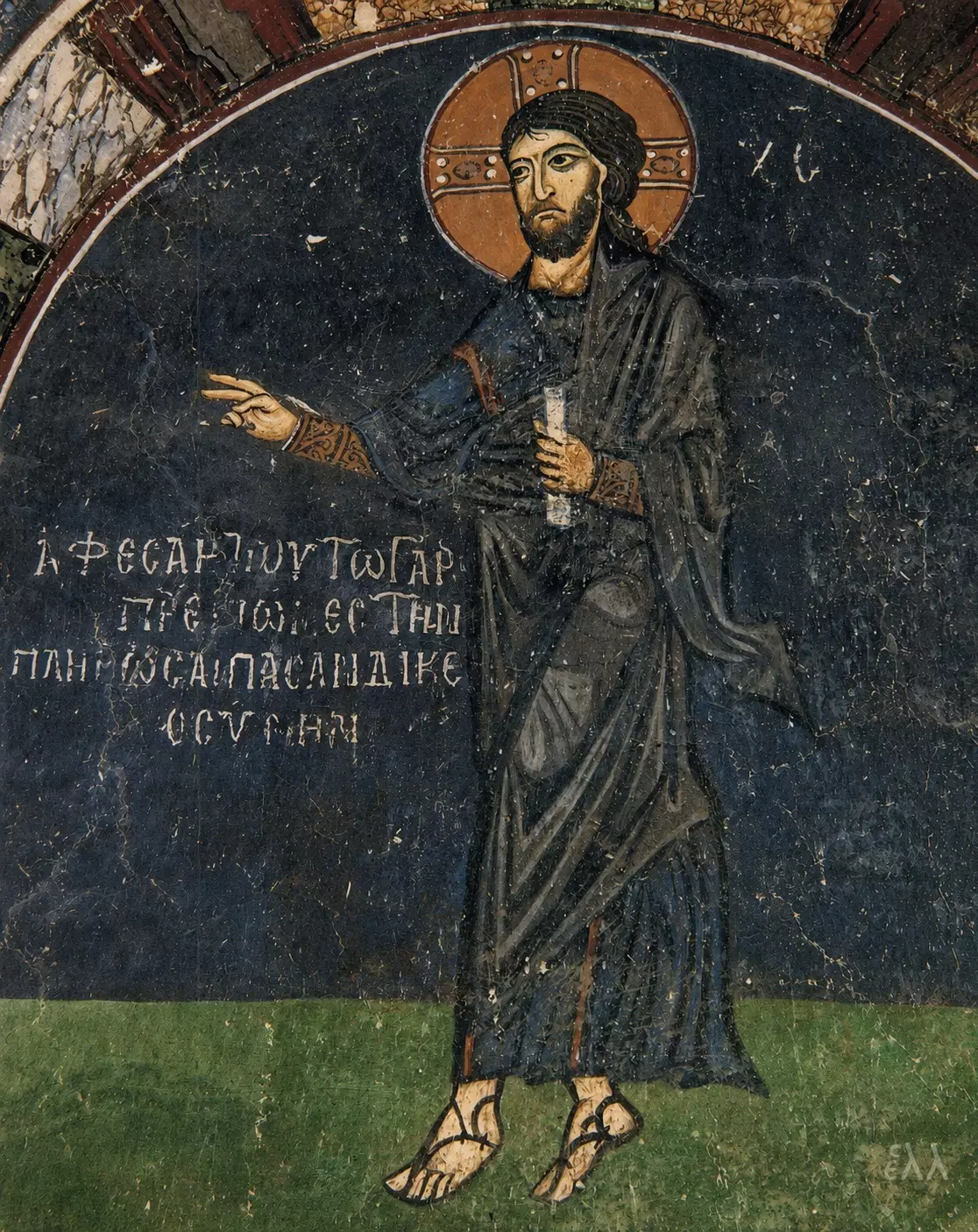
The standing figure of Christ preserved at the Monastery of Hosios Loukas in Boeotia belongs to the distinguished body of eleventh-century monumental painting that accompanies the celebrated mosaic decoration of the katholikon. Set within a side chapel and connected with the imagery of the Baptism, the figure represents Christ immediately before the sacramental event, in the encounter with John the Baptist at the Jordan. The accompanying Greek inscription, taken from the Gospel dialogue, strengthens this identification: it records Christ’s response that the action should proceed so that all righteousness may be fulfilled, the words of Matthew 3:15.
Isolated from the larger narrative, Christ acquires an almost iconic autonomy. He stands at full length against a deep blue background, his feet resting on a narrow strip of green ground. His right hand extends in a gesture of benediction; the left holds a closed white scroll vertically against the body. A large cruciform halo, rendered in warm ochre and articulated by painted bands and ornament, encloses the head and sharply distinguishes it from the surrounding dark field. The result is visually direct. Movement exists, though it stays disciplined, held within the figure’s solemn concentration.
The wall paintings in the side areas of the katholikon belong to an artistic context closely associated with the monument’s mosaic programme, sharing its emphasis on strong contours, frontal clarity and the hieratic presentation of sacred figures.
Christ Fresco at Hosios Loukas: The Full-Length Figure
Against the almost uninterrupted blue ground, the painter gives the body a remarkable degree of visual independence. No architecture encloses Christ, no landscape develops behind him. The green earth at his feet is sufficient to establish physical position; above it, space becomes abstract. This compression directs attention toward gesture, physiognomy and drapery, the elements through which the image is made legible.
The stance is neither completely frontal nor fully turned. Christ advances gently toward John the Baptist, who belongs to the wider composition beyond the limits of the surviving view, while the upper body preserves an imposing stillness. His right arm reaches outward and the fingers form the blessing gesture with considerable linear delicacy. The opposite hand gathers the scroll close to the torso. Between these two actions the painter constructs the figure: one hand addresses the narrative outside the body, the other draws the eye back towards its centre.
The garments deepen this measured tension. A dark chiton, touched by blue, appears beneath a heavy mantle whose broad mass falls from the shoulder and passes across the body in long, angular folds. Some folds are defined by narrow lighter strokes; others remain almost absorbed into the dark surface. The painter has not attempted to render textile through continuous tonal modelling. Volume is established intermittently, by the meeting of contour, highlight, shadow, change of direction. At the lower part of the body the drapery becomes more active, breaking into overlapping planes before opening enough to reveal the sandalled feet.
Colour is restrained but far from monotonous. Blue dominates the background and reappears within the garment, while black-grey passages create the mantle’s weight. Ochre enters at strategic points: the halo, the cuffs, the flesh, smaller ornamental passages. The pale scroll forms the sharpest vertical accent. Such a palette allows relatively small areas of warm colour to gain unusual force. The halo in particular seems almost to press forward from the blue field.
Across the painted surface, losses, abrasions and scattered marks of age remain visible. They interrupt the continuous colour of the background and pass across the garments and face, yet the fundamental design survives with unusual strength. Contours remain readable, the gesture has lost none of its precision, the long vertical silhouette still governs the composition. Damage, in this case, has not dissolved the pictorial structure.
Beside the figure stretches the painted Greek inscription connected with the Baptism narrative. Its placement is important. Text does not form a detached caption beneath the image; it occupies the same dark pictorial field as Christ and develops beside his body in several lines. The words therefore participate in the composition visually as well as identifying the Gospel exchange, so that the figure, its gesture and the written speech beside it come together within one continuous field.
This economy has a distinctly eleventh-century character. In the art of the period, monumental figures could be separated from elaborate settings and given an almost self-contained presence. The Hosios Loukas paintings, like the mosaics with which they coexist, rely heavily upon line, stable silhouettes and the controlled reduction of space. Their effect comes partly from what has been omitted, since narrative survives only to the degree the scene requires.
The Face of Christ and the Cruciform Halo
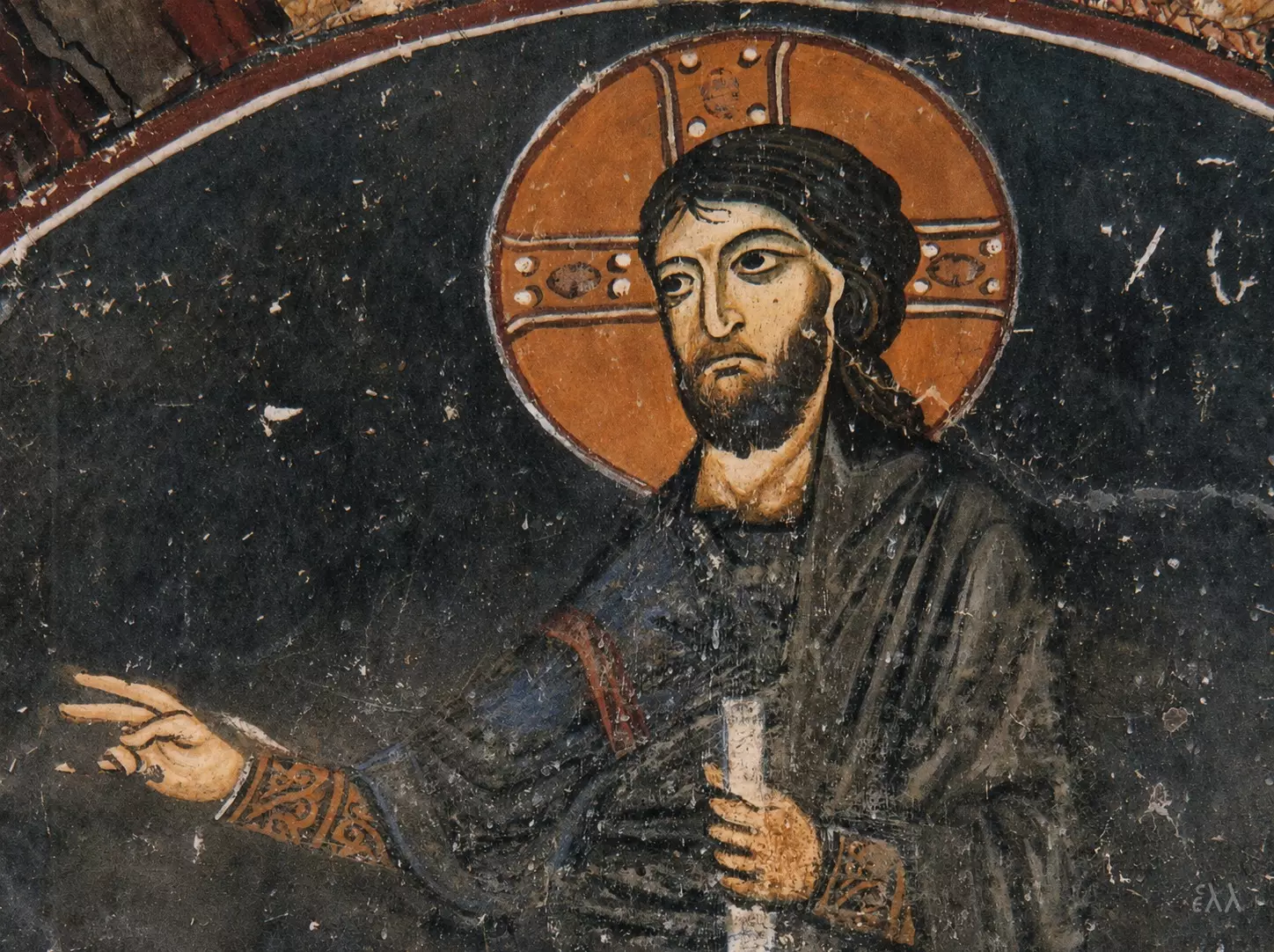
Seen more closely, the head reveals how carefully this apparent severity has been constructed. The face is elongated, framed by dark hair and a compact beard. A narrow nose descends from strongly defined brows; the almond-shaped eyes, enlarged and outlined, turn sideways rather than confronting the spectator directly. The mouth is small, closed, slightly weighted at the corners. Nothing is dramatically expressed, yet the physiognomy is not empty. Attention is concentrated in the eyes.
Flesh modelling proceeds through clearly differentiated zones of ochre, brown and lighter highlights. Dark passages along the cheeks, around the eyes and beneath the beard articulate the facial structure without producing the continuous softness expected of naturalistic modelling. Lines do much of the work. The eyebrow, nose, eyelids, moustache and locks of hair remain crisply delineated, and this linear treatment gives the face its disciplined intensity.
Behind it, the cruciform halo forms the dominant geometric structure of the detail. Its broad ochre circle is divided by the arms of the cross and enriched with small painted motifs. The warm field brings the head forward against the blue-black background, while the strong circular contour checks the directional movement of the gaze, so that even as the head turns, the surrounding contour holds it steady.
Particularly striking is the absence of theatrical emotion. Christ’s expression is solemn, introspective, almost withdrawn, although the scene itself precedes an action of central importance in the Gospel narrative. The painter relies on averted gaze, the slight inclination of the head and the steady rhythm of the features. Within the broader visual language of Hosios Loukas, spiritual authority emerges through restraint, expressed in the upright body, the measured gesture, the compressed colour and the grave cast of the face.
The figure thus belongs fully to the monumental conception of Middle Byzantine art. Its scale, reduced spatial setting and emphatic silhouette detach Christ from ordinary pictorial time, while the inscription binds him again to a precise Gospel moment. Between those two conditions, the timeless image and the unfolding narrative, the fresco continues to hold its particular force.
(The translation was edited by N. Jones.)