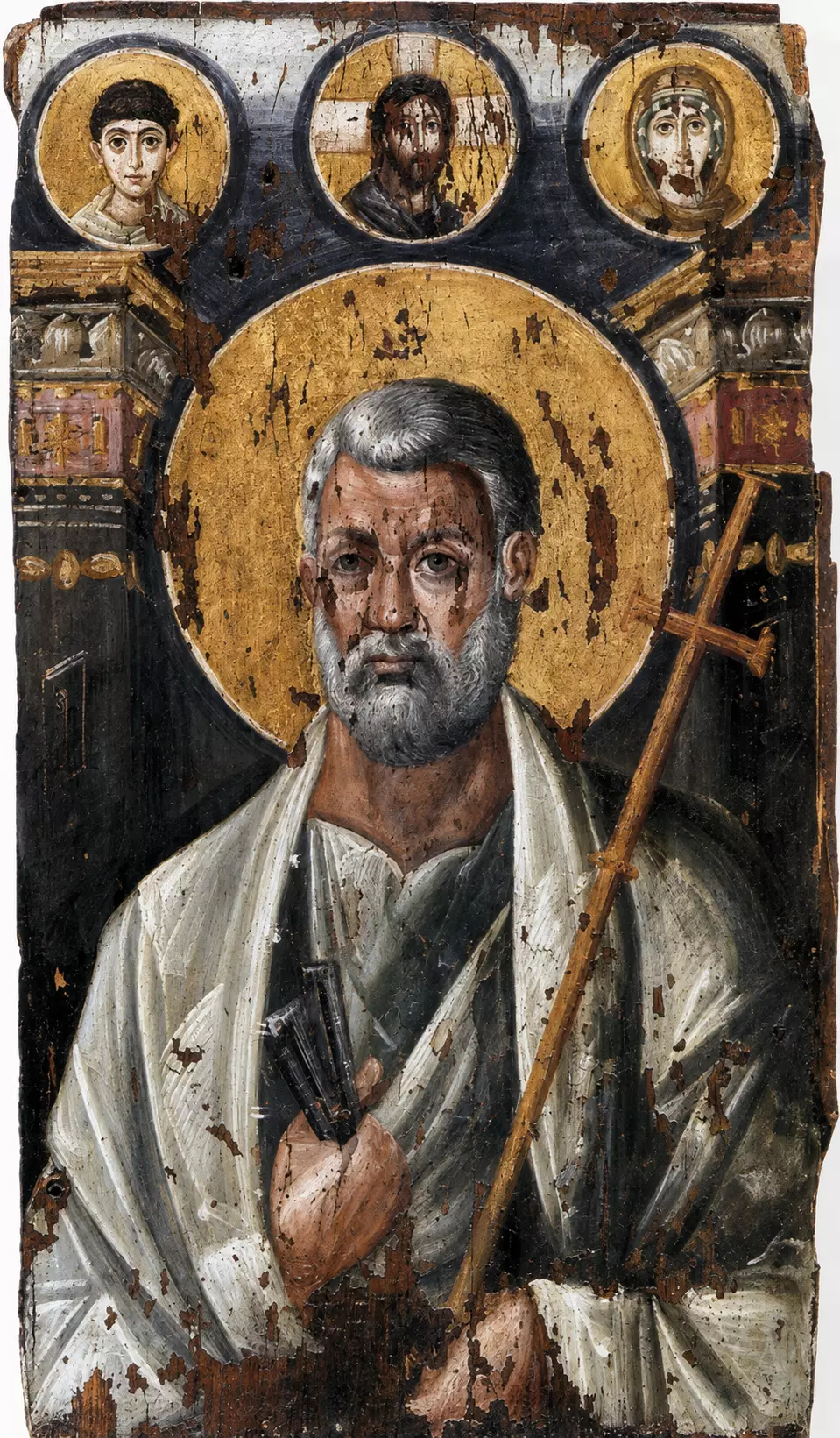
The Saint Peter Icon at Mount Sinai belongs to the exceptionally small body of panel paintings that preserves the visual language of Christianity before Byzantine Iconoclasm. Kept at Saint Catherine’s Monastery in Sinai, the work is generally placed around the late sixth or early seventh century; the Sinai archive catalogues it more broadly to the sixth century. The anonymous painter worked in encaustic and gold on a wooden panel measuring approximately 93 by 54 centimetres. The archive records dimensions of 93.4 by 53.7 centimetres, while slightly different measurements appear elsewhere in the literature.
Its setting is equally significant. Saint Catherine’s was founded in the sixth century, its surviving monastic complex closely associated with the building activity of Emperor Justinian I. Continuous occupation, isolation and the climatic conditions of Sinai contributed to the preservation of an outstanding collection of early Christian manuscripts and icons. The monastery itself singles out the Saint Peter panel among its important sixth- and seventh-century encaustic icons.
Within this historical setting, Peter’s image preserves a remarkable combination of Late Antique portrait practice and the emerging pictorial conventions of the Byzantine icon. The encounter is clearest in the face: individualized, strongly modelled, physically substantial, yet already framed by the gold nimbus and the concentrated stillness of a sacred image.
Peter appears half-length against a dark background, the large gilded halo occupying the central zone of the panel. A pale mantle descends over his shoulders in broad folds and opens across a darker tunic. Close to his body he holds the keys traditionally associated with his apostolic identity and a tall staff surmounted by a cross. Saint Catherine’s Monastery describes the figure as shown in three-quarter view with the head slightly turned, carrying precisely these two attributes.
That slight turn gives the figure an unusual physical presence. The shoulders possess weight, the neck emerges convincingly from the garment, and the head seems to occupy measurable space. Yet movement remains restrained. Large expanses of pale drapery descend vertically through the lower half of the panel, interrupted by the brown shaft of the staff and by Peter’s hands gathered close to the centre.
Most compelling is the face. Short grey hair follows the rounded structure of the skull, while the compact beard is articulated through numerous fine strokes of white, grey and darker pigment. Around the eyes, cheeks and nose, the painter moves through reddish brown, olive-grey and pale flesh tones, building volume through tonal gradation. The eyes are strikingly asymmetrical. One seems more open and direct, the other more deeply embedded in shadow, producing an intensity that depends upon subtle irregularity rather than geometric balance.
Behind the head, the broad gold nimbus establishes another kind of pictorial space. Its luminous disk cuts decisively across the dark field and isolates Peter’s physiognomy. Much of the gilded surface is now broken by losses and abrasions, with darker underlying areas appearing through it. The Sinai archive records scattered paint loss, later varnish, several repainted areas and particularly extensive deterioration toward the lower part of the panel.
Keys, Cross-Staff and the Three Medallions
The keys provide Peter’s most immediate iconographic attribute, referring to the Gospel tradition of the keys of the kingdom of heaven (Matthew 16:19). Beside them, the long cross-topped staff introduces a strong diagonal-vertical movement extending from the lower body toward the upper register. Both objects are held close to the apostle, giving the composition a controlled ceremonial gravity.
Above him, three circular medallions occupy the blue-grey upper field. At the centre appears Christ, distinguished by the cruciform halo. Another contains the Virgin Mary; the remaining medallion shows a youthful figure whom the monastery cautiously identifies as perhaps Saint John the Theologian. Their small scale establishes a clear visual hierarchy: three bust-length heavenly figures above, the monumental apostle below.
At either side, abbreviated architectural forms create a shallow framework around Peter. Columns, capitals and projecting horizontal elements are compressed against the edges of the panel, leaving little illusionistic depth. Circles and verticals consequently govern the composition—the enormous nimbus, three smaller medallions, upright body, rising staff—with the apostle’s face positioned at their visual intersection.
Encaustic Painting and the Late Antique Inheritance
Encaustic painting employs pigments in a wax-based medium, applied and fused to the support. The technique had a long history in Greco-Roman painting and survives with particular importance in the early panel icons of Sinai. Saint Catherine’s preserves notable sixth- and seventh-century examples executed with wax as the pigment medium. In technical terminology, the Saint Peter panel is therefore an encaustic icon with gilded elements, keeping medium, wooden support and metallic surface treatment precisely distinguished.
The relationship with the mummy portraits of Roman Egypt is especially instructive. Encaustic, wooden support, close attention to facial structure, direct gaze and modelling through changing tonal values all belong to a pictorial inheritance already highly developed in Roman Egypt. The continuity of techniques between Fayum mummy painting and the early Sinai icons has long formed part of the wider discussion of Byzantine classicism and Late Antique artistic survival. Roman Egyptian portraits likewise demonstrate how encaustic could produce considerable depth through flowing brushwork, transitions between shadow and light, and concentrated highlights around the eyes and forehead.
In Peter’s icon, these painterly resources serve the representation of a sacred figure. Individualized physiognomy coexists with the enlarged halo, frontal emphasis, attributes and celestial medallions. The short grey hair, compact beard and mature facial type would remain recognizable characteristics of the apostle throughout later Byzantine iconography, although subsequent painters frequently articulated such forms through increasingly controlled linear structures.
Survival Before Byzantine Iconoclasm
The material history of the Saint Peter Icon at Mount Sinai is inseparable from the exceptional preservation of early icons at Saint Catherine’s. The monastery notes that its pre-Iconoclastic panels survived partly because, during the Iconoclastic period, Sinai lay outside the effective authority of the Byzantine emperors responsible for suppressing sacred images. The possibility that some icons were subsequently brought to Sinai for protection has also been proposed, although the monastery presents this as scholarly speculation.
Time has nevertheless altered the Saint Peter panel considerably. Paint has disappeared in scattered areas, parts of the gilding are abraded, and later interventions belong to its recorded conservation history. Particularly evident is the damage affecting the central medallion of Christ. Across Peter’s clothing, larger losses expose the underlying surface; around his head and shoulders, smaller interruptions fragment passages that were originally continuous.
Enough remains, however, to reveal the painter’s handling with unusual immediacy. Broad strokes describe the pale mantle; finer marks follow beard and hair; heavier shadows gather beside the nose and beneath the eyes. Roman traditions of portrait modelling, Early Christian symbolism and an increasingly defined Byzantine conception of the holy image meet within those surviving layers of wax and pigment. Most persistent is Peter’s gaze—uneven, grave, almost disconcertingly present beneath the worn gold of the halo.