
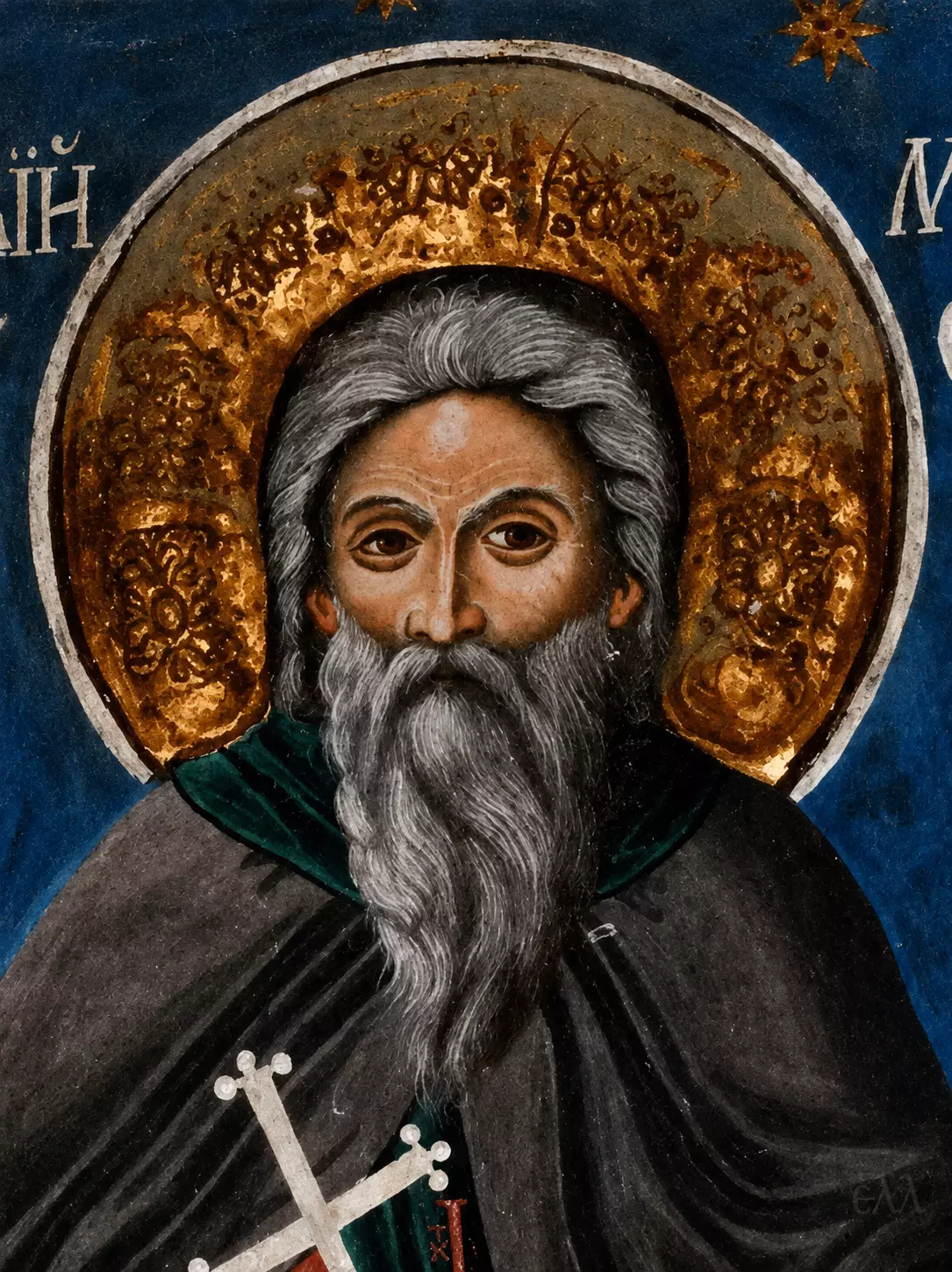
Painted in 1820 in the liti of the kyriakon of Kavsokalyvia Skete on Mount Athos, the image of Saint Maximos Kavsokalyvites presents the ascetic who gave the settlement its name as a monumental, frontal figure. His advanced age is stated immediately through the long grey-white beard, the abundant hair swept back from the forehead and the grave, unwavering gaze. Against these subdued flesh tones and dark monastic garments, the deep azure background is unusually forceful. Gold stars are scattered across it, while an extensively ornamented gold halo encloses the head in a second, denser field of light.
The composition follows the hieratic frontality long established in Byzantine and Post-Byzantine representations of monastic saints, yet its colour gives the figure a particularly emphatic presence. A dark mantle descends in broad, weighty folds from the shoulders; beneath it appears an orange-red garment, with a green analavos marked by red crosses occupying the central vertical axis of the body. The contrast is deliberate and visually effective: black and grey above, saturated red-orange below, dark green at the centre. The saint’s face, hands and attributes emerge clearly from this arrangement without disturbing its stillness.
In his right hand Maximos holds a long white cross. His left hand opens outward, while a prayer rope falls from the wrist and terminates near the lower edge of the composition. Cross, analavos, prayer rope, open palm: the painter gathers the visible signs of the ascetic vocation around a figure whose physical immobility gives them greater emphasis.
Saint Maximos Kavsokalyvites Fresco: Iconography and Monastic Identity
Particularly striking is the treatment of the head. The Saint Maximos Kavsokalyvites fresco does not idealize old age by suppressing its marks. Fine linear highlights articulate the forehead, the narrow face is framed by dense grey hair, and the long beard divides into irregular locks whose pale strokes stand sharply against the dark mantle. The eyes remain large and direct. This controlled combination of linear description and frontal solemnity belongs to the continuing Post-Byzantine artistic tradition, although the intense blue ground and decorative halo give the painting its own nineteenth-century Athonite character.
The identifying inscription flanks the halo and confirms the saint’s identity. Its angular forms sit firmly within the blue field without becoming merely ornamental; together with the gold stars, the lettering creates a secondary rhythm around the head. The multilingual environment of Athos during this period, inhabited and supported by Greek- and Slavic-speaking monastic communities, forms an important background to such epigraphic features, though the precise history of the inscription itself requires documentary evidence beyond visual examination.
Maximos belonged to the fourteenth-century Athonite ascetic world. A 1931 Greek encyclopedia describes him as an Athonite ascetic of that century and stresses the exceptional austerity of his life. Another Athonite anthology associates his practice with the forested, precipitous regions of Athos at considerable altitude. His name is also preserved within the spiritual literature of hesychasm: the Philokalia records material attributed to Maximos concerning noetic prayer and its fruits.
His epithet, Kavsokalyvites, is traditionally connected with the practice from which his memory became inseparable. He would inhabit temporary huts and, when abandoning them, burn them rather than allow even a rudimentary dwelling to become an object of attachment. The name subsequently passed from the ascetic to the locality itself. When the community was organized more formally in the eighteenth century, its identity was therefore already bound to a figure remembered less through institutional authority than through radical renunciation.
That connection explains the force of the 1820 wall painting within the kyriakon. Maximos appears neither as a narrative protagonist nor within an episode from his life. Standing alone, enlarged, facing the viewer, he functions almost as the visual name of the place. The blue field removes ordinary landscape; the stars replace it with an abstract celestial expanse. His garments carry the signs of the Great Schema, his hand the prayer rope, his body the cross. Around all this, the painter constructs an image austere in posture, richly coloured in surface, unmistakably Athonite in its monastic emphasis.
(The translation was edited by N. Jones.)