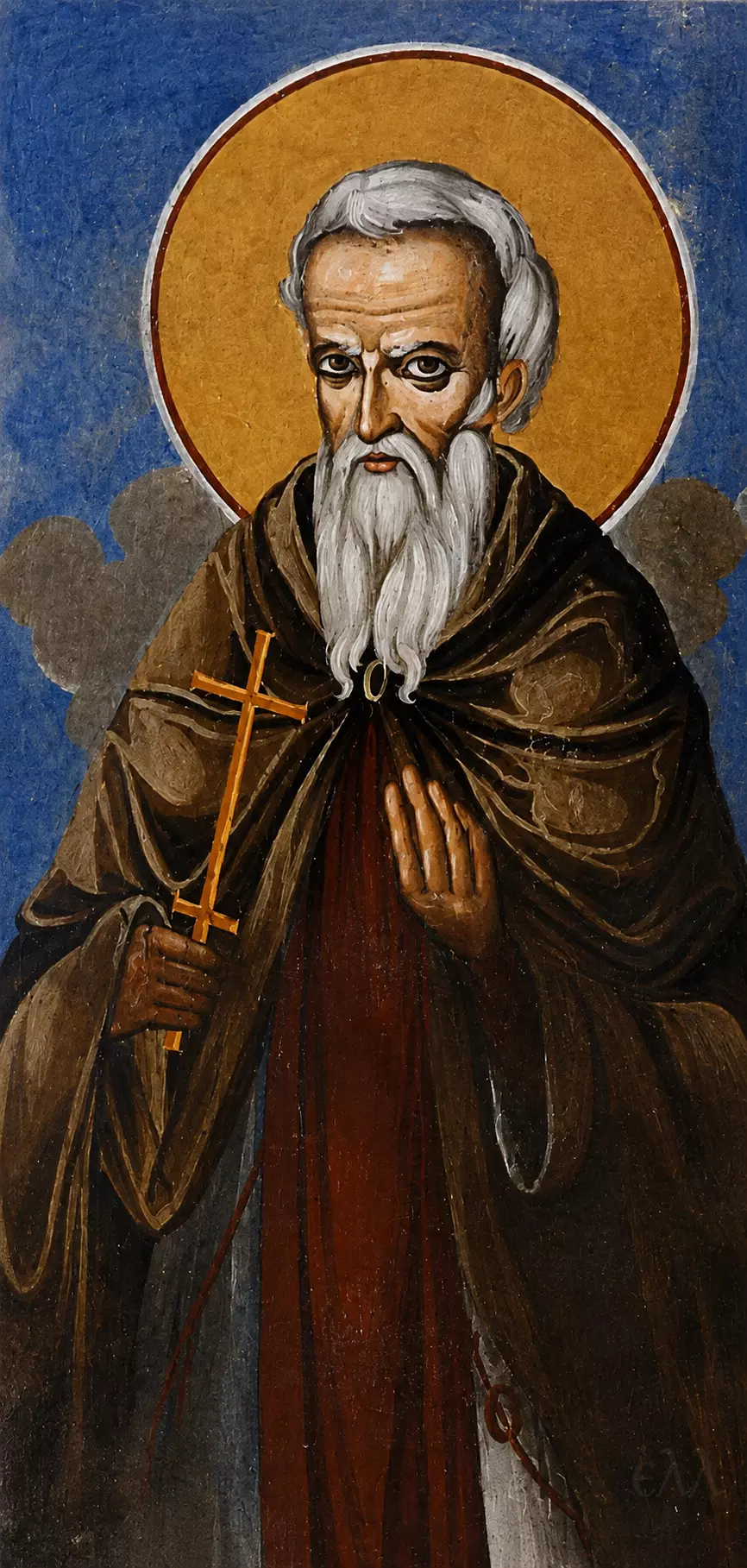
Saint Maximos Kausokalyvites, depicted in the wall painting of the narthex of the katholikon of Hilandar Monastery on Mount Athos, presents this fourteenth-century Athonite ascetic as an elderly, full-length monastic saint. Painted by an anonymous artist in the eighteenth century, the image belongs to the Post-Byzantine continuation of the monumental painting tradition on the Holy Mountain. Hilandar, historically associated with Serbian Orthodox monasticism, preserves artistic layers belonging to different periods of its long history.
Maximos stands frontally beneath a large ochre-gold halo outlined by narrow red and white bands. Grey-white hair recedes from the broad forehead, while an exceptionally long white beard descends over his chest. His dark monastic habit occupies most of the composition: brown and almost black folds surround a central area of deep reddish colour, giving the body weight without diminishing the severe verticality of the figure. In his right hand he holds a slender cross with two transverse bars; his left hand rises to chest level, palm exposed. Against the intense blue ground, the limited palette of earth colours, white and gold creates a restrained but forceful chromatic structure. The terminology appropriate to such a work is that of Post-Byzantine wall painting, without assuming a more specific fresco technique from appearance alone.
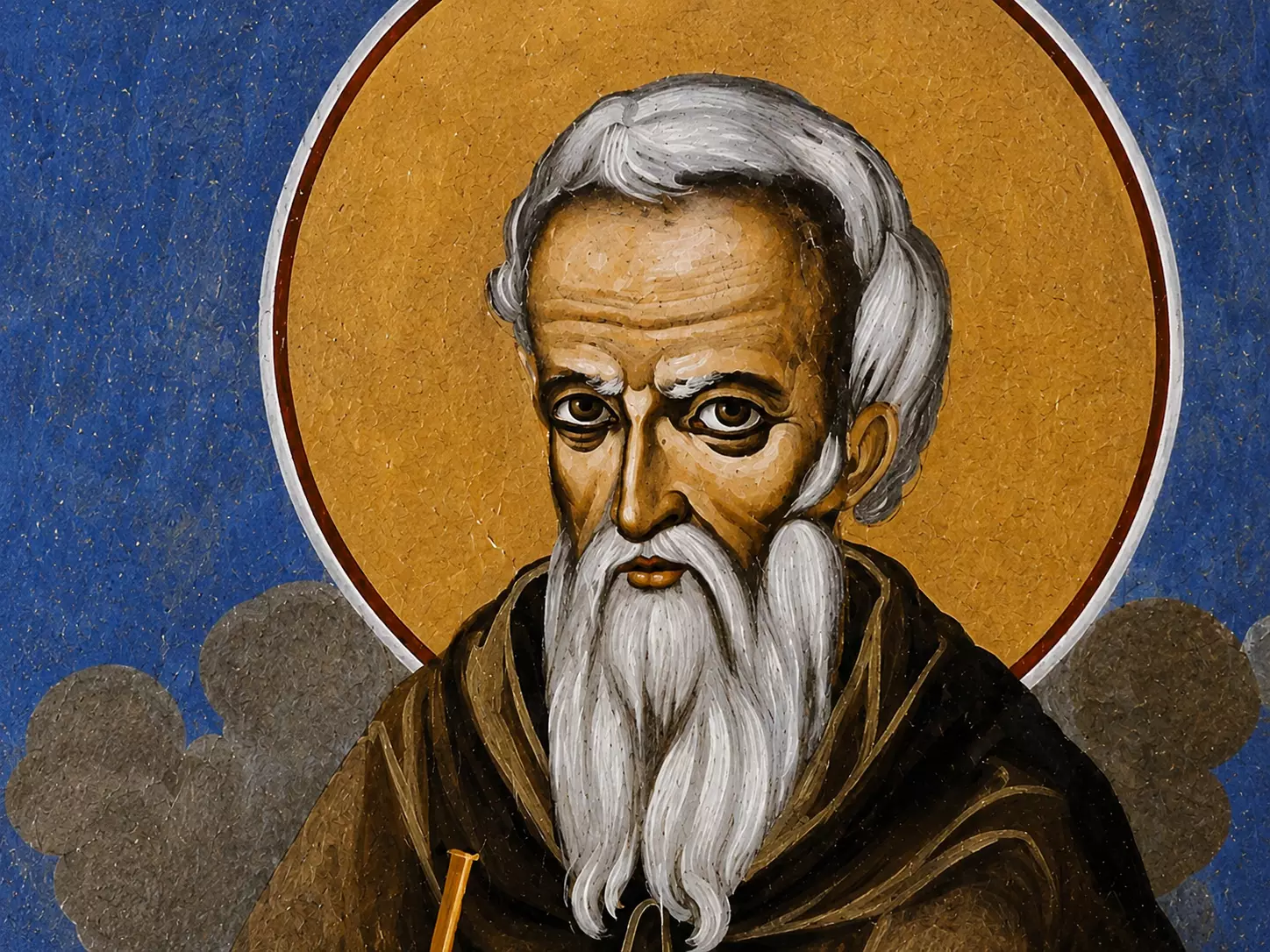
Across the face, the painter has concentrated much of the image’s expressive energy. Heavy dark contours surround the large eyes, meeting the sharply articulated nose and narrow mouth. Fine white strokes move through the hair, eyebrows and beard in irregular, almost calligraphic sequences. The forehead is built from broad ochre flesh tones crossed by short linear highlights and darker furrows. Particularly around the eyes, the modelling becomes dense; the direct gaze gives the saint a solemn, concentrated presence associated with the established visual language of ascetic saints in Eastern Christian art.
Saint Maximos Kausokalyvites Wall Painting: Iconography and Style
The beard provides another kind of movement. Divided into elongated locks, it descends in sweeping white and grey strands that contrast with the heavy dark mantle. Drapery folds, meanwhile, spread diagonally from the neck and shoulders before gathering around the torso. Their thin ochre highlights describe the surface of the cloth through line, producing a graphic treatment characteristic of a painter working within a durable iconographic tradition. The open palm introduces a quieter accent beside the cross and, within the ascetic vocabulary of the image, may be understood as an allusion to purity and the renunciatory life.
Behind this visual type stands a particularly distinctive Athonite biography. Maximos, whose secular name was Manuel, came from Lampsacus in Asia Minor and left his family home at about seventeen. After passing through monastic environments in the region of Mount Ganos, he eventually reached Mount Athos and, associating himself with the hesychast milieu of Gregory of Sinai, entered fully into its spiritual discipline. Sources place his life broadly in the late thirteenth and fourteenth centuries and preserve several traditions concerning his intense practice of inner prayer.
His epithet Kausokalyvites, literally connected with the burning of huts, arose from accounts that he repeatedly burned the temporary shelters in which he had lived before moving elsewhere. The practice expressed his rejection of settled possessions and became so closely identified with him that it shaped both his historical memory and the name of the Athonite locality of Kafsokalyvia. His encounter with Gregory of Sinai occupies an important place in traditions concerning hesychasm on Mount Athos.
Centuries later, the anonymous painter at Hilandar translated that remembered ascetic identity into a highly economical visual formula: frontal stance, monastic habit, exposed palm, cross, penetrating gaze. Nothing in the composition requires narrative action. Attention gathers instead around physiognomy and attribute—the deeply lined forehead, sharply outlined eyes, that hoary beard and narrow ochre cross emerging from the folds of the dark garment.
(The translation was edited by P. Alexiou)