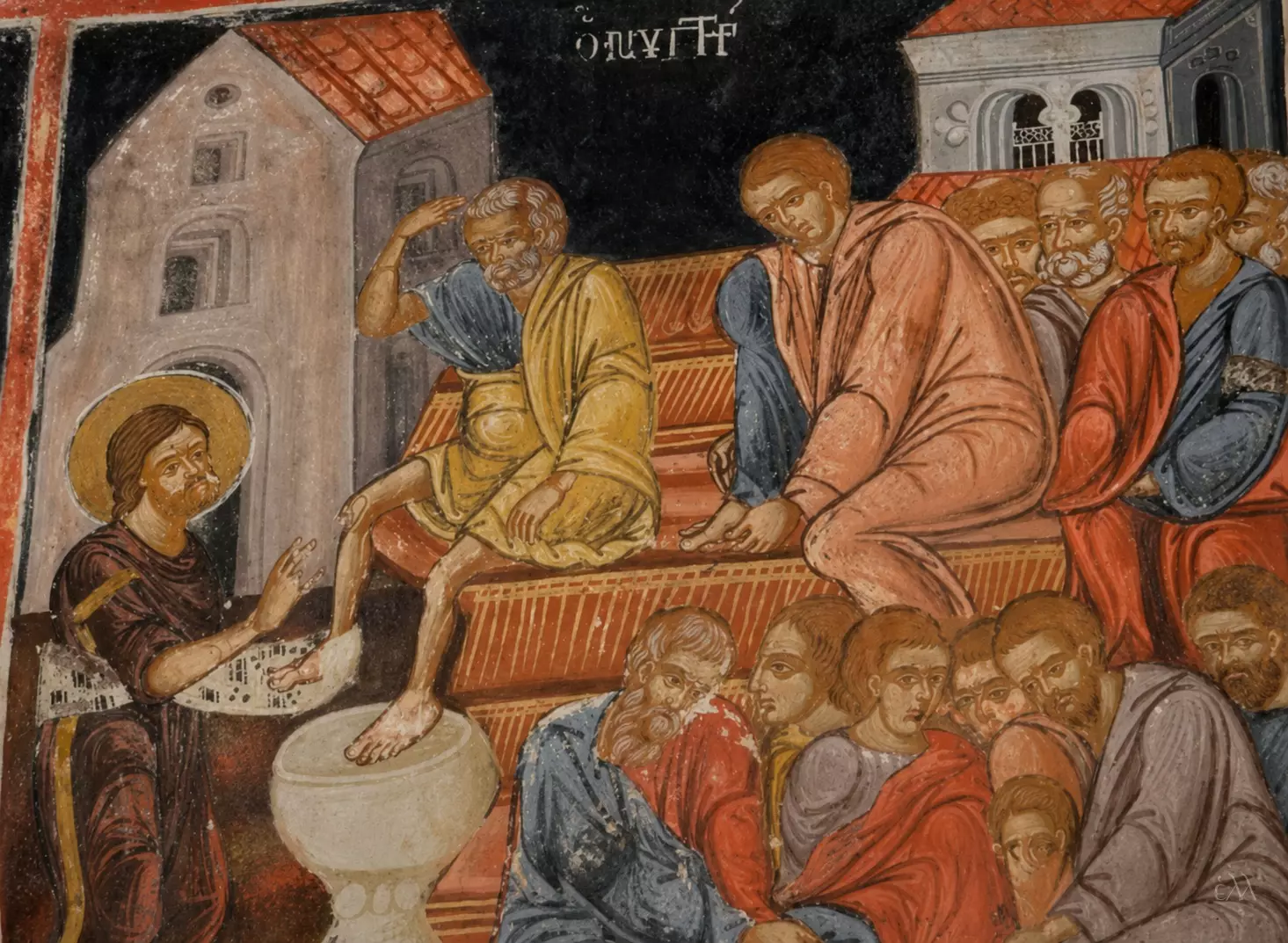
A kneeling figure with a thin gold-rimmed halo bends over a raised basin, both hands wrapped around the foot of a seated companion who has drawn one hand toward his own head in a gesture of visible protest. This is the moment of the Washing of the Feet, painted in 1741 on the walls of the katholikon of the Holy Trinity Monastery at Meteora, one of the fixed scenes of the Dodekaorton cycle and a subject drawn directly from the Gospel of John’s account of Christ washing the feet of his disciples before the Last Supper (John 13:1–17). The fresco belongs to a decorative campaign carried out by the priest Antonios together with his brother Nikolaos, painters active under Theophanes, Metropolitan of Stagoi, and Parthenios, hegoumenos of the monastery at the time. Their work forms part of a broader continuity: throughout the eighteenth century the monastic communities of Meteora functioned as working ateliers of ecclesiastical painting, sustaining post-Byzantine models of composition and iconography well after the fall of Constantinople had reshaped patterns of patronage elsewhere in the Orthodox world.
The scene as painted at the Holy Trinity Monastery follows the compositional logic long established for the Niptēr in Byzantine and post-Byzantine church decoration, organizing the disciples in tiered groups around a central architectural stage and reserving the moment of greatest emotional charge — Peter’s astonished refusal (John 13:8) — for the group nearest the basin. What follows examines how Antonios handled this traditional arrangement, and what the surviving brushwork and palette reveal about his particular hand within a well-worn iconographic scheme.
The Washing of the Feet Fresco at Meteora: Composition and Iconography
Christ kneels at the edge of the scene, his dark wine-colored chiton set off by a narrow gold clavus running along the sleeve — a detail of dress that, however modest, signals his identity independently of the halo above his head. His posture is entirely absorbed in the task: both hands cradle a disciple’s foot just above a tall white basin resting on a turned, knopped pedestal, and his gaze follows his own hands rather than meeting those of the men gathered around him. There is no theatrical address to the viewer here, only the physical fact of the act itself, rendered with the plain directness this subject demands from anyone working within the Orthodox pictorial tradition.
The disciple whose foot is being washed occupies the psychological center of the composition, seated on a raised bench beneath the projecting eave of a building, wearing an ochre himation over a blue undergarment. His right hand is lifted toward his own head, fingers spread near the temple — the conventional gesture used across post-Byzantine painting to register Peter’s exclamation that Christ should never wash his feet (John 13:8), a moment of protest rather than a devotional attitude, and one that artists of this period rarely varied in its basic form. Behind him, further apostles are seated in a loose row along the same bench, their garments moving through rose, deep red, slate blue, and mauve, each face turned at a slightly different angle so that the row reads as a gathering of individuals rather than a repeated type. A second, lower register crowds still more figures into the foreground, seated closely together in muted robes of blue-grey and dusty red, several with their heads inclined toward one another in quiet conversation while others look outward, toward the central act, with expressions that stay within the restrained, contemplative register typical of the period’s figure painting.
The architectural background does real compositional work rather than serving as mere ornament. To one side stands a modest structure with a steeply pitched, red-tiled roof and a plain arched doorway, rendered in pale ochre tones; opposite it rises a taller grey building fronted by an arcaded loggia, its arches picked out with a delicacy that recalls, at a distance, the conventions of Palaiologan architectural backdrops still current in provincial workshops of the eighteenth century. Both structures sit against a dark, almost black ground, a convention that pushes the figures forward and concentrates attention on the huddled mass of drapery and gesture below. Above the scene, in majuscule lettering typical of painted inscriptional fields in Orthodox church decoration, the fragmentary word ΝΙΠΤΗΡ identifies the episode for any viewer standing before it — inscriptions of this kind having long served a didactic purpose within the fresco cycles of Orthodox churches.
Color carries much of the emotional and hierarchical logic of the composition. Christ’s garment is deliberately subdued against the brighter hues worn by the apostles, a contrast that has less to do with narrative emphasis than with an inherited convention distinguishing the humility of his act from the more varied, worldly palette applied to the men receiving it. The drapery throughout is handled with schematic, angular folds rather than fluid modeling, a stylistic choice consistent with much monastic painting of the period in the region, where legibility and repeatable formula mattered more than illusionistic subtlety. What survives on this wall of the Holy Trinity katholikon remains a legible restatement of an established theme, carried out by an artist at ease within a formula he shows no sign of wanting to leave behind.
(The translation was edited by P. Alexiou.)