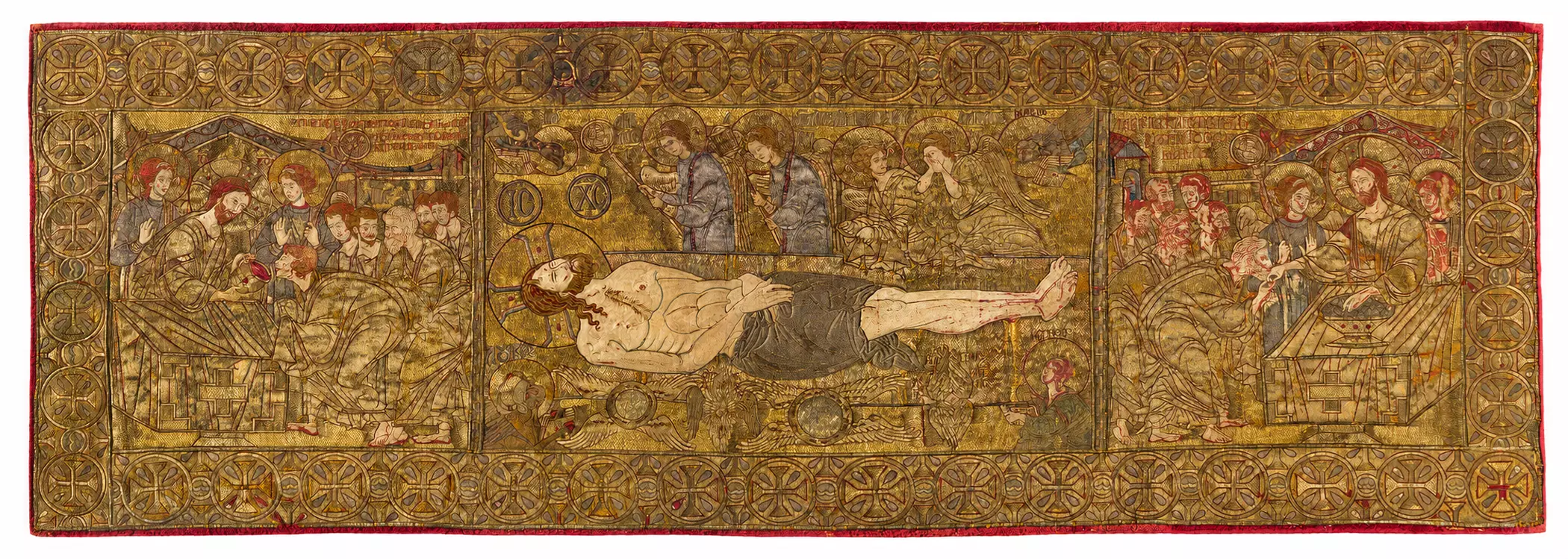
The Thessaloniki Epitaphios, dated to around 1300 and preserved in the Museum of Byzantine Culture in Thessaloniki, is among the most remarkable surviving examples of Late Byzantine ecclesiastical embroidery. Measuring 200 × 70 cm, the rectangular liturgical textile is made from silk and linen with gold and silver and was probably produced in a Thessalonian workshop. It was discovered in 1900 in a small church in the city. The Museum identifies its liturgical function with the services of Good Friday, while its imagery joins the dead Christ, angelic figures and the Communion of the Apostles within a single unusually elaborate programme.
Across almost the entire length of the cloth runs a dense field of gold embroidery. The rectangular format is framed by broad ornamental borders filled with repeated circular cross motifs, creating a measured visual rhythm around the more complex figural scenes. Inside this frame, architectural forms, haloes, inscriptions, garments and wings are compressed into a surface whose dominant impression is metallic and luminous. Gold does much of the structural work: contours emerge from changing patterns of embroidery, while areas of coloured silk distinguish faces, garments and smaller details. The result belongs fully to the sophisticated material culture of Late Byzantine liturgical art, in which precious textiles could carry pictorial programmes of considerable complexity.
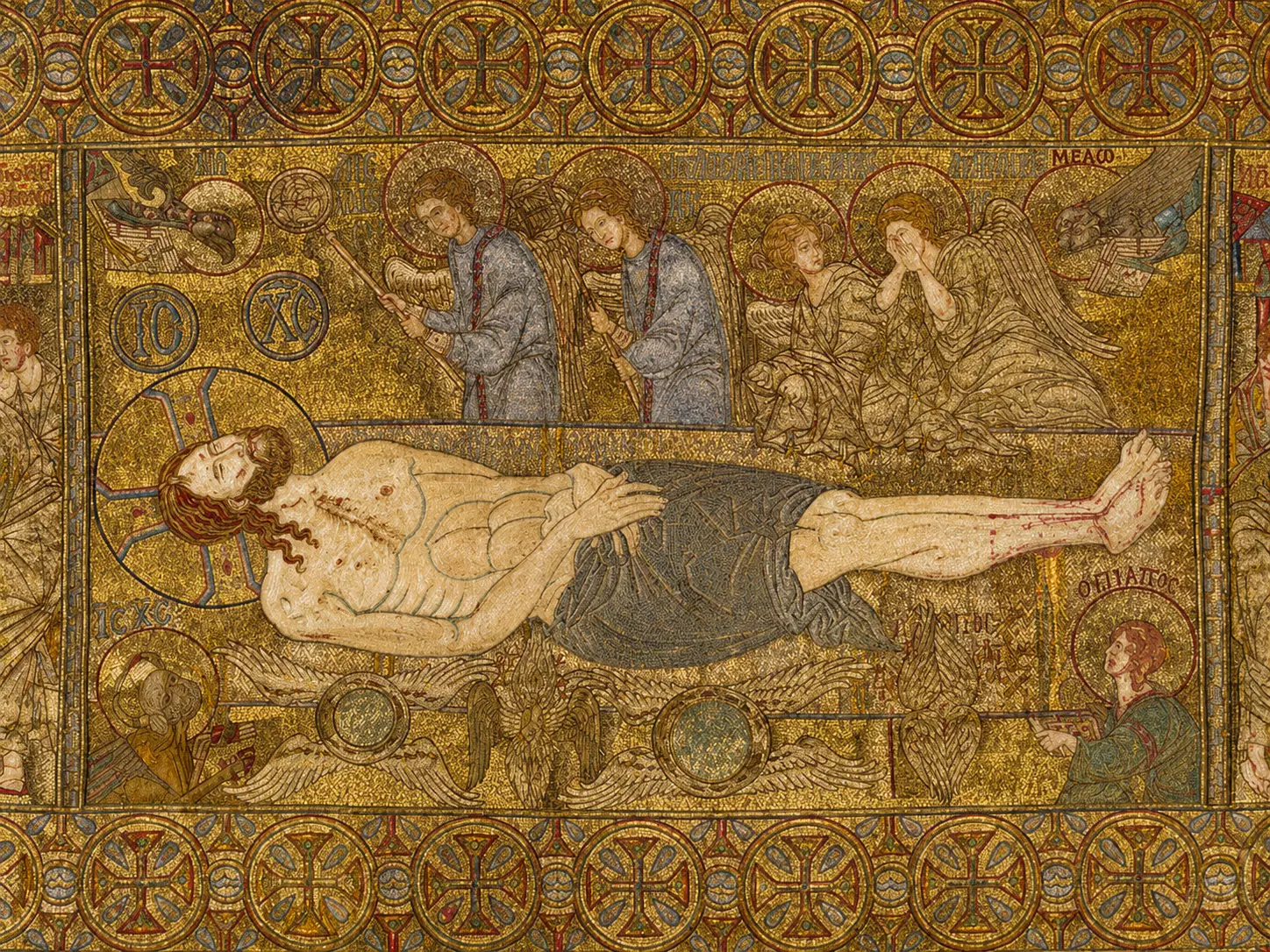
Thessaloniki Epitaphios: Eucharistic Imagery and Gold Embroidery
At the centre lies the dead Christ, shown horizontally upon a richly ornamented bier. His body forms the principal axis of the entire composition. The head rests within a large cruciform halo; the torso is uncovered, the arms cross low over the body, and a dark cloth covers the lower part of the figure. Against the surrounding gold, the pale flesh is strikingly exposed. Fine linear details articulate the ribs, wounds, hair and facial features, while small passages of red accentuate the marks of the Passion. Despite the abundance of embroidery around him, the body remains remarkably uncluttered.
Around Christ, the celestial attendants introduce movement and grief. Angels lean forward above the bier, some with hands raised toward their faces, while others carry liturgical objects. Beneath the body appear further winged beings belonging to the heavenly hierarchy. Scholarly discussion of the textile has drawn particular attention to this concentration of angelic figures and to the close conjunction of funerary and Eucharistic imagery. The overlapping wings, inclined heads and repeated gestures produce a restless pattern around the rigid horizontal form of Christ.
At the two ends of the textile, the composition changes markedly. Christ appears again, now standing behind an altar and administering the Holy Gifts to approaching Apostles. One group receives the consecrated bread, the other the wine. Architectural structures frame both scenes, their angular outlines separating the apostolic groups from the central bier while preserving the continuity of the embroidered field. The Museum describes these episodes as the Transmission and Communion of the Holy Gifts.
Their placement is exceptional. The two halves of the Communion are arranged in an unusual orientation, a feature that has generated discussion concerning the textile’s original use. One scholarly interpretation proposes that its configuration becomes intelligible when the cloth is conceived as being carried or wrapped around a priest or deacon, bringing the separated Eucharistic scenes into a different visual relationship. This remains an interpretation of the object rather than a securely documented reconstruction of its use, but it demonstrates how closely the imagery was conceived in relation to movement, viewing and liturgical space.
In the detail of the central field, the embroidery reveals its extraordinary density. Fine changes in direction distinguish the angels’ feathers, garment folds, architectural surfaces and the ornamental ground; slender lines define faces and hands against fields almost entirely occupied by metal thread. The figures retain the elongated proportions, animated contours and expressive gestures associated with sophisticated painting around 1300, qualities that scholarship has connected with contemporary artistic production in Thessaloniki. Gold here behaves almost like light moving across a mosaic surface: every small alteration in the embroidered pattern changes its reflection.
The physical splendour of the Thessaloniki Epitaphios is inseparable from its iconographic concentration. At its centre, the still body of Christ; around it, the heavenly liturgy; at either end, Christ distributing the Eucharistic gifts to the Apostles. Sacrifice, burial and Communion consequently occupy the same textile field, their relationships established through proximity, repetition and the long horizontal structure of the cloth. Around all three zones, the continuous border of crosses maintains its steady cadence, enclosing a surface of silk, linen, gold and silver that has survived from about 1300.