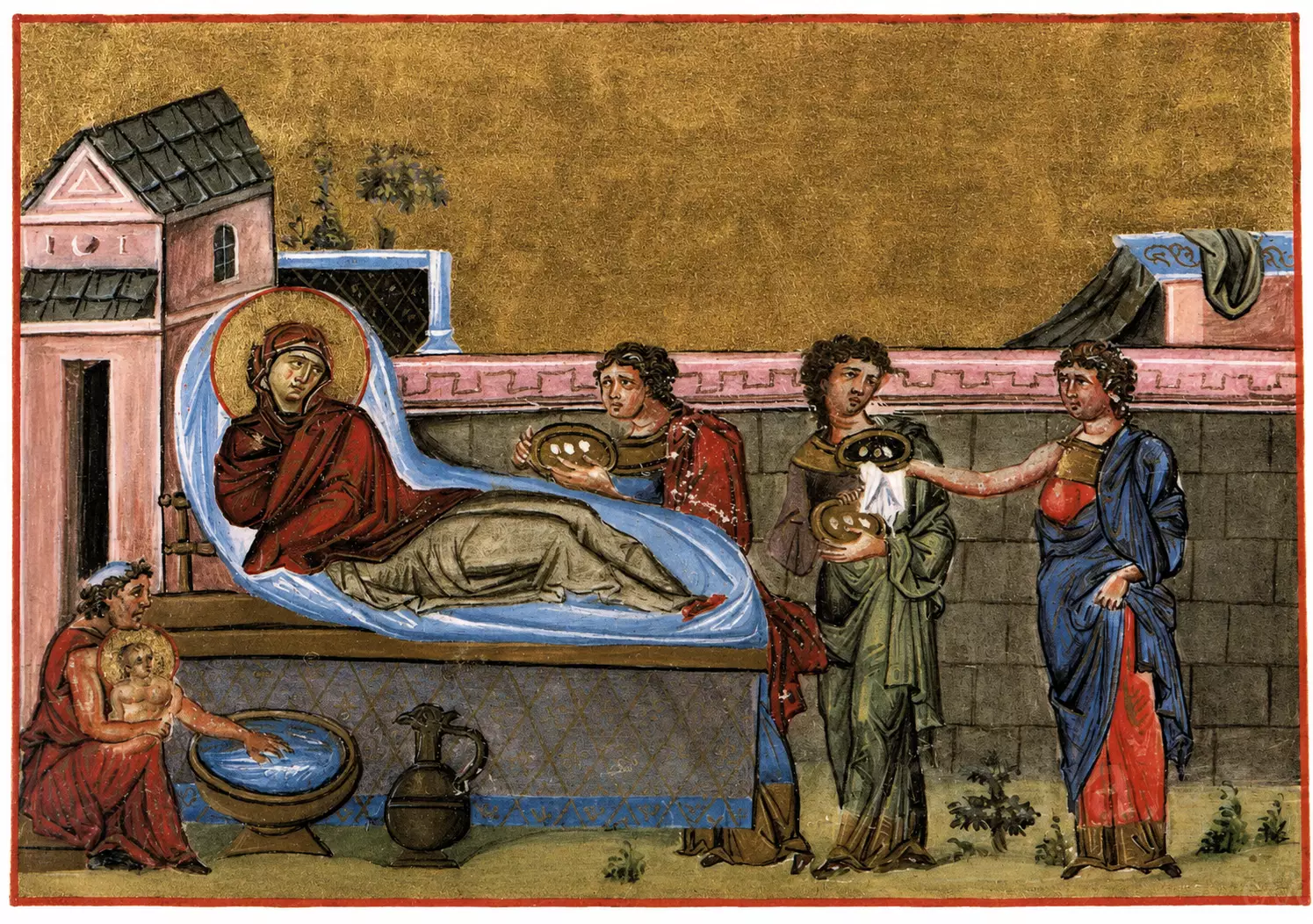
The Nativity of the Theotokos, preserved in the Menologion of Basil II (Vatican Library, Vat. gr. 1613, fol. 22), belongs to the exceptional flowering of Constantinopolitan manuscript illumination around the end of the tenth century. Usually dated to around 985, the miniature presents the birth of the Virgin Mary through a carefully compressed sequence of domestic actions. Saint Anne, haloed and already resting after childbirth, occupies the large couch at the left, while attendants approach from the opposite side carrying shallow dishes. Below, another woman supports the newborn Mary beside a basin prepared for her bath. Narrative time has been condensed: recovery, attendance upon the mother and care of the child coexist within one pictorial field.
Across almost the entire upper part of the miniature extends the gold ground, interrupted by a low architectural enclosure and by buildings placed at the lateral edges. A narrow red line marks the outer boundary of the image. The architecture does not construct a continuous, measurable interior. Walls, roof forms, openings, textiles and parapets establish enough spatial information to suggest a prosperous household, yet they remain subordinate to the figures. Against this restrained setting, the pale blue bedding around Anne becomes unusually conspicuous. It sweeps from behind her halo, follows the length of the reclining body and turns downward near her feet, giving the large horizontal form of the couch a fluid contour.
The manuscript itself is among the most ambitious surviving products of Byzantine courtly book production. Its hundreds of miniatures transform the succession of commemorations within the ecclesiastical year into an extensive visual cycle, and its production, notably, involved eight illuminators working within an exceptionally coordinated programme. The chronology of this celebrated codex has long attracted scholarly discussion; Sirarpie Der Nersessian devoted a substantial dating study to the Menologion and the Psalter associated with Basil II.
Nativity of the Theotokos: composition and Byzantine manuscript style
Saint Anne provides the visual centre even though her figure is displaced towards one side. Reclining almost horizontally, she occupies far more pictorial space than any of the attendants. Her red-brown maphorion is drawn into broad, angular folds around the upper body, while a muted garment covers the legs. The halo, set directly against the golden field, separates the head from the architectural forms behind it. Anne’s pose is composed, her face slightly inclined; around her, by contrast, movement continues.
From the right advance three women whose overlapping bodies create a measured succession. Their garments vary markedly—red, green, deep blue—and the alternation gives the group a strong chromatic rhythm. Each carries a circular vessel or dish. Their poses are individualized through inclination of the head, extension of the arms and changes in stance, preventing the sequence from becoming mechanically repetitive. One figure approaches the bed, another turns slightly as though caught between movement and pause, while the outermost attendant extends her offering towards the centre. The artist thus communicates conversation and service principally through gesture. Little physical depth is required.
Below the bed another episode unfolds, on a much smaller scale. The newborn Virgin is held beside a broad basin filled with water, while a dark vessel stands nearby. The shift in scale is striking but coherent with the pictorial hierarchy. Anne remains the principal figure of the birth chamber; the bathing of the child forms a subsidiary narrative unit, visually attached to the lower edge of the couch. Such compression allows several moments of the story to be read almost simultaneously.
Nativity of the Theotokos: sources and iconographic tradition
The source of the subject lies outside the canonical Gospels. Traditions concerning Joachim and Anne, their childlessness and the miraculous conception and birth of Mary were transmitted above all through the Protoevangelium of James, an early Christian apocryphal text that exercised profound influence on Marian iconography. Byzantine artists developed the Nativity of the Virgin from this narrative tradition into an established composition: the reclining mother, serving women, newborn child and ritual bath became durable elements of the scene, subsequently reworked across manuscripts, icons and monumental painting.
What distinguishes this miniature is the disciplined relationship between those narrative details and the luxurious pictorial surface. The gold ground suppresses any ordinary atmosphere beyond the enclosure, while the small plants along the lower margin and the carefully differentiated architecture prevent the scene from becoming wholly abstract. Figures possess weight, faces are modelled with compact tonal transitions, garments fall in clearly articulated folds. Yet space remains shallow. The painter is concerned with the legibility of action, the hierarchy of figures, the rhythmic distribution of colour.
The result belongs closely to the artistic culture of the Macedonian period, when imperial manuscript production could combine classical habits of bodily modelling and narrative gesture with the more explicitly hieratic ordering of Byzantine sacred representation. Domestic life is present in remarkable abundance—couch, basin, pitcher, dishes, roof tiles, hanging cloth—and still the miniature never loses its ceremonial character. Gold surrounds the human activity; ordered gesture controls it. Within a few centimetres of painted parchment, an intimate birth chamber becomes part of the monumental visual history constructed for the court of Basil II.
(The translation was edited by N. Jones.)