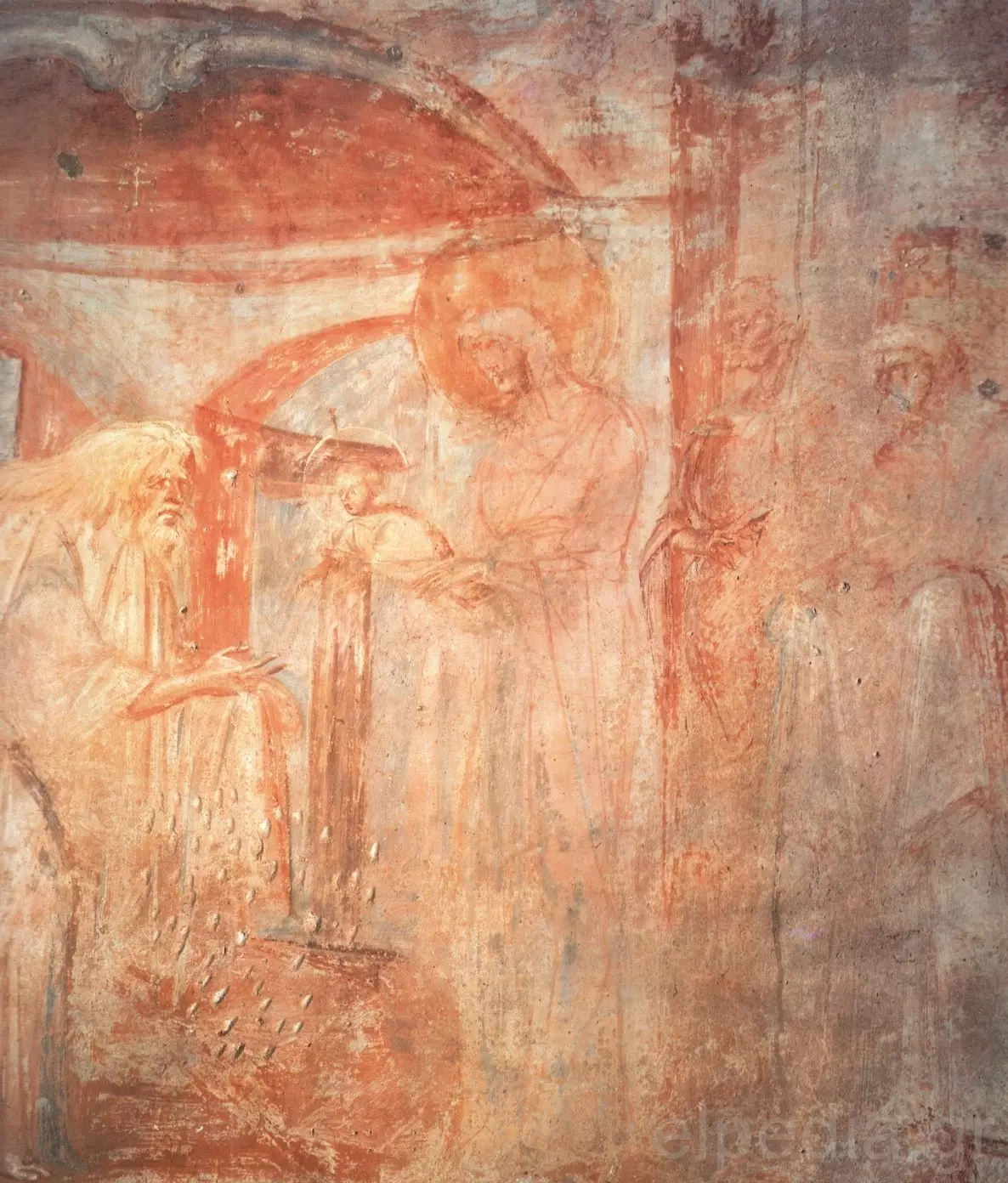
The Presentation of Christ at Castelseprio, preserved in the church of Santa Maria foris portas in Lombardy, belongs to one of the most extraordinary surviving cycles of Early Medieval wall painting in western Europe. An anonymous painter represented the episode within the central apse, as part of a sequence devoted to the infancy of Christ. The cycle combines narratives from the canonical Gospels with episodes drawn from apocryphal traditions, particularly the Protoevangelium of James and the Gospel of Pseudo-Matthew. The Presentation itself follows the account in Luke, in which Simeon recognises the infant Christ brought to the Temple by the Virgin Mary (Luke 2:22–38). Within the extant programme, it is the final narrative episode in the sequence and occupies the curved wall of the apse beyond one of its windows.
Its date has produced a debate almost as remarkable as the paintings themselves. The church is generally assigned to the seventh or eighth century, while the frescoes have been placed at various points between that same range and the beginning of the tenth. Their exceptional classicism has encouraged comparisons with Early Byzantine painting still visible in Rome, especially Santa Maria Antiqua, while later datings have connected them with the renewed interest in antique artistic models associated with the Carolingian world or the so-called Macedonian Renaissance. In the absence of a single secure date, the official presentation of the monument consequently retains this broad chronological range.
Presentation of Christ at Castelseprio: Movement, Space and Classical Tradition
Much of the painted surface has disappeared, yet the central action remains surprisingly intelligible. Simeon bends forward toward the Christ Child, extending his arms with a gesture whose quiet urgency survives despite extensive pigment loss. The infant is brought towards him by the Virgin, whose tall figure occupies the central portion of the scene as it now stands. Other forms remain considerably fainter. Pale halos, long garments and fragments of faces emerge from an architectural setting dominated by warm red, ochre and cream tones. Small lacunae and areas of surface abrasion repeatedly interrupt the forms, so that a robe may dissolve into the plaster before its contour becomes visible again.
The architecture matters. A large reddish canopy curves above the figures, establishing an interior that is neither reduced to a conventional sign nor constructed according to later mathematical perspective. Arches, supports and overlapping planes give the Temple an unexpectedly spacious character. Some architectural elements recede; others seem to turn towards the foreground. The resulting pictorial space has the instability familiar from Late Antique painting, yet it stays convincing enough to allow the figures to move within it rather than simply stand against a background. This spatial freedom is one of the qualities that has made Castelseprio so difficult to fit comfortably into conventional narratives of Early Medieval art.
Movement passes between the figures through their bodies and hands. Simeon’s forward inclination is answered by the direction of the Child, while the Virgin forms a taller, more stable vertical presence behind him. These are not rigidly frontal figures arranged according to an emphatic symmetry. The artist lets one body overlap another and allows gestures to continue the rhythm established by neighbouring forms. Even in its damaged condition, the scene preserves something unusually immediate: a meeting taking place, not a sequence of isolated sacred portraits assembled beside one another.
This quality connects the Castelseprio cycle with the continuity of the classical tradition in Byzantine visual culture. Drapery once appears to have been modelled with broad transitions rather than with the severe linear patterning characteristic of many later medieval paintings. Faces turn, bodies incline and figures possess a degree of volume. The handling nevertheless never becomes an exercise in archaeological imitation of antiquity. Classical pictorial habits have been absorbed into a Christian narrative whose subject depends upon recognition, encounter and gesture. Such coexistence of Roman inheritance, Byzantine influence and new Early Medieval artistic languages also characterises the broader historical importance of the Lombard sites recognised by UNESCO. Castelseprio and Santa Maria foris portas form part of the serial World Heritage property Longobards in Italy: Places of the Power (568–774 A.D.), inscribed in 2011.
Presentation of Christ at Castelseprio: Discovery and Fragmentary Survival
Concealed for centuries beneath later plaster, the sophisticated cycle was uncovered only in 1944, adding another layer to its history. Their present fragmentary state can at first make the painting appear almost monochromatic, but closer attention reveals a restrained chromatic range: red-orange architectural masses, pinkish and ochre flesh tones, pale garments and traces of darker modelling. What has disappeared is considerable. What has come down to us is enough to show a painter able to pass rapidly from contour to volume and from architectural setting to human gesture without forcing every element into the same degree of finish.
Presentation of Christ at Castelseprio: Place within the Apse Cycle
The Presentation also occupies a significant place within the iconographic logic of the apse. Earlier scenes move through the events surrounding Christ’s conception and birth; some derive from canonical Scripture, others from narratives that expanded the early life of the Virgin. The official description of the monument identifies the cycle as a sequence of episodes from the childhood of Jesus, beginning with the Annunciation and Visitation and continuing through such subjects as the ordeal of the bitter water, Joseph’s dream, the journey to Bethlehem, the Nativity and the Adoration of the Magi before reaching the Presentation. Within that progression, Simeon’s encounter with the Child forms a natural point of arrival: the infant who has been announced, conceived and born is now recognised within the Temple.
Whether the artist worked in the seventh century, somewhat later, or under circumstances still imperfectly understood, the Presentation of Christ at Castelseprio retains an artistic language in which Late Antique naturalism had not disappeared from Christian monumental painting. Line remains supple, pictorial space remains mobile, and sacred figures communicate through physical movement of unusual delicacy. Precisely because so much of the surface has been lost, these gestures acquire an unexpected clarity. In the damaged meeting between Simeon, the Virgin and the Child survives one of the most elusive passages between antique painting and the visual culture of medieval Byzantium.
(The translation was edited by D. Manou.)