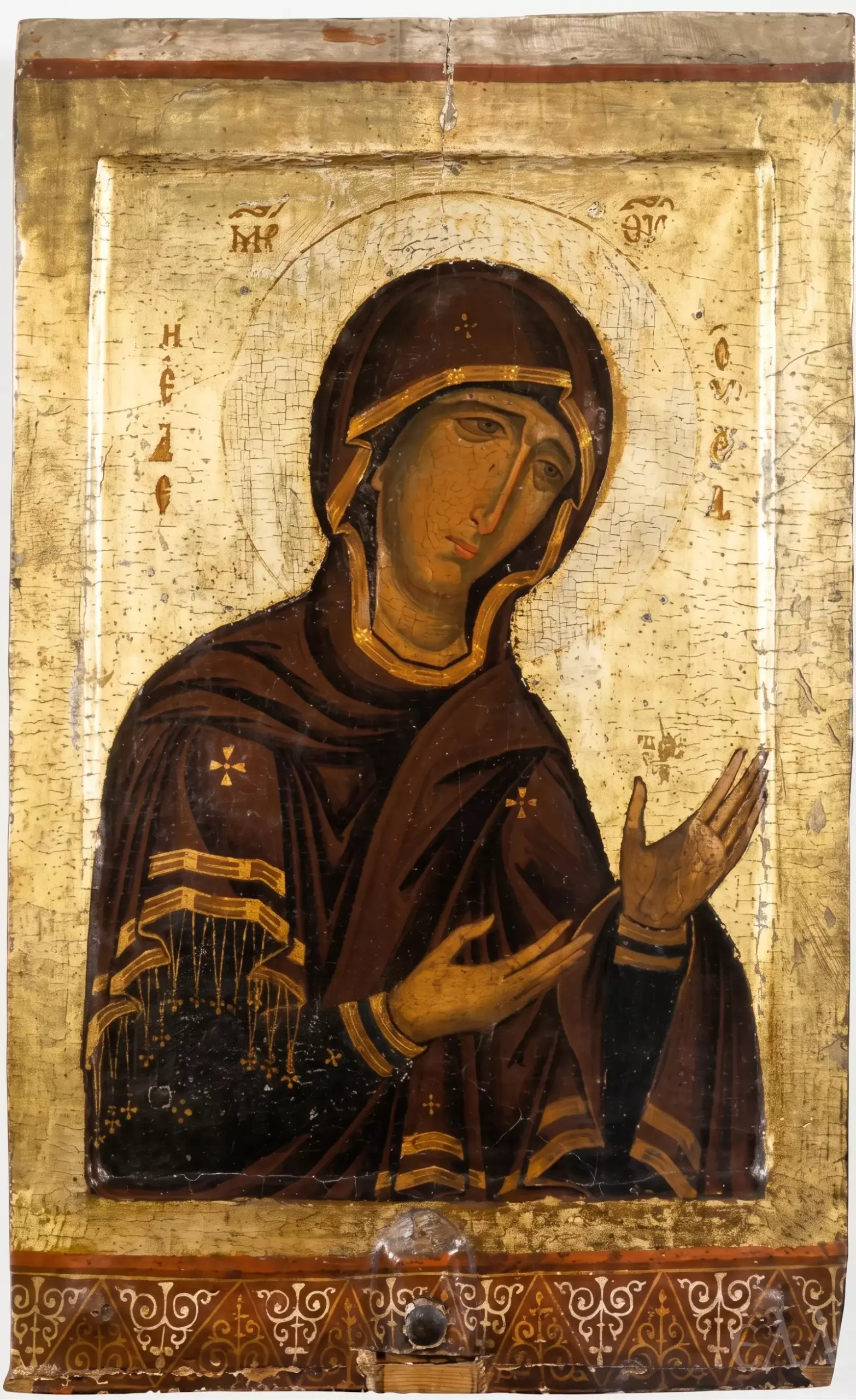
The Theotokos Eleousa, preserved at the Monastery of Saint Neophytos near Paphos and generally dated to the late twelfth century, belongs to a small group of Cypriot panel icons whose physical construction, iconography, and original function remain closely interwoven. Measuring 75 × 45.5 cm, the icon presents the Mother of God at half length against a gold ground. Her head inclines towards the right side of the panel, while her two hands establish the movement of the composition: her right hand crosses the body at a lower level, her left rises with the palm open in a gesture of supplication. Nothing interrupts the gesture. The Christ Child is absent.
That absence is important. The epithet Eleousa is frequently associated with representations of the Virgin and Child marked by physical tenderness, yet the designation is not confined to a single iconographic formula. In the Paphos panel the Theotokos appears specifically as an intercessor. Her slightly inclined head, the direction of her gaze, the open hands, even the displacement of the figure from an absolutely frontal axis, belong to an image conceived in relation to another. Its counterpart was the icon of Christ Pantokrator bearing the epithet Philanthropos, towards whom the Virgin’s supplication was directed. A pair, therefore: Christ receiving the appeal, the Theotokos presenting it.
Theotokos Eleousa as a Processional Icon
The composition is restrained, although scarcely static. A dark reddish-brown maphorion encloses the head and falls across the shoulders in broad, irregular masses, its darkness intensified by the much lighter field surrounding the figure. Narrow golden or ochre bands sharpen its edges. At the forearms, horizontal ornamental bands and fine linear accents break the otherwise weighty expanses of cloth; small cross-like ornaments appear upon the garment. The face, long and gently narrowing towards the chin, is modelled through warm brown and ochre tones. Exceptionally slender and extended is the nose; small the mouth, elongated the eyes beneath strongly defined brows. The result is a physiognomy contemplative, somewhat severe, yet softened by the inclination of the head.
Through the hands the painter changes the rhythm. The lower right hand, drawn across the torso, forms an oblique that leads towards the raised left arm; the latter continues upwards in a second diagonal, opening the figure towards the absent object of her address. Fingers are long, narrow, separately articulated. Drapery encloses the body; gesture exceeds it. The contrast gives the panel much of its expressive force without requiring violent movement or exaggerated facial emotion.
Across the gold ground, the conventional abbreviation MP ΘY, identifying the Mother of God, occupies the upper inscriptional field. The title Eleousa further defines the image, but its significance must be understood alongside the companion Christ Philanthropos. Mercy and loving-kindness were thus articulated through two confronting sacred figures. The relationship was visual before it was textual: gaze answering gaze, intercession directed towards authority, two independent panels forming a larger devotional arrangement.
The object itself preserves evidence of another kind of movement. A pronounced opening at the centre of the lower edge accommodated the support used when the icon was carried in procession. On the reverse, a jewelled cross was painted, allowing the panel to remain visually active when seen from either direction. Its processional function therefore explains features that might appear peculiar if the work were considered solely as an immobile icon fixed permanently within an architectural screen. Front and reverse mattered; so too did the unusually substantial frame.
That frame, carved from the same wooden support, becomes notably broader below. Along this lower zone runs an ornamental sequence of upright and inverted palmettes, white linear forms unfolding over a reddish-brown ground. The effect recalls the repeated motifs of woven or embroidered textiles. Elsewhere, incised circular outlines appear to anticipate decoration that was apparently never completed. Ornament finished, ornament projected and abandoned, the large central recess for the carrying support: the lower border preserves something of the material biography of the panel.
Surface losses now interrupt several passages, particularly across the lower part of the figure and the dark sleeve. Abrasion has weakened some contours and decorative details; other areas remain unexpectedly forceful. The face, above all, retains the controlled linear construction upon which the figure depends. Such discrepancies of preservation should not be mistaken for differences originally intended by the painter. They also make the surviving passages of modelling unusually valuable for understanding the icon’s stylistic character.
A proposed attribution connects the panel with Theodoros Apseudes, the painter associated with the celebrated decoration of the Enkleistra of Saint Neophytos. Attractive though the connection is, the principal phase of those wall paintings is securely tied to 1182–1183 by inscriptional and textual evidence. The foundational investigation by Mango and Hawkins established the historical framework for the Enkleistra and its painted programme, including the evidence surrounding the painter and the campaign of 1183. Attribution of the portable panels to Apseudes remains a scholarly proposal, however, and is better retained as such than transformed into documented authorship.
Chronology makes the association especially suggestive. In the later twelfth century Cypriot painting participated closely in the increasingly expressive language of Komnenian art: elongated proportions, controlled linearity, dark and saturated draperies, fine highlights, gestures capable of carrying psychological weight. That artistic world the Paphos Eleousa shares without becoming restless. Her movement is concentrated into the incline of the head and the ascending hands; the large dark silhouette remains compact against the luminous ground.
Most distinctive is the relationship between image and object. The broad lower frame was made for handling, the reverse was painted because it could be seen, the Virgin’s pose was conceived because another icon completed its direction of address. Seen in isolation today, the Theotokos Eleousa still carries the traces of that larger arrangement—wooden support, processional opening, ornamental border, supplicating hands, an icon constructed around movement and encounter.
(The translation was edited by A. Orfanos.)