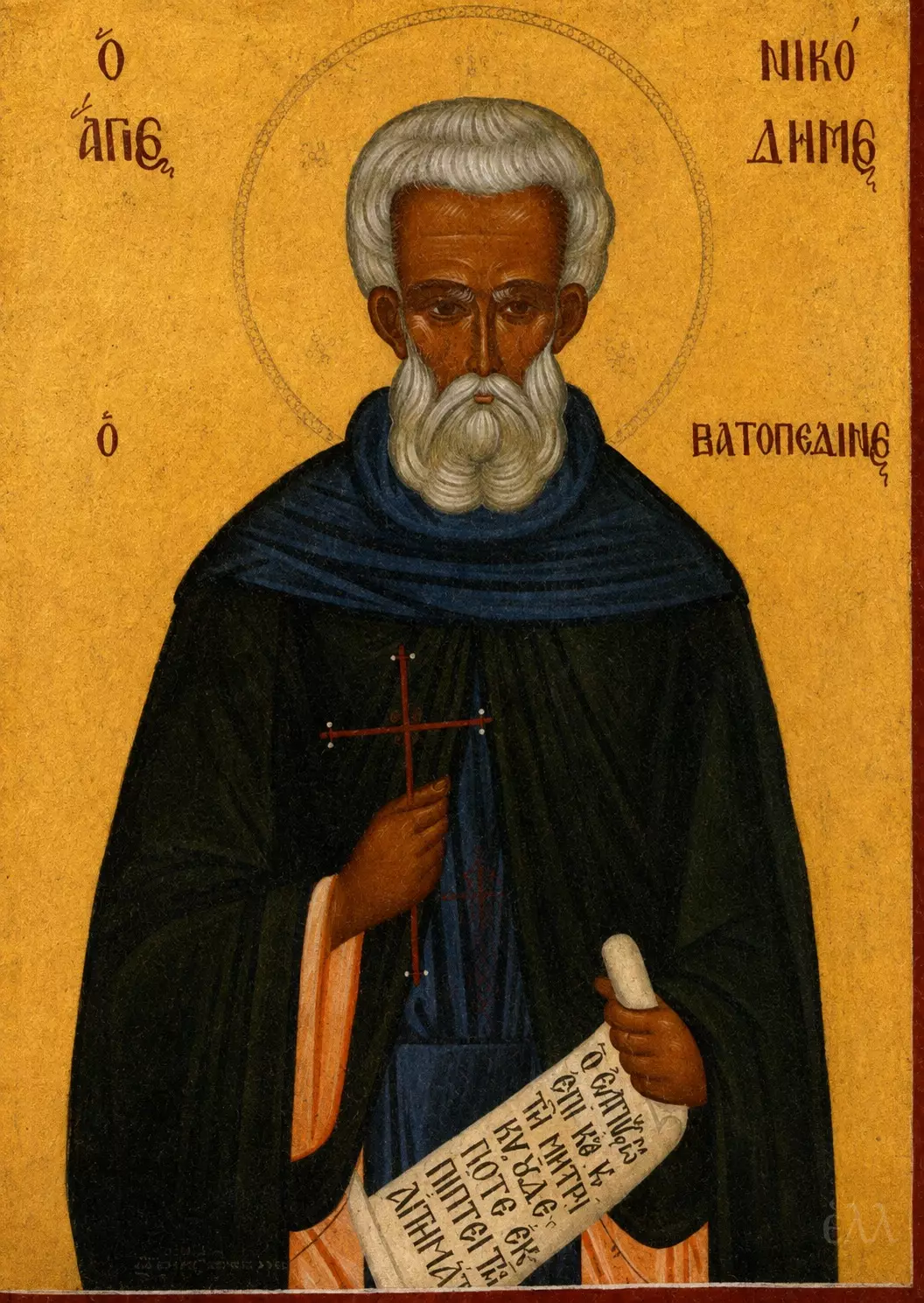
The Saint Nikodemos of Vatopedi icon presents the fourteenth-century Athonite hesychast in a modern portable image associated with the Holy Great Monastery of Vatopedi. Its anonymous painter works within the continuing Byzantine artistic tradition of Mount Athos, placing the half-length figure against an uninterrupted gold ground. Two identifying Greek inscriptions, Ο ΑΓΙΟΣ ΝΙΚΟΔΗΜΟΣ and Ο ΒΑΤΟΠΕΔΙΝΟΣ, occupy the upper field. The elderly monk faces forward, though his lowered, slightly averted gaze gives the physiognomy a contemplative reserve.
Saint Nikodemos of Vatopedi Icon: The Hesychast Figure
Across the face, strongly defined lines articulate the forehead, cheeks and narrow area around the eyes. Thick white hair forms an almost continuous arc around the head; below, the long bifurcated beard is modelled through repeated grey and white strokes. A dark monastic habit encloses the body in a broad, compact silhouette, with deep blue folds providing restrained chromatic variation. In his right hand Nikodemos holds a slender red cross. His left supports an open scroll bearing Greek text, an attribute that places emphasis on his role as an ascetic teacher. The halo, outlined by a delicate ornamental border, remains visually absorbed into the surrounding gold field.
Nikodemos, when raids in Asia Minor forced him to leave the region, had already practised the monastic life at Mount Auxentios near Chalcedon before moving to Mount Athos. Near Vatopedi he became the spiritual elder of Gregory Palamas, who remained with him for three years, from 1319 until Nikodemos’s death in 1322. Patriarch Philotheos Kokkinos later described him as remarkable in both praxis and theoria, language closely connected with the hesychast tradition. His commemoration is observed on 11 July, and a liturgical office in his honour was composed by the hymnographer Charalambos Bousias.
(The translation was edited by E. Alexandraki.)