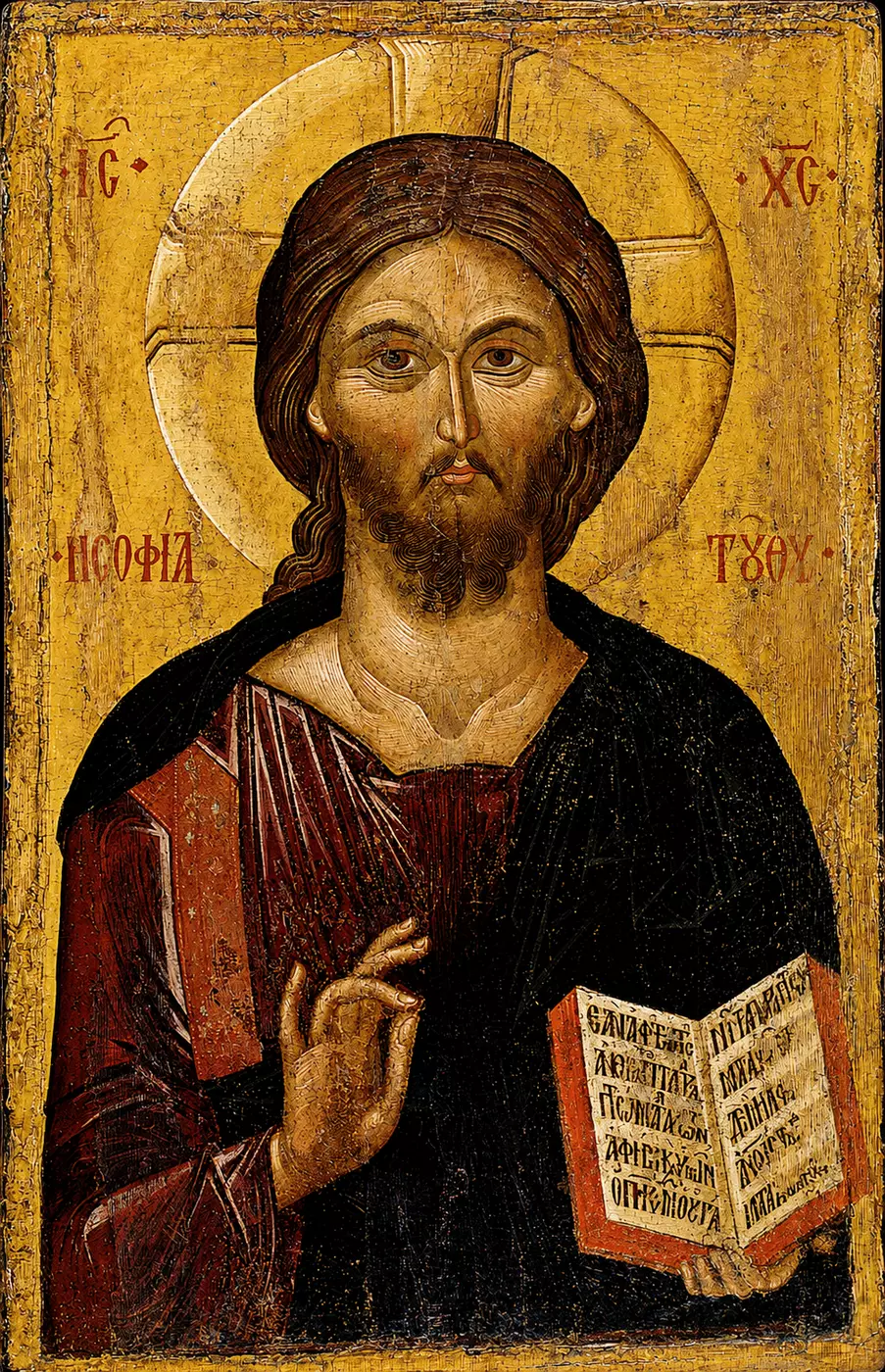
The icon bearing the inscription The Wisdom of God belongs to one of the rarest theological subjects of Byzantine painting, a composition that identifies the form of Christ Pantocrator with a dogmatic content deeply bound to the theological discussions of the fourteenth century. Executed around the third quarter of that century by a painter whose name has not been preserved, probably a member of a workshop active in the wider Macedonian region, the icon is preserved today in the Museum of Byzantine Culture in Thessaloniki. Its dimensions, approximately 1.54 by 1.08 metres, far exceed the customary size of a portable icon of the period, a fact that has led a number of scholars to the supposition that it came from a large church, perhaps the very church of Hagia Sophia in Thessaloniki, whence it probably also drew its unusual name.
At the centre of the composition Christ is depicted in bust, frontal, with his right hand raised in blessing before the breast and his left holding an open Gospel, on whose pages is read a passage from the Gospel according to Matthew concerning the forgiveness of sins. The epithet Wisdom of God, rare even within the broad repertoire of Christian iconography, points to dogmatic questions that intensely occupied the hesychast theologians of the period, lending the work a weight that surpasses the mere depiction of a figure.
The Form of Christ and the Iconography of the Wisdom of God
The surface of the icon is of wood, faced with a thin layer of cloth and gesso, upon which the painter worked in egg tempera, a technique that predominates throughout the Byzantine tradition of the portable icon. The thickness of the wooden support, around five centimetres, attests to the construction of a work intended to endure through time and, perhaps, to dominate a prominent position within a large church. Ochre, and not gold, is the ground against which the figure stands forth, a choice that points directly to workshops of the wider Macedonian region and that recurs also in the halo of Christ. The halo itself, built up with gradations of the same ochre tone, bears an incised cross whose arms terminate in a zigzag, a technique that creates the illusion of relief and that is found, in similar fashion, in the halo of an icon of Christ the Extreme Humility now in a private collection in Athens. Above the shoulders is read the familiar abbreviation IC XC, while lower down, on either side of the face, is inscribed the epithet THE WISDOM OF GOD, in red letters that stand out clearly against the ochre.
The himation, deep, almost inky in tone, covers the shoulders and leaves free the right side of the breast, where the tunic, deep red with violet tinges, stands forth. The neck remains bare down to a low point, robust, with the open collar allowing a portion of the tunic to be seen, with the characteristic angular outline of its hem. The right hand, raised before the breast, forms the blessing in the familiar arrangement of the fingers, while the left, with the palm slightly curved, holds the Gospel inclined slightly towards the body, a detail that occurs also in another known fourteenth-century icon of Christ, preserved in the National Gallery of Sofia.
On the pages of the book, written in majuscule script, is read the passage: “For if ye forgive men their trespasses, your heavenly Father will also forgive you” (Matthew 6:14). This particular evangelical passage places forgiveness at its centre, a theme closely bound to the epithet Wisdom of God and to the soteriological dimension borne by this title. In corresponding icons of Christ Pantocrator in the museums of Sofia, where the same gesture of blessing occurs, there is read instead the saying “I am the light: he that followeth me shall in no wise walk in darkness” (John 8:12), a difference that shows how flexibly the painters adapted the evangelical text to the sense of each particular commission.
The Macedonian Workshop and Fourteenth-Century Byzantine Art
A number of features connect the technique of the icon with painting workshops active in the wider region of Macedonia during the second half of the fourteenth century. First of all the very features of the face: the strongly prominent cheekbones, the large eyes with the deep curves beneath them, the grave, almost severe expression. These features occur, with only slight variations, in the well-known icon of Christ the Saviour in the monastery of Chilandar on Mount Athos, a work dated to around the middle of the thirteenth century and one that the painter of our icon appears to have known well. From that composition it appears to borrow the manner in which the himation covers the shoulders, the zigzag outline of the tunic’s hem, even the ethos of the figure, in which divine severity coexists with a discreet, almost human sorrow. An unusual detail, found both in the Chilandar Christ and in our icon, is constituted by the soft locks of hair as they fall upon the right shoulder instead of the left, a reversal of a convention so firmly established that any deviation from it lays claim to interpretation.
This iconographic type, with the open Gospel before the breast, is not invented in the fourteenth century. A mosaic icon of Christ in the Bargello Museum in Florence, a work of the twelfth century, already presents it fully formed, with the luminous face of Christ bound to the evangelical saying concerning the light that dispels the darkness. At the beginning of the thirteenth century the same type is followed by a precious Constantinopolitan icon in the monastery of Sinai, where the epithet of the Saviour is again bound to the Transfiguration, natural enough if one considers that the monastery itself has honoured, since its founding, this very event. In our own icon this old type survives, adapted now to a different theological content, that of divine wisdom.
An almost identical scene occurs also in the frescoed representation of Christ in the catholicon of the monastery of Gračanica, where the same inclination of the locks accompanies a corresponding posture of the body and the same form of the open Gospel before the breast. In the later iconography of the region, moreover, the Wisdom of God is bound to the same theological background by the hesychast theologians of the fourteenth century as well, for whom divine wisdom constituted a central dogmatic issue within the great theological disputes of their age. The preference for ochre instead of gold, both in the ground and in the haloes, belongs also to the known customs of this region. In the great works of the templon of the monastery of Dečani, where are depicted the Virgin Glykophilousa, the Archangel Gabriel, and the saints Nicholas and John the Forerunner, the same choice is found, together with impressive dimensions that approach, at least in height, our icon.
The Detail of the Eyes in the Icon of the Wisdom of God
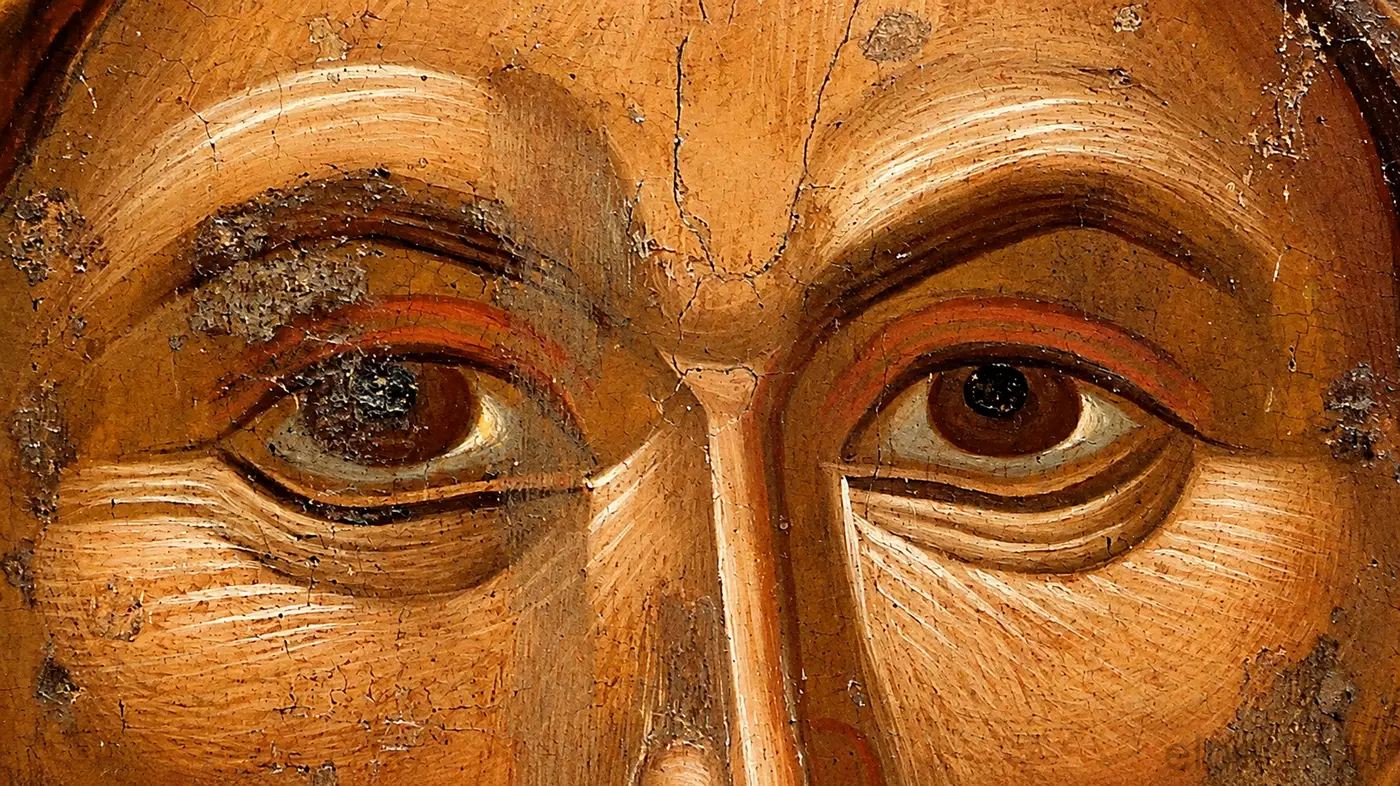
Looking closely at the eyes of the figure, one discerns the process by which the painter worked the human face upon a dark, greenish under-painting. Upon this dark base are built up gradually, with fine parallel brushstrokes of white, the highlights that model the brow, the eyelids, and the deep lines beneath the eyes. The outline of the eyes is emphasised with a reddish line, while the iris, almost black, allows only a faint reflection of light to be seen within it. Cracks of time run across the surface, especially around the root of the nose, without however altering the penetrating quality of the gaze. It is not a serene gaze. It is something heavier, almost weary, as though the painter had sought to render, within the countenance of the divine person, traces of human suffering. This technique, known from a multitude of icons of the Palaiologan period, allowed painters to render volume and intensity in the face without strong shading, relying exclusively on the gradation of tones.
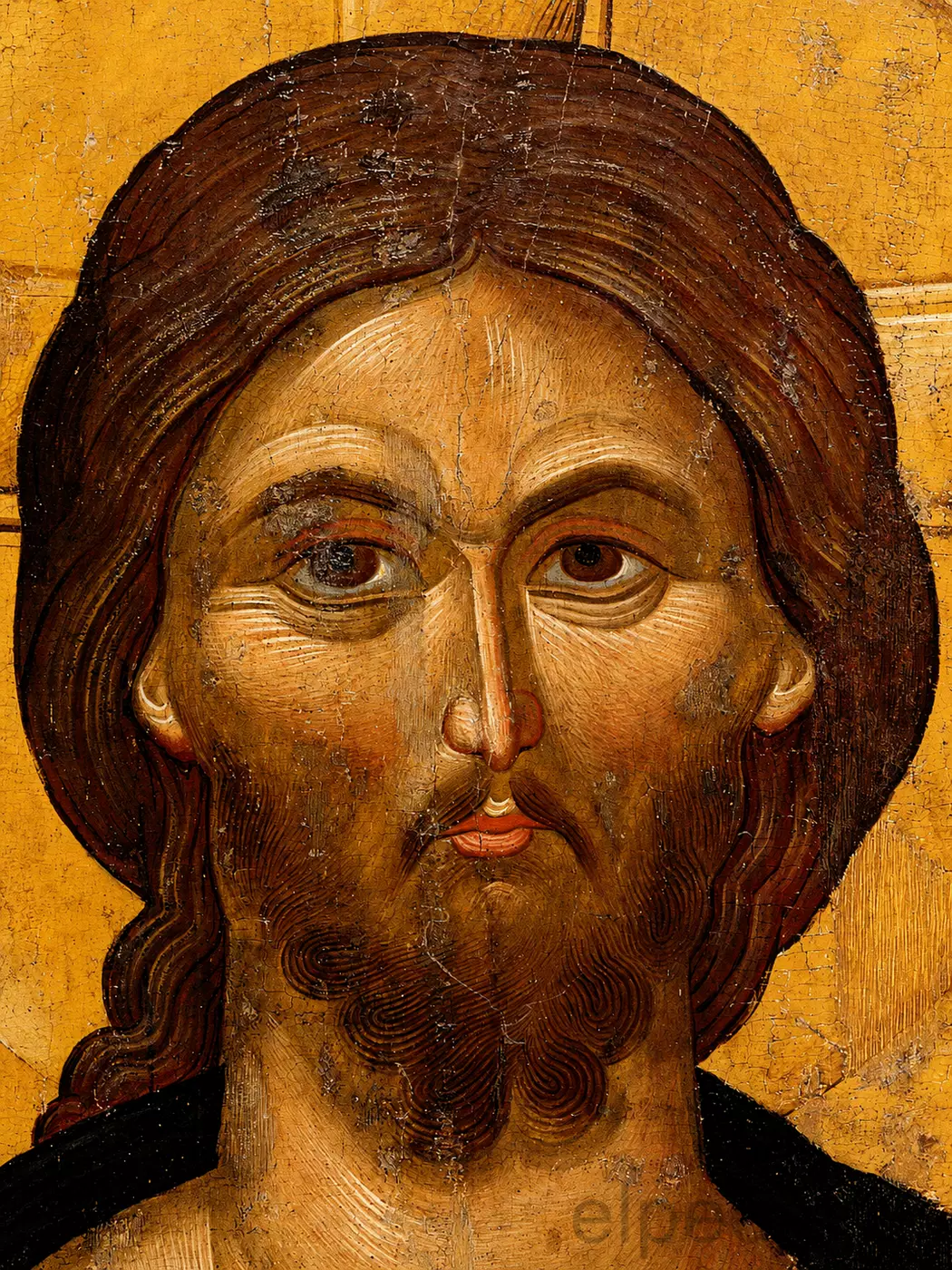
The Face of Christ in Close-Up
The coarse features of the figure, the prominent cheekbones, the thick, auburn hair parted in the middle and falling in soft waves on either side, compose a face strongly individualised for the standards of Byzantine art. The beard, of moderate length, ends low in small spiral curls, a detail one might read as the personal signature of the hand that painted it. The expression remains grave, without a trace of severity touching upon menace, yet without the tenderness one would meet in other types of Christ. Between these two poles, of severity and of tenderness, moves the whole Palaiologan iconography of Christ Pantocrator, each workshop giving its own emphasis.
How much, though, of this intensity proceeded from a conscious choice of the painter, and how much from the faithful copying of an older model, is a question that remains, in the end, open. What is certain is that the icon continues to stand, without the name of a painter and without a fully attested provenance, among dozens of kindred works of the same period, one more trace of a workshop that worked anonymously upon common, established models.
(Translated from the Greek text; translation by K. Pappas.)

