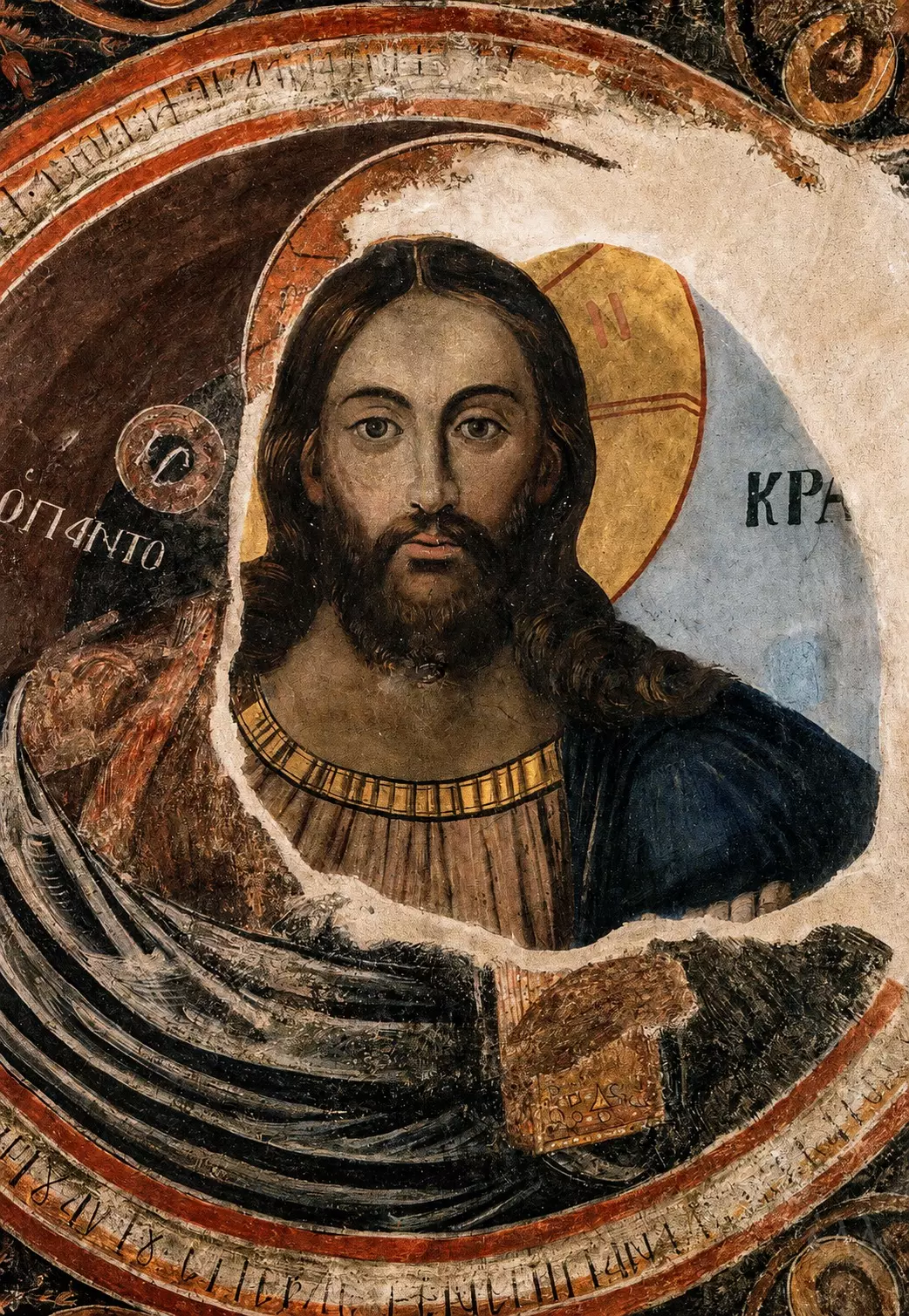
In the katholikon of the Monastery of the Forty Martyrs, located in Chrysafa of Laconia, a visitor who directs their gaze toward the apex of the dome confronts head-on the bust of Christ Pantocrator. This composition, in its present form, owes much to the brush of the Cretan hierodeacon Γεωργίου Καλλιτεράκη, who repainted the monument in 1879. However, the original painting dates back to 1620, when the painter Γεώργιος Μόσχος from Nafplio painted most of the church, as attested by the founder’s inscription on the narthex, written in his own hand. Between these two chronological layers—early 17th century and the latter quarter of the 19th—a representation of the Pantocrator has been shaped, with the face, hair, and much of the wardrobe showcasing more recent interventions, while the general arrangement, body position, and the closed Gospel remain faithful to the original design. The dome’s type, featuring the Pantocrator at the center, archangels in the immediately lower zone, and the Forerunner in a separate space, belongs to a long-standing tradition traversing the Middle Byzantine, Late Byzantine, and post-Byzantine periods, without losing its fundamental logic over the centuries. This iconographic schema, recognizable in dozens of monastic katholika throughout the Greek countryside, here garners particular interest due to the visible traces of two distinct hands, two eras, and two aesthetics.
## The Pantocrator of the Dome: Iconography and Inscription
The face of Christ occupies much of the composition, with hair parted in the middle falling symmetrically to the shoulders and a beard tapering gently into a soft, rounded line. The gaze is entirely frontal, with large, sunken eyes seeking direct contact with anyone standing below, while the eyebrows, slightly raised, lend the face a serious expression, devoid of harshness. Surrounding the head is the halo, a section of which preserves the vertical arm of the inscribed cross. In the upper left part of the image is the conventional monogram ΙC in a circle, while to the right are the letters ΚΡΑ, remnants of the word Παντοκράτωρ that once completed the entire inscription around the figure. Lower down, to the left, another fragment of text, now incomplete due to the deterioration of the plaster, reveals only a few letters.
The garment combines a dark, almost black mantle that covers the left shoulder and falls in dense, parallel folds, with a lighter-colored tunic adorned at the neckline with a wide golden fringe, decorated with vertical lines. At the bottom of the composition is the closed Gospel, bound in a metallic cover with embedded ornamentation, upon which a hand rests, fingers gently outstretched. The other hand, which in this iconographic type would be expected to be raised in blessing, is lost beneath the heavy folds of the mantle, which, at this point, spreads out into a broad, dark surface. The apparent absence of the member is explained by the customary convention of wall painting, where the artist preferred to conceal the extremity within the weight of the fabric rather than reveal it in detail.
The band that once fully encircled the medallion bore verses from David’s Psalm, where the Lord descends from heaven to see humankind (Ps. 13: 2), a text found in numerous domes since the Middle Byzantine period, particularly favored by the workshops of the brothers Μόσχος and Δημήτριος Κακαβά in the Peloponnese.
The Post-Byzantine Art of Moschos and the Repainting of 1879
This choice reflects precisely the local custom followed by Γεώργιος Μόσχος in his post-Byzantine painting, one of the two brothers from Nafplio, active in numerous katholika of Laconia during the early decades of the 17th century. Γεώργιος Καλλιτεράκης, of Cretan origin, studied at the School of Arts in Athens between 1868 and 1873, during a period when the masters sought to adapt religious painting to models related to the art of the Nazarenes, infused with a strong classicist spirit. In the depiction of the Pantocrator, as well as other areas of the church, the younger iconographer maintained the arrangement inherited from Μόσχος and restricted himself to repainting the faces and hands of the figures where the plaster had been damaged by an earthquake and fire, during the tenure of the abbot Παΐσιος Ζαχαρακόπουλος.
The conservation that followed many years later, between 1985 and 2004, removed part of the later interventions and allowed for a clearer distinction between the two different styles on the same surface, that of the 17th century beneath that of the 19th.


