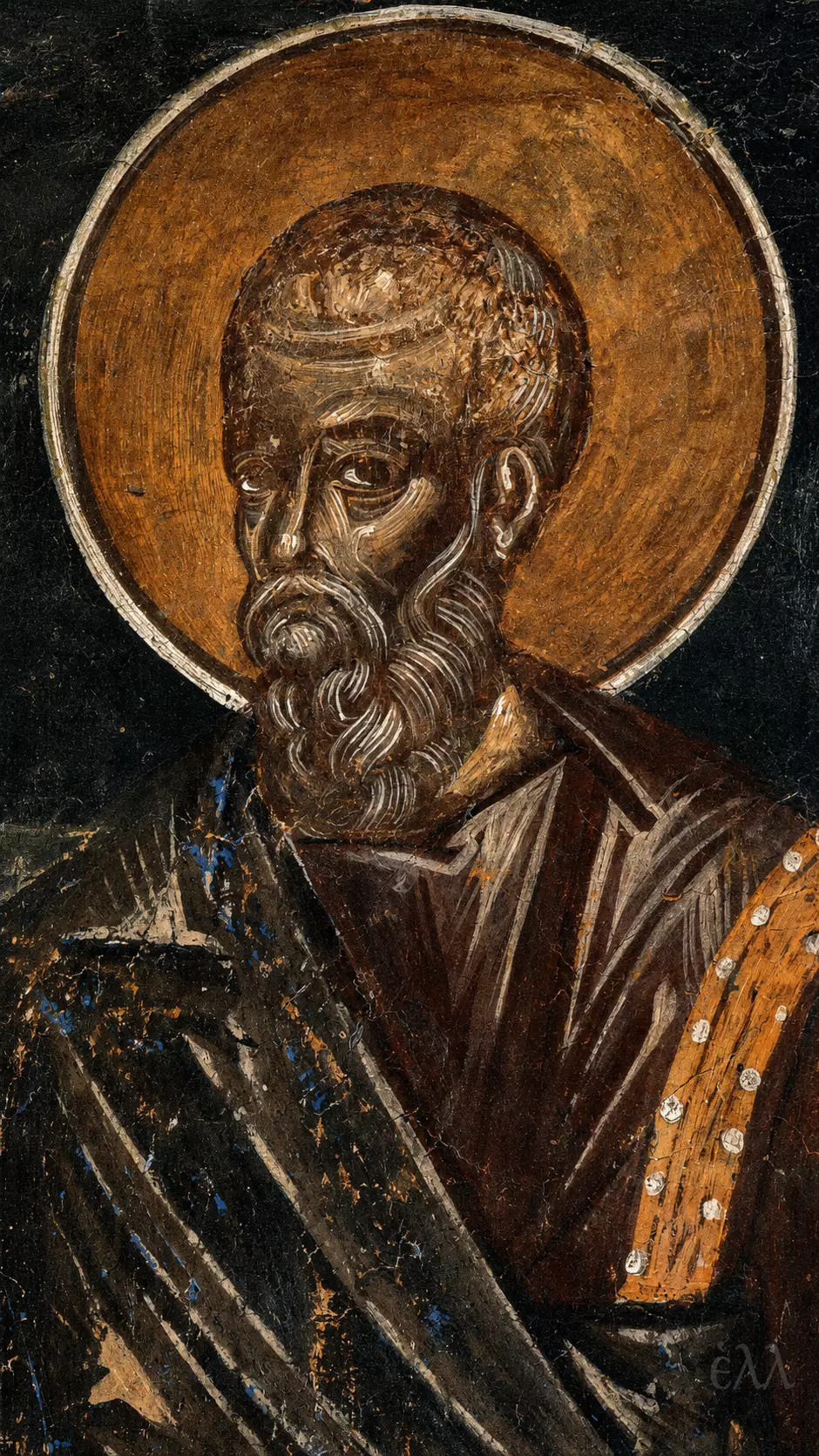
The painter Georgios Moschos rendered, in 1620, in the dome of the katholikon of the Monastery of the Holy Forty Martyrs, some eight kilometers from Sparta in the Chrysafa area, the figure of the prophet Zephaniah. He belongs to a series of Old Testament prophets occupying the fourth zone of the vault, depicted in pairs within round medallions against a deep, almost midnight background. The bust, with its heavy gaze and long gray-white beard, is presented here at chest width, without the hands or the scroll usually held by prophets in Byzantine and post-Byzantine iconographic programs. The face, furrowed with deep wrinkles and drawn brows, betrays a man who contemplates more than he proclaims.
The church in which the scene is integrated was built at the beginning of the 17th century, in a cross-in-square domed type known as Athonite, and Moschos, who came from Nafplio, undertook, as the dedicatory inscription of the church itself states, to paint almost the entire interior almost single-handedly. We know very little about the painter himself beyond his works. In Chrysafa, however, he left one of the richest iconographic ensembles in post-Byzantine Laconia, where the prophet Zephaniah holds a discreet, though not secondary, place among dozens of other figures of prophets, evangelists, and martyrs.
The fresco of the prophet Zephaniah: composition and technique
The golden halo, worked with broad brushstrokes of ocher, almost concentric, frames the head with a dark inner band and a white strip along the outer contour, a convention repeated in almost all the figures in the dome. Cracks run through the plaster around the forehead and above the shoulder, traces of four centuries of humidity and earthquakes that the region has not spared. The deep, almost starless darkness around the halo is a stable convention of the dome, where each figure seems to emerge from an absolute, timeless depth. The hair, short and sparse at the top of the head, is rendered with brief, curly strokes that allow the dark underpainting to shine through.
On the forehead, three or four white lines summarize, with stark economy, the wrinkles of an elderly man. The eyes, sunken beneath thick brows, glance obliquely, without meeting the viewer. The nose, long and slender, casts a faint shadow over the upper lip.
With rapid strokes of white, almost nervous, against a dark ground, the volume of the beard is built up, descending in curls that wind down строго all the way to the chest. A deep chestnut-purple tunic is visible on the chest, over which a gray-green mantle falls from the prophet’s right shoulder, with folds that are stiff and angular. On the left shoulder, a golden band with white dots, recalling pearls sewn into fabric, marks the edge of the inner garment.
The prophet Zephaniah, son of Cushi, lived in the 7th century BC, during the reign of Josiah, and the book that bears his name announces both the destruction and the salvation of Jerusalem. In dome iconographic programs he is usually accompanied, as here, by the prophet Ezekiel, though Ezekiel is not included in the portion of the composition presented here.
Post-Byzantine art in the dome of the Holy Forty Martyrs
Georgios Moschos, together with his brother Demetrios, ranks among the most important mural painters of the Peloponnese in the early 17th century, with works extending from Zakynthos and Poretzo to Chrysafa and Karya. Active at least from 1606 to 1638, the younger brother often worked alone, as he did in the katholikon of the Holy Forty Martyrs, where his art combines the robust, linear tradition of post-Byzantine painting with an expressive, almost improvised rapidity of brushwork.
The monastery had already been recognized as stavropegial before 1592, placed directly under the Ecumenical Patriarchate, and for centuries functioned as one of the most important spiritual centers of Laconia. It is built amid dense vegetation of holm oaks and cypresses, with steep rocks closing the horizon on almost every side, in a location that neither the earthquake of 1886 nor the fire of 1943 ultimately managed to alter radically. In 1879 part of the church’s fresco decoration was overpainted by the Cretan hierodeacon Georgios Kalliterakis, who intervened mainly in the faces of the hierarchs and in certain saints in the main church. The zone of prophets in the dome, where Zephaniah is located, appears to have preserved to a great extent the original painting surface from the 17th century. Systematic conservation of the frescoes was carried out between 1985 and 2004, under the supervision of the competent Ephorate of Antiquities, thanks to which the entire decorative ensemble is preserved today in remarkable condition.
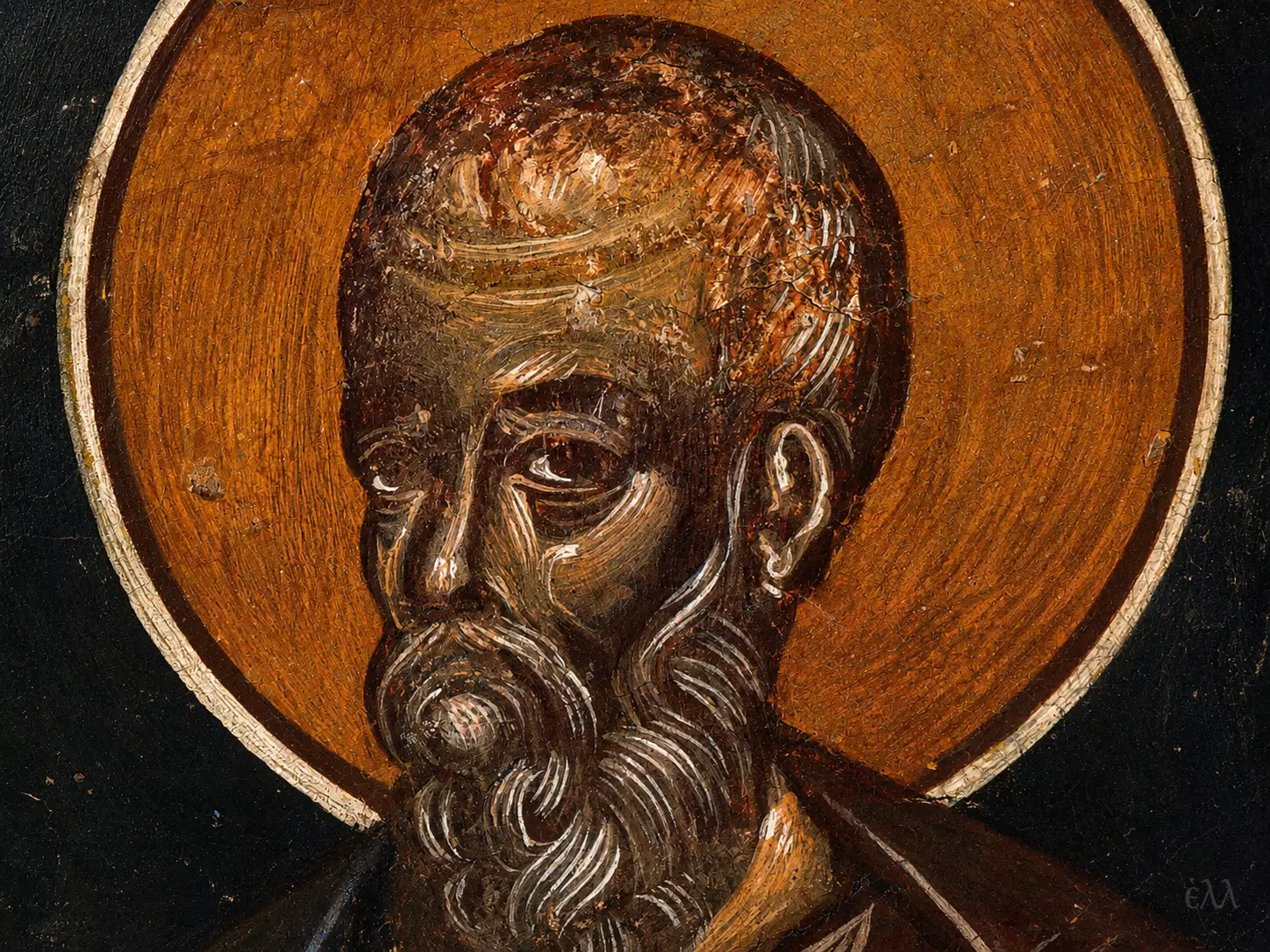
Detail: the prophet’s face
Seen in magnification, the surface of the plaster reveals what the general view conceals. The vertical cracks above the forehead run through the golden disk of the halo as well, while small areas of flaking paint around the ear allow the grayish underlayer of the mortar to show through in places.
Seen up close, the beard reveals the logic of its construction. Beneath the white, almost metallic highlight lines, the painter had laid down a uniform dark brown layer, over which he worked freely, without a predetermined outline for each curl. The ear, with its characteristic white contour emphasizing the cartilage, stands almost detached from the hair—a detail the painter clearly intended to distinguish.
In the depths of the eyes, where the paint has darkened further, one can still discern a trace of deep red, perhaps the residue of an earlier, more vivid tone that time and candle smoke have already managed to dull.


