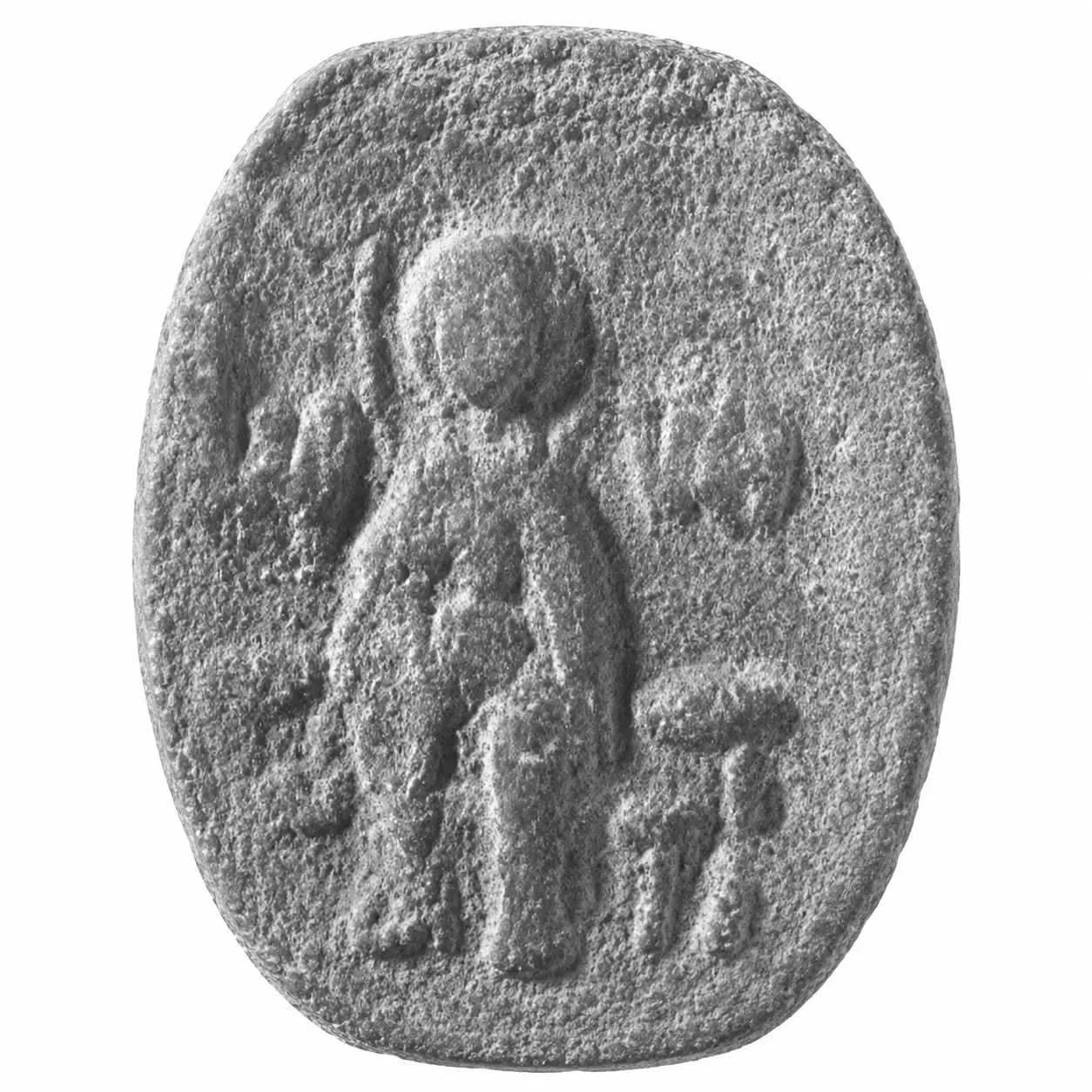
The Theodora Doukaina Palaiologina lead seal, dated to 1259–1282 and preserved in the Museum of Byzantine Culture in Thessaloniki, belongs to the imperial sigillography of the early Palaiologan period. Wife of Michael VIII Palaiologos, founder of the dynasty that ruled the Byzantine Empire after the recovery of Constantinople in 1261, Theodora was closely connected with the Vatatzes imperial house. She was the daughter of John Doukas and a grandniece of Emperor John III Doukas Vatatzes, in whose household she was raised. The seal entered the Museum as part of the Dimitrios Economopoulos Collection, one of the collections represented within its holdings of Byzantine lead seals.
On one face appears the Theotokos Platytera, presented frontally with Christ held centrally before her. The abbreviated inscription MP ΘY, placed to either side, identifies her as the Meter Theou, the Mother of God. Within the worn relief, the broad contours of the Virgin and the smaller figure of Christ remain visible, their strongly frontal arrangement adapted to the restricted circular field. The surface is extensively textured and abraded — individual features have softened, while the principal masses of halo, body and surrounding lettering remain legible.
Theodora Doukaina Palaiologina Lead Seal: Imperial Image and Inscription
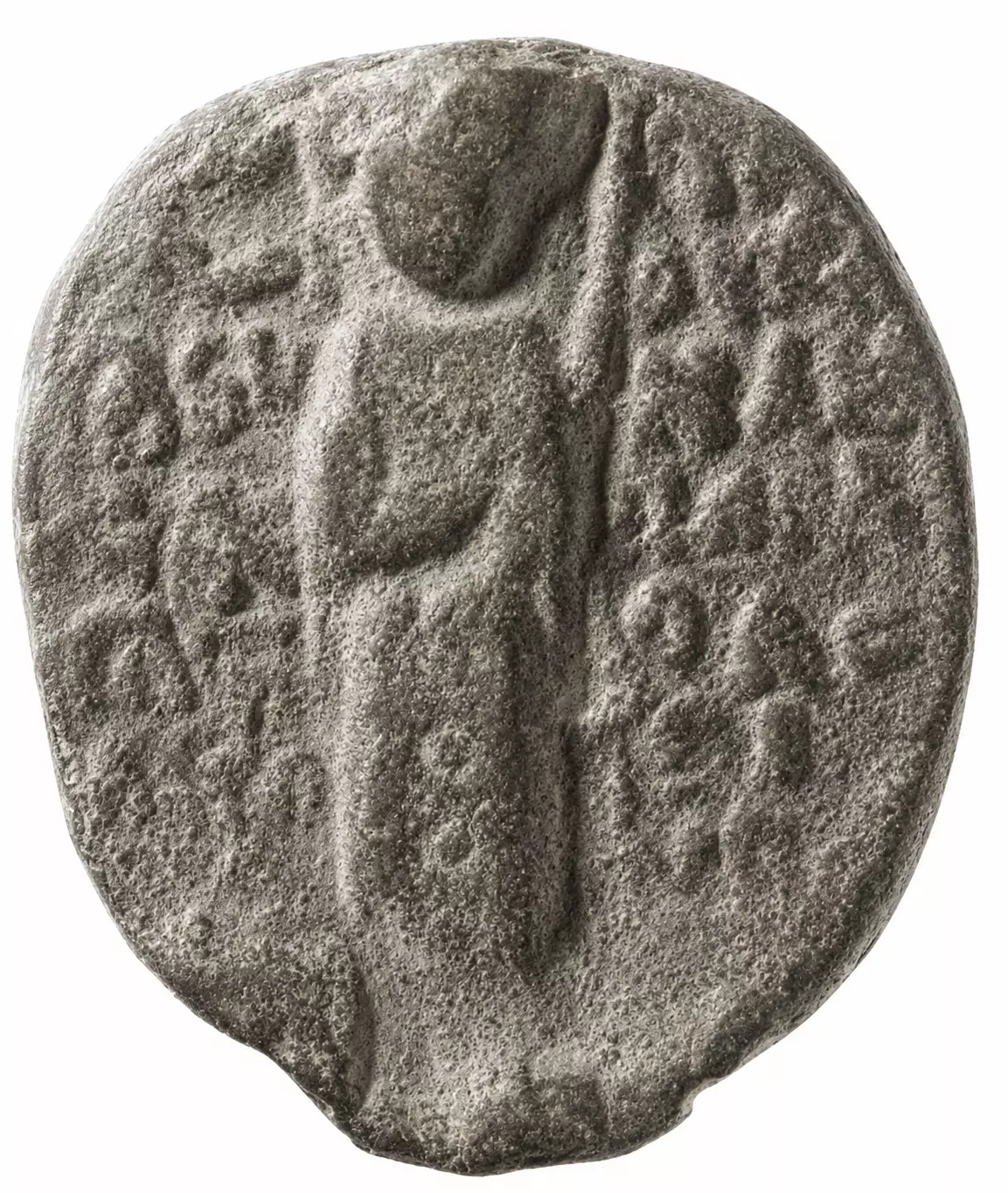
The reverse gives unusual prominence to the empress herself. Theodora stands frontally in courtly dress, crowned and enclosed between two vertical groups of Greek lettering, her figure occupying almost the full height of the field. A long garment descends in comparatively straight folds, while the upper body is articulated through compact, raised forms; comparable surviving impressions show her with one hand brought toward the breast and a sceptre held in the other. The image is severely compressed by the scale of the seal, with regalia, body and inscription forming a dense surface of relief.
With a notably full imperial titulature, the inscription identifies her: “Theodora Doukaina Palaiologina, most pious Augusta” (Θεοδώρα εὐσεβεστάτη αὐγούστα Δούκαινα ἡ Παλαιολογίνα). The title Augusta places her status explicitly within the language of sovereign authority. Beside that titulature, the sacred image on the opposite face links the owner of the seal with one of the most established Marian types of Byzantine visual culture, the frontal presentation lending the minute object a distinctly hieratic character.
Serving a practical administrative purpose, lead seals authenticated and secured Byzantine correspondence, while simultaneously carrying information about office, rank and personal identity. The Museum of Byzantine Culture describes such molyvdoboula as important primary sources for the administrative and ecclesiastical history of Byzantium. On Theodora’s seal, within only a few centimetres of relief, Marian iconography and the empress’s name, portrait and rank occupy the two opposing faces now preserved in the Dimitrios Economopoulos Collection in Thessaloniki.
(The translation was edited by P. Alexiou.)