The emergence of the hunting still life, or jachtstuk, in the middle of the seventeenth century marked a decisive shift in Dutch painting, moving away from the crowded, raucous market stalls of early Flemish masters toward images of calculated, aristocratic refinement. Willem van Aelst, born in Delft in 1627 to a family of respectable bourgeois standing—his father served as a notary—would become one of the most sophisticated practitioners of this highly specialized genre. After receiving his initial training from his uncle, the still-life painter Evert van Aelst, he traveled extensively, spending significant time in France and Italy before eventually settling in Amsterdam in 1657. By the time he executed the Willem van Aelst Still-Life with Hunting Equipment and Dead Birds in 1668, now housed in the Staatliche Kunsthalle in Karlsruhe, he had fully consolidated the elegant, highly finished visual language that secured his formidable reputation among wealthy urban elites.
Measuring 68 x 54 cm and painted in oil on canvas, the picture constructs a deliberate fiction of noble leisure. The right to hunt in the densely populated Dutch Republic was strictly regulated and largely reserved for the traditional nobility and a few powerful landowners. For the affluent patricians and wealthy merchants of Amsterdam who purchased such paintings, the imagery of the hunt functioned as an aspirational status symbol, a means of visually acquiring the trappings of a seigniorial lifestyle. Stripped of the blood and physical exertion of the actual chase, the dead game is rendered into an object of quiet, almost jewel-like aesthetic contemplation.
The Architecture of Illusion and the Suspended Trophy
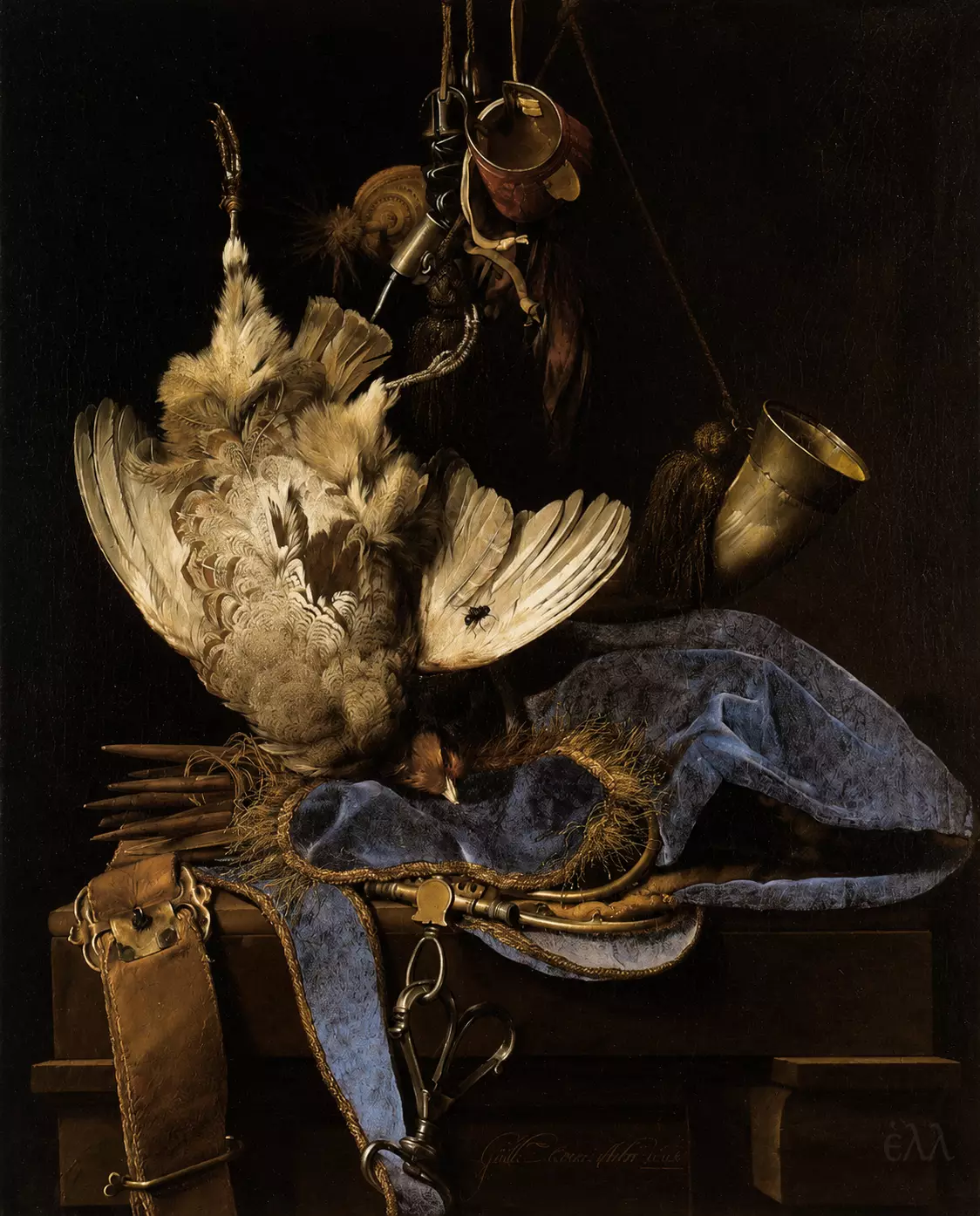
Against the deep, impenetrable shadows of the background, the brilliant white plumage of the suspended bird asserts an immediate physical presence. The composition is anchored by a solid, sharply illuminated stone ledge, a recurring structural device in van Aelst’s mature work that establishes the boundary between the painted illusion and the viewer’s physical space.
Its wings splayed open to reveal a soft, downy under-layer of feathers, the central game bird—likely a partridge—dominates the vertical axis of the canvas. The partridge hangs suspended by its right leg, the foot tightly bound by a thin cord that stretches upward into the darkness, attached to a complex arrangement of hunting implements. The partridge’s limp posture and the heavy slump of its neck register the physical reality of death, yet van Aelst ensures the carcass remains pristine, entirely free from visible wounds or blood. Behind this primary specimen, a second, smaller fowl with darker plumage is partially obscured in the shadows, creating a subtle recession of depth within the shallow niche.
Carefully arranged around the central trophy, the specialized instruments of the chase complete the narrative of aristocratic privilege. A polished hunting horn, crafted from horn or bone and adorned with a dark, heavy silk tassel, emerges from the gloom on the right side of the image. A sumptuous blue velvet game bag lies directly beneath the dangling quarry, resting flat upon the stone plinth. This pouch, heavily trimmed with intricate metallic gold fringe, spills over the hard edge of the stone. The wooden shafts of several hunting arrows or crossbow bolts are stacked horizontally beneath the rich textile, their sharp metal tips pointing towards the darkness on the left. Falling off the ledge and protruding dramatically into the viewer’s space on the left side of the image, a wide, worn leather belt equipped with a heavy brass buckle hangs vertically, a compositional counterweight to the upward pull of the hanging trophies.
Materiality, Color, and the Painter’s Craft
Willem van Aelst—whose mastery of surface texture remained largely unparalleled among his Amsterdam contemporaries—approached the hunting piece not merely as a record of dead game but as a rigorous exercise in optical refinement. He engineered his compositions to maximize the contrast between disparate materials, juxtaposing the dull, absorbent matte of the stone ledge with the cold metallic gleam of the brass buckle and the soft, light-catching pile of the velvet.
The color palette is deliberately restrained, organized around cool, silvery tones that characterize his most successful Amsterdam period works. The vibrant, saturated ultramarine blue of the velvet game bag acts as the primary chromatic anchor, drawing the eye downward from the stark, luminous whites and warm ochres of the partridge’s feathers. Van Aelst achieves the extraordinary softness of the feathering through a complex layering of glazes over a more opaque, carefully modeled underpainting, utilizing extremely fine brushwork to articulate the individual barbs of the plumes where they catch the raking light.
Resting upon the bright white down of the partridge’s left wing, a single black fly is rendered with startling, microscopic clarity. This insect, a classic motif of trompe l’oeil painting, operates on multiple interpretive levels. While it gestures toward the inevitable onset of decay—inserting a subtle memento mori into an otherwise pristine display of wealth—it functions primarily as a rhetorical boast of the painter’s mimetic skill. The fly is painted so convincingly that it appears to sit not upon the depicted feathers, but upon the actual surface of the support itself, challenging the viewer to brush it away.
Signature and Lasting Impact
Just visible on the sharply illuminated, chipped edge of the ledge, the artist has inscribed his signature and the date: Guill.mo van Aelst 1668. The use of the Italianized “Guillielmo” was a lifelong habit adopted during his highly successful tenure at the Medici court in Florence, where he worked for Grand Duke Ferdinando II alongside his compatriot Otto Marseus van Schrieck. By signing his works in this manner, van Aelst actively reminded his Dutch clientele of his prestigious international pedigree and his association with one of Europe’s most powerful ruling families.
The sophisticated interweaving of light and shade, the crisp linearity of the leather straps, and the sheer tactile plausibility of the fabric firmly establish the work within the highest echelon of seventeenth-century still-life production. Van Aelst does not ask the viewer to mourn the dead birds, nor does he focus on the violence of their capture. Instead, through the deliberate suppression of the background and the intense, almost theatrical lighting directed onto the center of the arrangement, he forces a sustained engagement with the raw materials of the physical world, transformed through the alchemy of oil paint into an enduring monument of domestic elegance.
(The translation was edited by N. Jones.)