
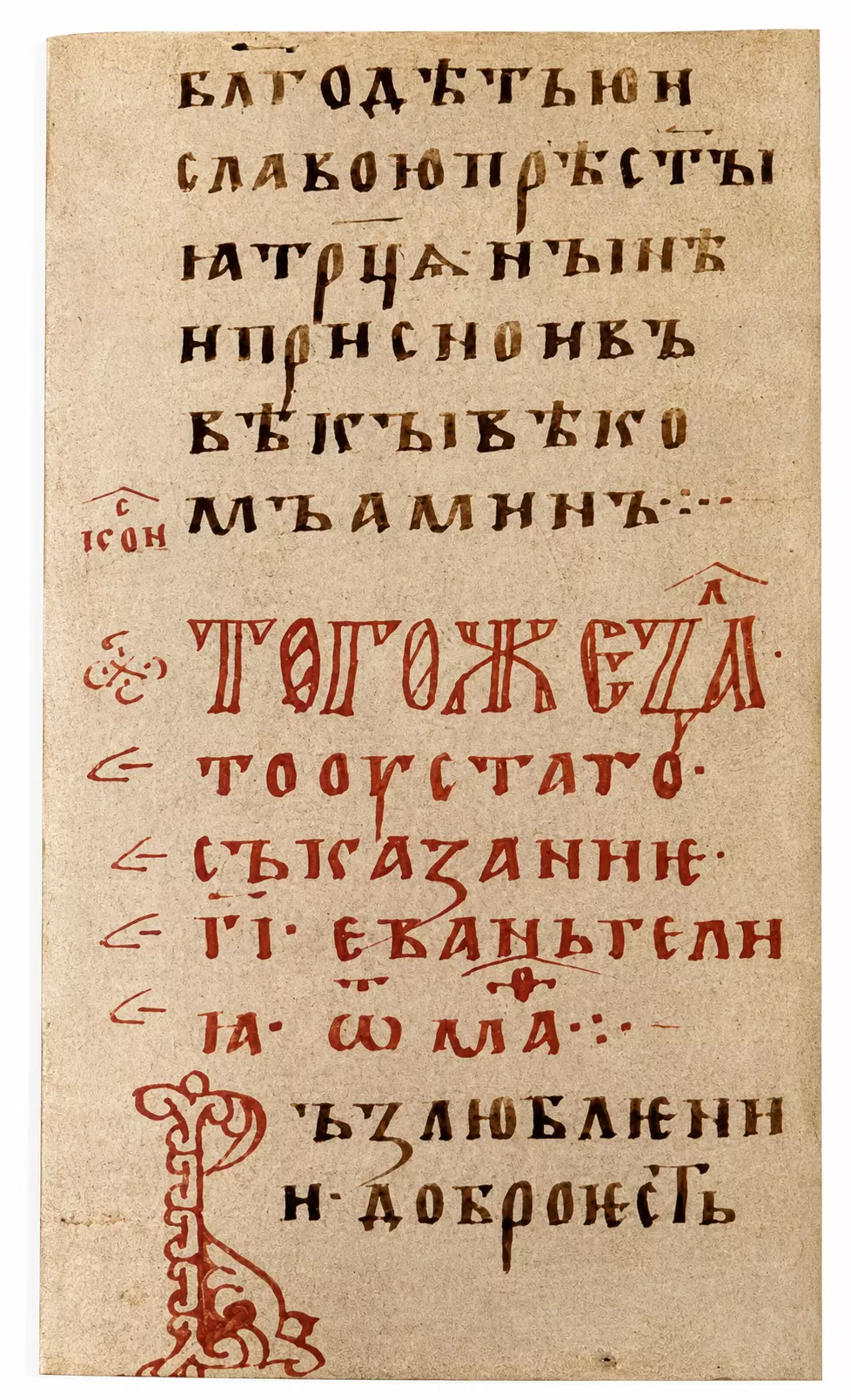
Slavonic Teaching Gospel Folio 106v belongs to GIM Syn. 262, the earliest surviving East Slavonic witness to the Teaching Gospel associated with Constantine of Preslav. The leaf brings together two distinct stages in the movement of a homiletic text. A closing passage in dark ink occupies the upper part of the column and ends with a doxology and Amen; beneath it, cinnabar assumes control of the page. Written in enlarged Cyrillic letters, an expansive rubric announces the following section, while an ornamental initial В descends into the left margin beside the opening words of the new discourse. Colour, scale and spacing make the textual transition immediately visible.
The older catalogue information supplied with the folio dated the codex to the late twelfth or early thirteenth century and tentatively connected its production with Vladimir or Rostov. The chronology has since shifted. The State Historical Museum’s current museum catalogue places GIM Syn. 262 in the first quarter of the twelfth century and gives Ancient Rus’ as its place of production; it records 265 parchment leaves measuring 39.5 × 31.3 cm. Roman Krivko’s linguistic study, approaching the codex from another direction, argues that its graphic, orthographic and phonetic evidence is consistent with the end of the eleventh or beginning of the twelfth century. Within the transmission of Constantine’s late ninth-century Bulgarian work, the manuscript consequently occupies an unusually early position.
Slavonic Teaching Gospel Folio 106v and the Cinnabar Initial В
The script of folio 106v is a formal Cyrillic ustav, built from broad, separated letterforms whose verticals and rounded bodies preserve considerable regularity without becoming mechanically identical. Across the upper portion, the dark writing has aged unevenly from black towards warm brown. Iron-gall ink is included among the writing materials recorded by the museum catalogue, and the varying density visible within individual strokes can therefore be understood as part of the material history of the manuscript rather than a deliberate polychrome effect. Abbreviated sacred and recurrent words are marked by titla, while points and grouped punctuation marks articulate the ends of textual units.
After the final Amen comes a considerable change of scale. The rubricator uses cinnabar for a heading written with much greater spacing; its letters are tall and comparatively narrow, with several developing elongated descenders or extended internal strokes. The red text includes the clearly legible съказание and a formula referring to the Holy Gospel, terminology characteristic of the interpretative sections of Constantine’s Teaching Gospel. The word sъkazanie carries the sense of an exposition or explanation, appropriate to a collection in which individual homilies combine introductory address with Gospel interpretation. Scholarship on the work has long treated Sъkazanie světaago evangelija as an important designation within Constantine’s textual practice, while more recent philological research continues to examine the Greek sources underlying the collection, including questions discussed in Palaeobulgarica.
Within the written page, rubrication performs an architectural function. The red heading occupies almost as much visual attention as the dark text above it, though its purpose remains practical: a reader moving through a dense homiletic codex can recognise the textual boundary at once. Several small cinnabar signs in the left margin reinforce the division of the rubric into successive lines. Beneath the central part of the heading appears a compact ornamental mark built around a circular form with short lateral extensions, small in scale against the predominantly vertical lettering.
Below this heading stands the initial В, its construction markedly different from the plain majuscule forms used for ordinary text. A narrow upright stem is accompanied by looping bands that fold inward, interlace and broaden into rounded terminals before continuing downwards into an elongated ornamental extension. At the bottom the curves become denser, forming a compact knot of red line before tapering into the margin. The decoration remains linear and vegetal rather than figurative, corresponding closely to the older Byzantine-derived ornamental vocabulary associated in the historical catalogue with the manuscript’s cinnabar initials.
Its placement is equally important. Displaced well to the left of the first dark letters, the initial extends across more than one textual line and belongs simultaneously to script and ornament. It supplies the first letter of the verbal sequence while establishing a conspicuous threshold between rubric and discourse. When the red initial is read together with the following dark letters, the opening can be recognised as възлюблении—“beloved”. Enlarged coloured initials of this kind allowed the scribe to establish hierarchy within a page without requiring either a headpiece or a miniature, and here the effect depends largely on the distance between the initial and the body of the text.
The parchment itself contributes to the visual organisation. Its pale cream surface is irregular in tone, with slight variations and traces of use visible around the writing. Against this field the cinnabar remains sufficiently saturated to separate the rubric and ornamental initial from the brown-black script, though the palette is restrained. Large areas of the support remain unoccupied by ornament, especially beside the main text, while decoration is concentrated around the transition from one textual unit to another.
Within Syn. 262 this economy has particular significance. The codex contains a substantially more ambitious figural miniature on folio 1v, whereas numerous later leaves depend upon rubrication and initials for their visual articulation. Folio 106v represents this quieter register of manuscript illumination, closely connected with the practical demands of reading. Continuity is carried by the ustav script; the textual hinge is marked in cinnabar, and the initial В, extending into the margin, gives the opening address an ornamental presence before the homily resumes in dark ink.
Free Translation of the Visible Text
The upper passage concludes with a conventional doxological formula which may be rendered freely:
“…by the grace and glory of the Most Holy Trinity, now and ever and unto the ages of ages. Amen.”
The cinnabar rubric then introduces an interpretative section of the Gospel. Its clearly recoverable sense is:
“Of the same [author]: an exposition of the Holy Gospel…”
Beneath it, the new discourse begins with the ornamental В followed by the dark script:
“Beloved and devout…”
The wording continues beyond the surviving excerpt, and a fuller reconstruction would require comparison with the corresponding critical text rather than conjecture from partially preserved letterforms. Within the visible passage, the sequence nevertheless remains clear: the preceding discourse closes, the rubric identifies the new textual section, and the enlarged initial introduces the address that follows.
(The translation was edited by D. Smith.)