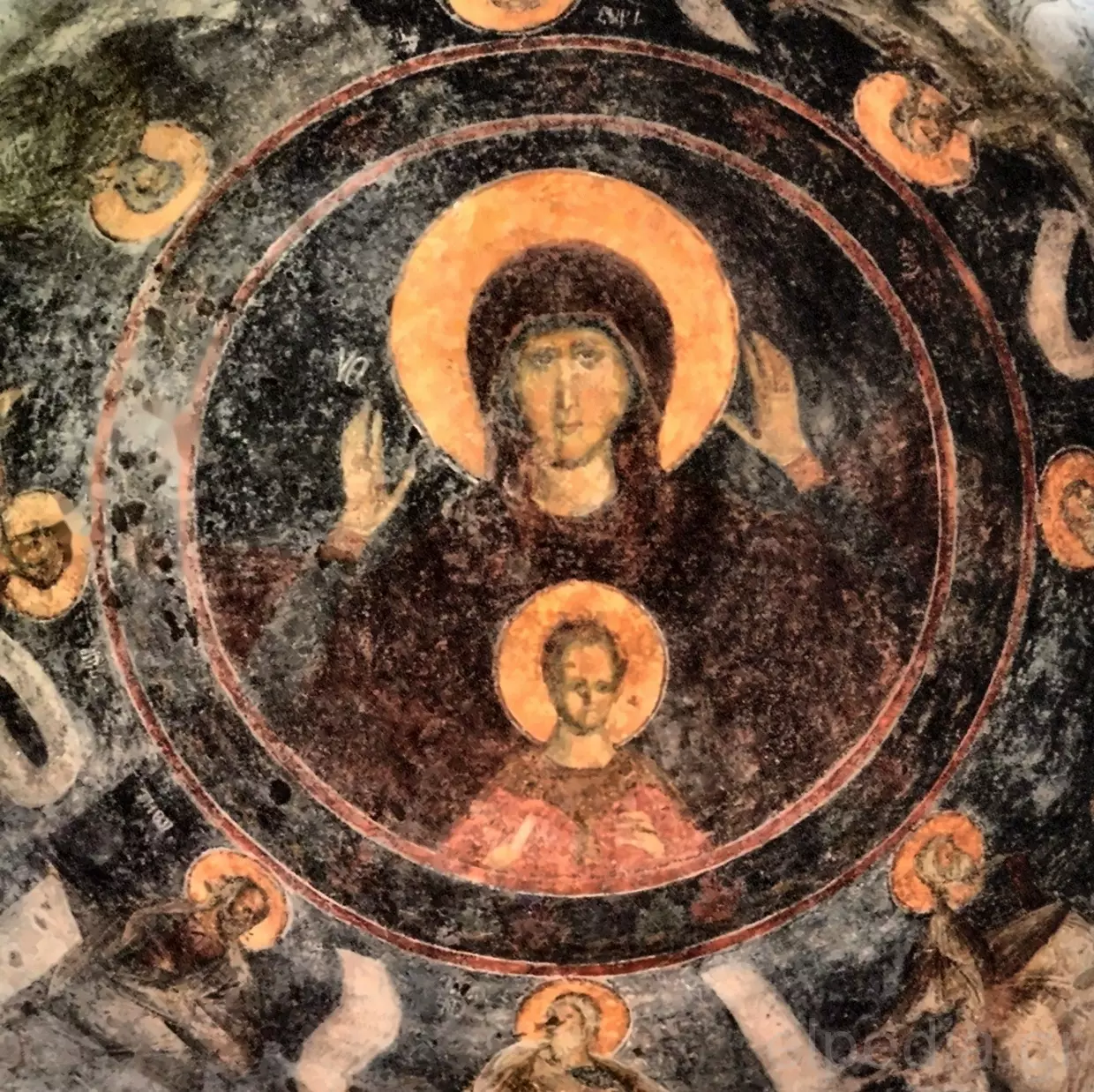
The Byzantine fresco of the Theotokos in Mystras occupies the dome of the western gallery of the Church of the Panagia Hodegetria, better known as the Aphentiko, the katholikon of the Brontochion Monastery. Painted in the early fourteenth century, within the great decorative campaign associated with the foundation of the church by the hegoumenos Pachomios, the image belongs to one of the most ambitious surviving programmes of Palaiologan monumental painting in the Peloponnese, and scholarship has long recognised the Hodegetria’s paintings as an especially accomplished ensemble of the period. The Virgin appears frontally, her arms raised in an orant gesture, while the Christ Child is set before her at the level of the breast; around this central image, concentric framing and subsidiary sacred figures extend the composition across the curved surface of the dome.
Its architectural setting is unusually important. The Hodegetria was conceived as a two-storey church: a three-aisled basilica below and, above, a five-domed cross-in-square arrangement with galleries. This combination, generally known as the “Mystras type”, created a complex hierarchy of spaces and surfaces capable of carrying distinct but interconnected iconographic groups, so that the western gallery dome does not function as an isolated field: its image of the Theotokos belongs instead to a larger system in which the Virgin, Christ, prophets, ancestors, apostles, bishops, saints, Gospel episodes and liturgical themes are distributed through the building according to theological and spatial relationships.
Byzantine Fresco of the Theotokos in Mystras: Iconography and Palaiologan Context
At the centre of the small dome the Virgin is given an emphatic, almost architectural stability, her raised hands opening the figure laterally while the vertical axis passes through her halo and the figure of Christ, producing a centralized composition adapted to the circular field. The iconography differs from the Hodegetria type after which the church is named. Because the dedication of a church and the iconographic type of an individual representation need not coincide, the distinction carries real weight here: rather than holding the Child on one arm and gesturing toward him with the other, the Theotokos assumes the ancient orant posture, Christ appearing before her body in a manner especially fitting for a programme centred on the Incarnation.
The figures surrounding the Virgin belong to a broader genealogical and prophetic conception: in the gallery decoration of the Aphentiko, prophets, kings and righteous ancestors of Christ participate in a visual account of sacred history, and the domed spaces in particular carry much of the weight of Christ’s genealogy. Their presence around a Marian image makes the logic of the programme immediately intelligible, since the Old Testament figures precede the Incarnation historically, yet in the painted church they are gathered around its fulfilment, the dome compressing chronology into a single visual order that binds prophecy to the Virgin standing at its centre.
This emphasis was not accidental in the foundation of Pachomios. A monk of considerable standing, he held the office of megas protosynkellos and secured substantial privileges for the monastery from Andronikos II and Michael IX. The church was founded before 1309 and completed before Pachomios’s death in 1322; other archaeological accounts place the principal construction campaign around 1310. Painted copies of imperial chrysobulls, donor imagery and carefully differentiated chapel programmes reveal a foundation in which institutional ambition, monastic identity and sophisticated theological planning were closely connected. Pachomios also appears in his funerary chapel presenting a model of the church to the Theotokos, a donor image that gives unusually concrete form to his role in shaping the monument.
Constantinople is present throughout the Aphentiko without reducing its paintings to provincial imitation, since the architecture adopts features associated with the capital and scholarship has likewise recognised Constantinopolitan affinities in the wall paintings. At least two painters appear to have participated in the early decorative campaign: one stylistic current, especially visible in parts of the narthex and the funerary chapel of Pachomios, has been compared with the elegant, classically informed painting of the Chora Monastery, while another is more dynamic in its handling of colour and light — evidence that the decoration was a coordinated undertaking rather than the work of a single pictorial temperament.
The Theotokos in the western dome belongs to that larger climate of Palaiologan painting, in which inherited iconographic structures could be made visually supple without losing their doctrinal precision. The circular framing gives the central figure a hieratic clarity, yet the surrounding figures keep the image from settling into anything static, multiplying the directions in which it can be read: the eye moves from the Virgin and Child outward into prophecy and genealogy, then, by way of the architecture, toward the other parts of the programme, so that the painted surface works simultaneously as image and as passage between spaces.
Such integration was made possible by the unusual architecture of the Hodegetria. The lower basilican level establishes a longitudinal movement, whereas the upper galleries and domed cross-in-square system introduce a more centralized spatial rhythm. The result has often been related to contemporary Constantinopolitan architecture. Its importance for Mystras is clear from its later reuse in the Pantanassa and in the remodelled Metropolis. Even more revealing is the transmission of the Hodegetria’s iconographic organisation: roughly a century later, the Pantanassa adopted important elements of its programme, including the placement of the Virgin in the dome of the western gallery.
The surviving painting is damaged, and this loss inevitably alters the balance of the ensemble. Yet the principal idea remains legible. Within a church dedicated to the Hodegetria, the Virgin in the western gallery is presented through another Marian formula, one that places the mystery of the Incarnation at the centre of a prophetic and genealogical field. Around her, the ancestors and witnesses of sacred history do more than provide a decorative circumference. Their arrangement binds the dome to the intellectual structure of the church, while the figure of the Theotokos, frontal and prayerful, becomes the point through which an expansive programme is gathered into a single image.
(The translation was edited by A. Orfanos.)