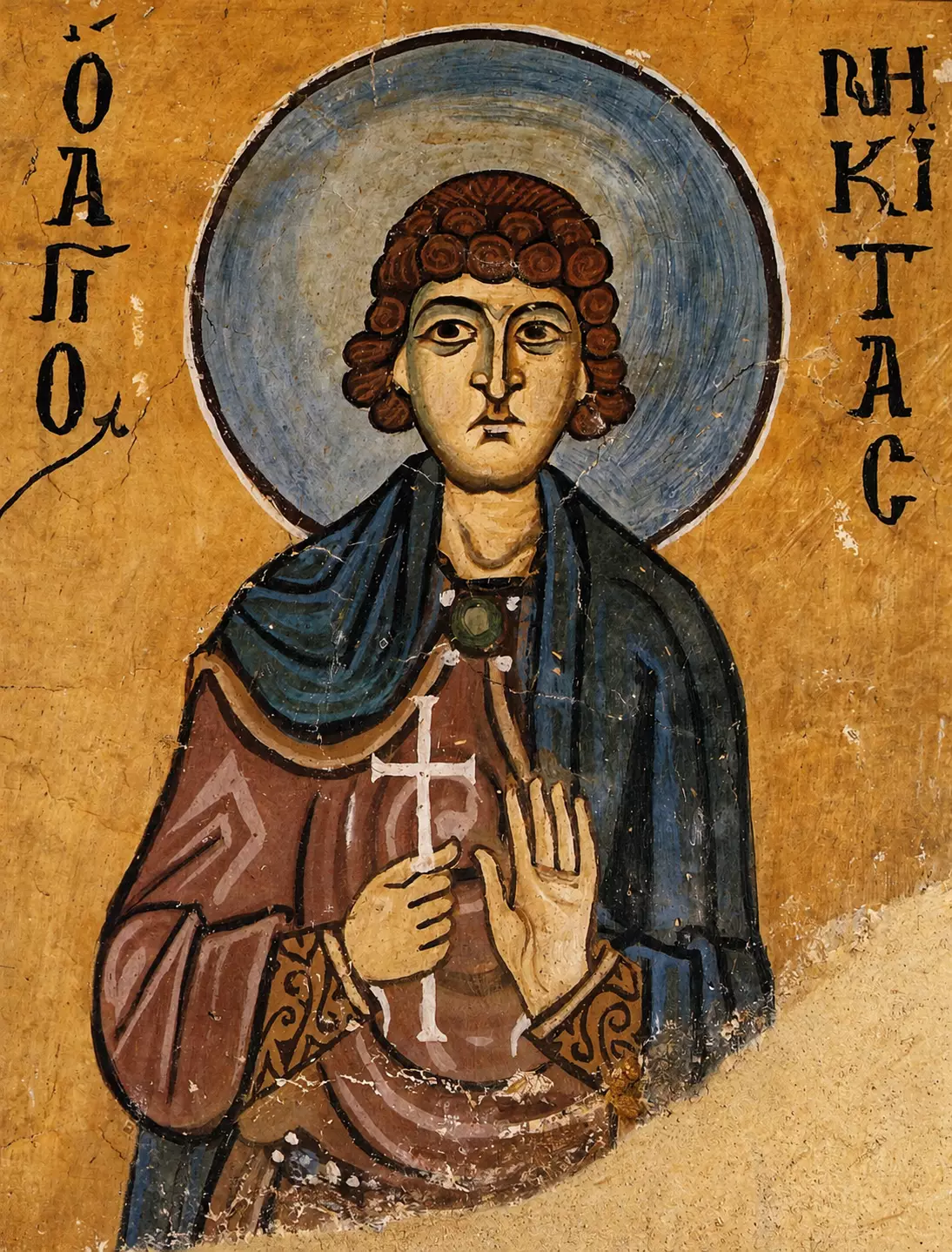
Surviving the passage of a millennium within the katholikon of the Holy Monastery of Hosios Loukas in Boeotia, a profound image of holy martyrdom commands the viewer’s attention. The Saint Niketas fresco at Hosios Loukas exemplifies the austere, spiritualized aesthetic that dominated monumental decoration in eleventh-century Greece. Executed by an anonymous master, the young saint is rendered in a bust-length format against a saturated ochre background—an economical but visually striking substitute for the shimmering gold ground typical of imperial mosaic programs. Framed by a pale blue nimbus, the figure projects an imposing, unbroken stillness. His presence belongs to an expansive theological vision that sought to integrate the architecture of the church with the heavenly hierarchy, surrounding the monastic congregation with a silent, ever-present cloud of witnesses.
Iconographic Structure and Vestments
The saint, in a compositional choice that demands immediate veneration while establishing a direct psychological connection with the observer, assumes a rigorously frontal stance. This strict bilaterality strips the figure of casual, earthly movement, anchoring him permanently within the sacred space. Niketas is clothed in the refined attire of a nobleman or court official, a notable departure from the heavy, scale-armor-clad military saints frequently found in later Byzantine iconographic cycles. He wears a warm, reddish-brown tunic, adorned at the wrist with a prominent gold-ochre cuff that bears delicate, geometric embroidery. Over this foundational garment, a dark blue chlamys drapes heavily across his shoulders. The mantle is fastened centrally at the chest by a circular green gemstone set within a modest metallic mounting, a single point of tension anchoring the sweeping folds of the fabric.
The chromatic contrast between the earthy reddish-brown and the deep, muted blue generates a visual gravity, weighting the lower half of the composition. The folds of the chlamys are delineated with thick, dark lines, rejecting naturalistic volume in favor of a flat, schematic rhythm that acknowledges and respects the two-dimensionality of the masonry surface.
In the saint’s right hand rests a white martyr’s cross, the thin vertical shaft resting gently between his long, stylized fingers. The stark white of the cross creates a sharp tonal contrast against the dark garments, immediately drawing the eye to the instrument of his martyrdom and salvation. Conversely, his left hand is raised before his chest, the palm exposed outward toward the viewer. This specific gesture carries profound symbolic weight in Eastern Christian art; it serves simultaneously as a declaration of steadfast witness, a sign of ascetic purity, and an emblem of virginity. To the left and right of the vivid blue halo, painted black majuscule inscriptions—O AΓIO C and NH KI TAC—unambiguously identify the youth. The lower right section of the composition reveals a jagged expanse of exposed plaster, a physical scar attesting to the fragility of the Middle Byzantine wall painting tradition.
Physiognomy and Linear Execution: Detail Analysis
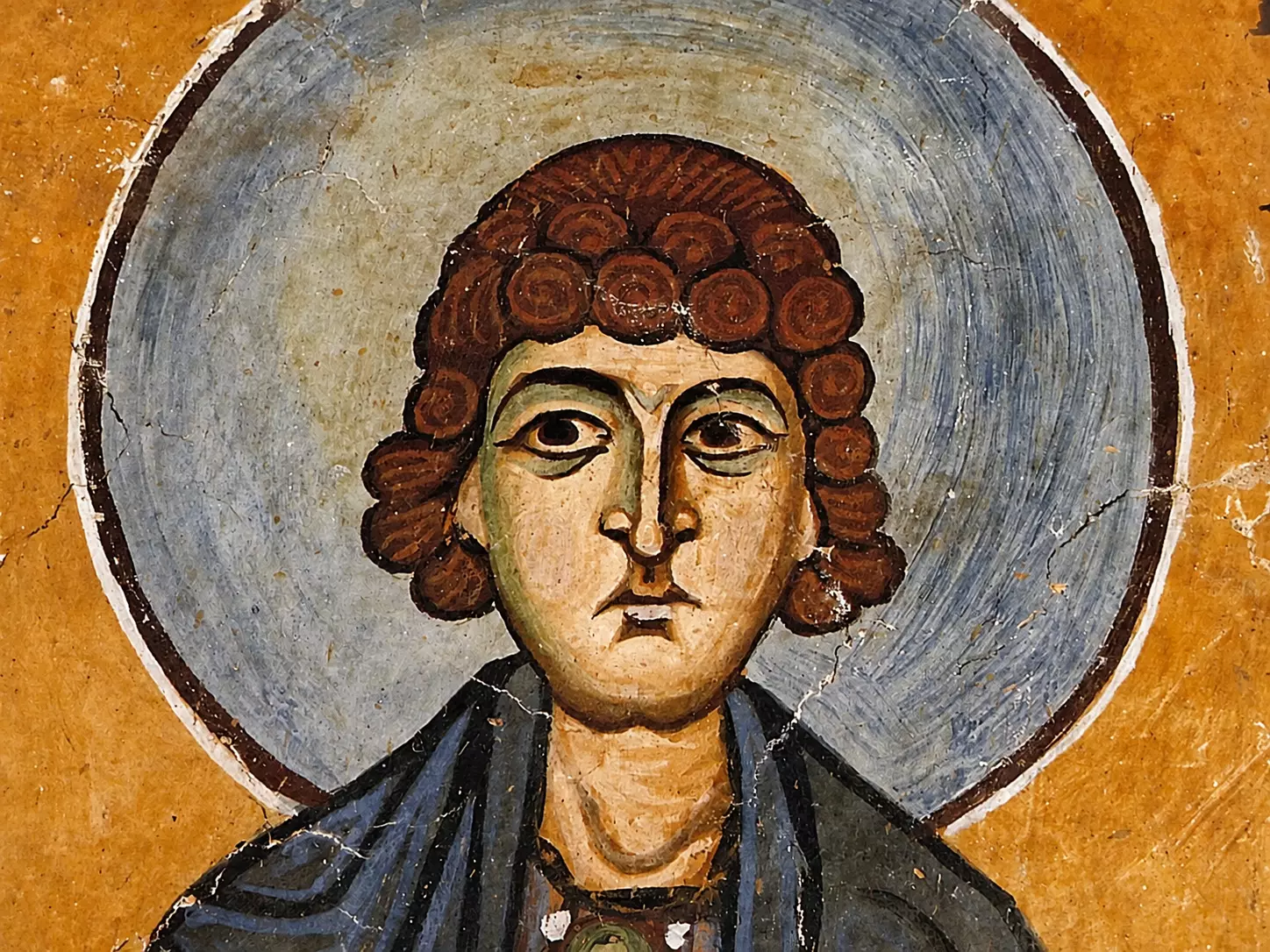
The technical mastery of the eleventh-century painter becomes strikingly apparent in the treatment of the saint’s head. The facial modeling relies heavily on the application of proplasmos—a dark green earth underpainting—which remains deliberately visible along the jawline, pooling in the shadows around the deep-set eyes, and framing the straight, narrow nose. Over this cool, recessed foundational layer, the artist applied warm flesh tones, building volume sequentially through decisive, linear highlights.
The eyes are oversized, their dark pupils suspended beneath thick, dramatically arched eyebrows that curve smoothly into the bridge of the nose. These pronounced ocular cavities were designed to capture the dim, fluctuating light of the church interior, animating the visage with an intense, haunting vigilance.
It is perhaps the saint’s hair that constitutes the portrait’s most captivating stylistic feature. Rendered as a tight, rhythmic cap of chestnut spiral curls, it frames the high forehead with absolute geometric precision. Each individual curl is articulated with concentric strokes of darker pigment, creating a textured pattern that feels almost sculptural, echoing late antique relief carving adapted to a two-dimensional medium. This stylized coiffure, combined with the heavily outlined eyes and the small, pursed mouth, strips the face of transient human emotion. The gaze is fixed and contemplative, directed entirely outward into the divine sphere.
Such linear abstraction is a hallmark of the frescoes of Hosios Loukas, reflecting a monastic era that prioritized the dematerialization of the physical body to reveal the inner, incorruptible spirit. The master who painted Niketas achieved a delicate equilibrium, wielding strict conventions to project a profound vitality that continues to resonate through the heavy stonework of the sanctuary.
(The translation was edited by D. Manou.)