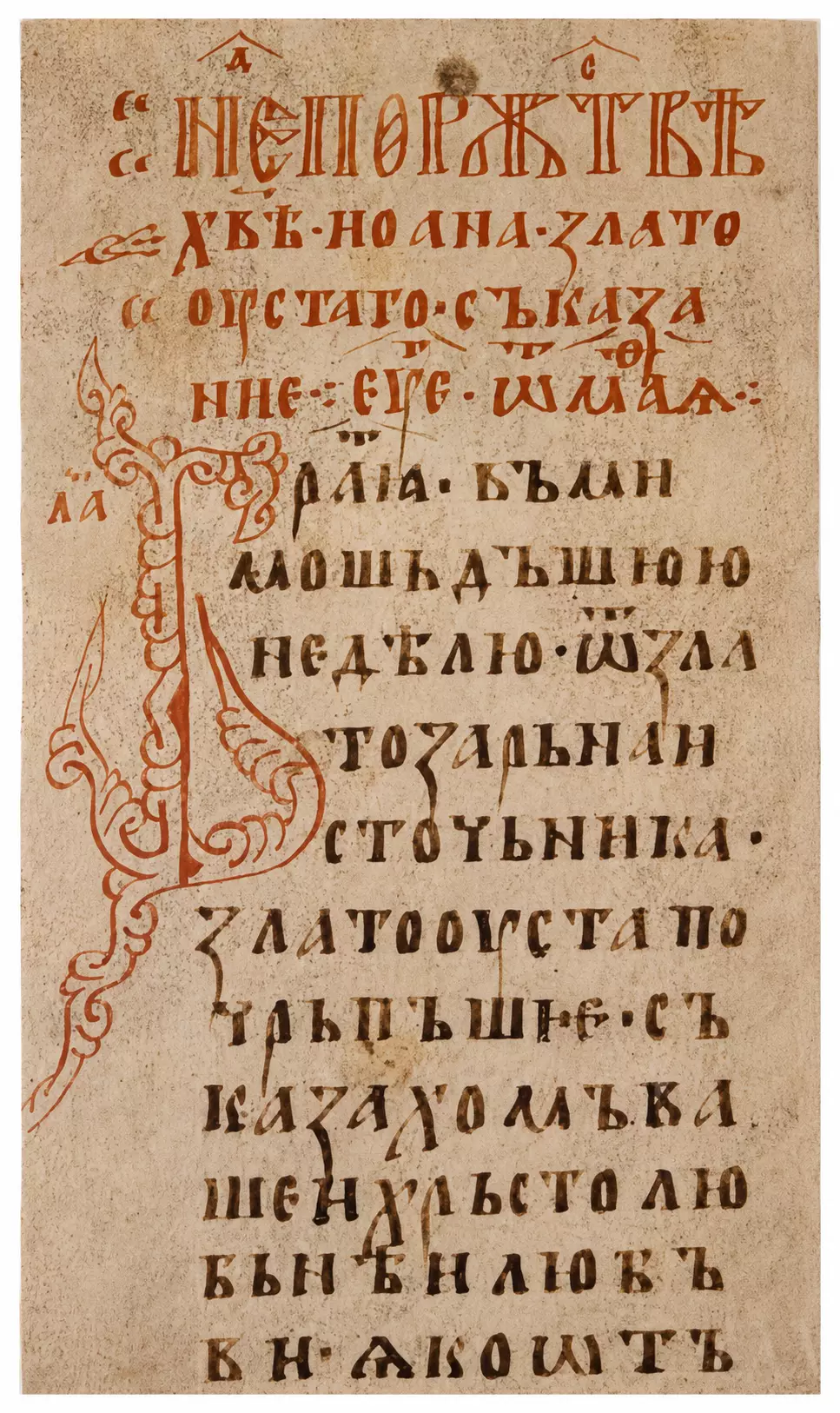
Teaching Gospel folio 182 belongs to GIM Syn. 262, the earliest surviving manuscript witness to the Teaching Gospel associated with Constantine of Preslav. The parchment leaf is dominated by an unusually elongated ornamental initial Б, drawn in cinnabar and extending down the left side of the written area, while a large red rubric above it establishes a second, more monumental level of script. Dark brown-black Cyrillic ustav carries the homiletic text below. Decoration, textual organisation and evidence concerning the people who copied the codex all meet within this relatively small area of parchment.
The manuscript’s date requires some caution. The older catalogue information supplied with the codex placed it at the end of the twelfth or beginning of the thirteenth century and tentatively associated its production with Vladimir or Rostov. Elena Ukhanova’s palaeographical work subsequently argued for a considerably earlier chronology, while the State Historical Museum currently describes Syn. 262 as a manuscript of the first quarter of the twelfth century. Linguistic evidence later reopened the question: Krys’ko and Mol’kov proposed the second half of the twelfth century, a dating adopted in some recent scholarship. Roman Krivko, in his detailed study of the manuscript, discusses both the early palaeographical assessment and the archaic linguistic features preserved by the codex. The chronology therefore remains debated within a range extending across much of the twelfth century.
Teaching Gospel Folio 182 and the Cinnabar Initial Б
Across the upper portion of the leaf, rubrication changes the visual register before the new discourse properly begins. Broader than the letters of the main text and more openly spaced, the cinnabar characters have tall verticals and emphatic angular terminals. Within the heading, the name of John Chrysostom is discernible, followed by wording identifying an exposition or interpretation of the Gospel. This corresponds closely to the literary construction of Constantine’s Teaching Gospel. Its fifty-one homilies explain the Sunday Gospel readings of the ecclesiastical year, drawing extensively upon Greek exegetical compilations. Much of this material, modern research has shown, passed through Byzantine Gospel catenae containing excerpts from writers including John Chrysostom and Cyril of Alexandria; Constantine shaped translated exegetical passages into Slavonic homilies and supplied introductory or concluding material of his own. Recent research has refined several of the traditional patristic attributions preserved in manuscript headings.
Below the rubric, the ornamental Б is conceived on a scale quite different from that of ordinary script. Its long upright descends beside several lines of text, while the body of the letter opens into curling extensions resembling interlaced leaves or hooked vegetal forms. Some passages remain as fine cinnabar outlines; elsewhere the pigment is dense and opaque, especially along the narrow vertical shaft and the pointed lower compartment. Beyond the normal rectangular limits of a written character, the ornament reaches into the margin. A long tendril drops down the left side and bends sharply back towards the text, smaller scrolls gathering around the upper portion of the initial. The geometry of the principal vertical remains disciplined even as the surrounding ornament becomes markedly asymmetrical.
Such initials belong to the decorative vocabulary described in the older catalogue under the broad historical designation “Old Byzantine”. The label is imprecise by current art-historical standards, although the connection it records is useful: patterns familiar from Byzantine manuscript decoration are adapted here to a Slavonic context of monumental Cyrillic writing. The visual function of the initial is architectural on the page. By enlarging and elaborating the first letter of the discourse, the rubricator creates a strong boundary between the cinnabar heading and the continuous text that follows.
Formal Cyrillic ustav forms the main script. The letters stand separately, with strongly defined vertical strokes, relatively broad bodies and an alternation between rectilinear and rounded forms. Several characters rise close to a common upper line, though the rhythm varies sufficiently to avoid mechanical regularity. Superscript signs and titla interrupt that line at intervals; abbreviations compress familiar words while retaining the spacious character of the writing. Word division follows medieval scribal practice rather than modern segmentation, and punctuation consists principally of small points and related signs placed within the line. In several places the dark writing medium has aged towards brown. Its precise composition cannot be determined from appearance alone, whereas the red pigment employed for the headings and initials is identified in the manuscript documentation as cinnabar.
The parchment remains conspicuous beneath both colours. Across its warm, pale surface are mottled passages, stains and areas of irregular tonal density, with some dark characters markedly stronger than their neighbours and others reduced in intensity. Cinnabar retains much of its visual force. Against a support whose colour and texture alter from one part of the leaf to another, the repeated forms of the ustav acquire a slightly shifting rhythm despite the discipline of the hand.
More unusual is the evidence concerning the scribe himself. On the side margin of folio 182, the older catalogue records a small cinnabar note written by the same hand responsible for another annotation on folio 169. Its abbreviated wording is transcribed as “Михаилъ пъп(ови)ць пс(а)лъ 3”. The fuller note on folio 169 supplies the missing sense: Mikhail, popovich—literally the son of a priest—had written three quires. Brief and visually subordinate beside the much larger ornamental initial, the annotation is nevertheless important for the material history of the codex. An individual copyist appears within the manuscript record, identifying himself and the extent of his labour.
The note also belongs within the more complicated palaeography of Syn. 262 as a whole. Ukhanova distinguished numerous scribal hands in the manuscript; Krivko’s analysis discusses thirteen scribes and stresses its unusually archaic graphic and orthographic features, including the preservation of a particularly rich system of early Cyrillic characters. Those observations concern the complete codex and cannot simply be assigned to every individual leaf. On folio 182, however, the broader palaeographical argument acquires a specific point of reference through Mikhail’s annotation and the visible work of a copyist within a large collaborative manuscript.
The opening in dark ink begins unmistakably with Братия, “Brothers”, the ornamental initial itself supplying the first letter. The following lines refer back to the preceding Sunday and explicitly invoke Chrysostom as a source. Such movement from one Sunday’s instruction to the next belongs naturally to a collection organised around recurring Gospel readings. Here the transition is registered visually before it is fully apprehended through the text: the red heading, the monumental Б, then the darker lines beginning with the direct address to the audience.
Free Translation of Folio 182
Rubric: “…of Saint John Chrysostom. An exposition of the Gospel…”
Opening text: “Brothers, on the preceding Sunday, drawing from Chrysostom, we set forth the teaching to your Christ-loving assembly. In the present Sunday…”
The surviving wording continues beyond the portion securely recoverable from this leaf, so the translation follows the sense of the visible opening without expanding abbreviated or uncertain readings into unsupported text.
On folio 182, the hierarchy of cinnabar rubric, monumental Б and dark ustav makes the structure of the homily immediately legible. The ornamental vocabulary situates the leaf within early Slavonic book art, while the marginal annotation preserves a much more personal element in the history of its production. Byzantine exegetical authority is present as well: Chrysostom’s name appears prominently in red before his teaching passes into a Slavonic discourse addressed directly to Братия, “Brothers”.
(The translation was edited by E. Wilson.)