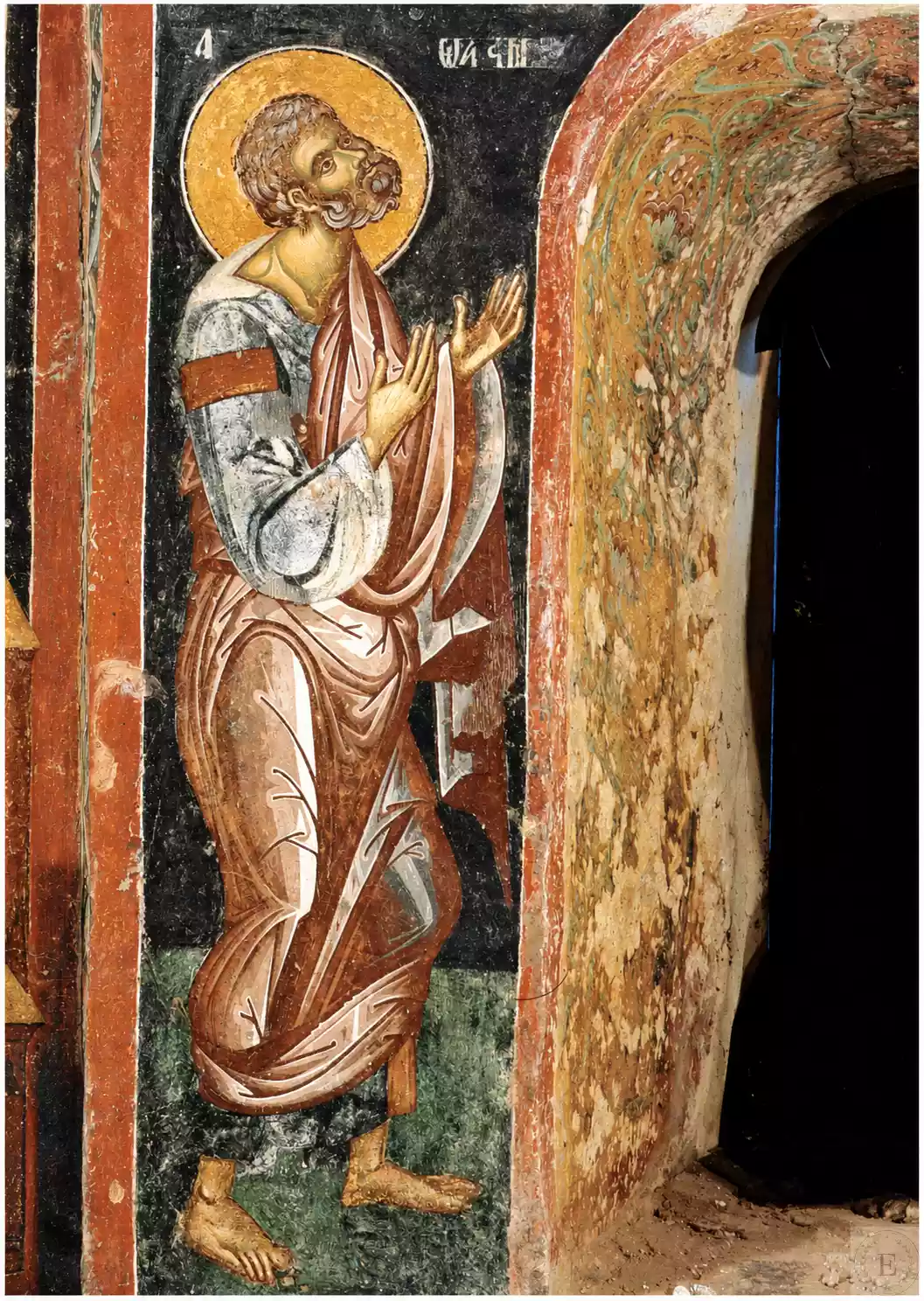
 Joachim, Ancestor of God. Katholikon of the Pantanassa Monastery, Mystras, 15th century.
Joachim throws his head back so abruptly that his face is seen almost in profile, and he opens his arms towards a point above him. Opposite him Anna, wrapped in her red maphorion, likewise raises her palms in the same direction. The Ancestors of God Joachim and Anna belong to the fifteenth-century mural decoration of the katholikon of the Pantanassa Monastery at Mystras. According to the European Centre for Byzantine and Post-Byzantine Monuments (EKBMM), the church was founded in 1428 by the protostrator John Frangopoulos. Both figures are full-length and stand in narrow vertical fields bounded by red bands. Between them opens an arch with a painted intrados.
The founder is known from the monograms on the windows and on the south-west capital. He is also attested by the verse inscription at the base of the dome of the western gallery. Frangopoulos was among the most powerful figures of the Despotate of the Morea in the time of Theodore II Palaiologos. The fifteenth-century wall paintings were first published in 1910, in Gabriel Millet’s album on the Byzantine monuments of Mystras. In 1970 Suzy Dufrenne examined the iconographic programmes of the town’s churches as a whole.
The parents of the Theotokos in the sanctuary
Where the figures stand within the church goes a long way towards explaining their gesture. Melita Emmanuel has studied the programmes at Mystras in relation to their donors. In the Pantanassa she places the Virgin’s parents, in an attitude of prayer, in the sanctuary, together with Christ of the Ascension and the Virgin in the apse. Two archangels and the apostles Peter and Paul, she notes, are depicted on the columns that carry the central dome. She reads this ensemble as a Deesis unfolding almost in three dimensions, with reference to salvation and the afterlife (Religious Imagery in Mystra).
No narrative setting surrounds the figures. There is no house, garden or temple, only the dark, almost black background and a green strip of ground beneath their feet. In this way the couple takes on the role of intercessors. Their story, as told in the apocryphal Protevangelium of James, presents the birth of Mary as God’s answer to their prayer for a child. Emmanuel invokes this connection for another image at Mystras, the Nativity of the Theotokos in the south-east chapel of Hagia Sophia. In the Pantanassa the parents’ supplication is set on a broader scale, that of the sanctuary.
At Mystras itself the Ancestors of God had already appeared in a different form, in the narthex of the Hodegetria (Aphentiko). There they flank the Virgin Zoodochos Pege in the tympanum above the entrance to the naos. Joachim is shown down to the thighs, with one hand raised in supplication, while Anna holds her hands crossed in front of her. Rhodoniki Etzeoglou dates this painting to the five years between 1315 and 1320 (Ο ναός της Οδηγητρίας του Βροντοχίου στον Μυστρά [The Church of the Hodegetria of the Brontochion at Mystras]). Anastasios Tantsis, by contrast, places it considerably later, at the end of the fourteenth century. Whichever date one accepts, the contrast with the Pantanassa is marked. The parents no longer accompany a central image of the Theotokos within the same frame. They stand full-length and apart, each in a field of their own, and their prayer crosses the void of the arch.
Joachim
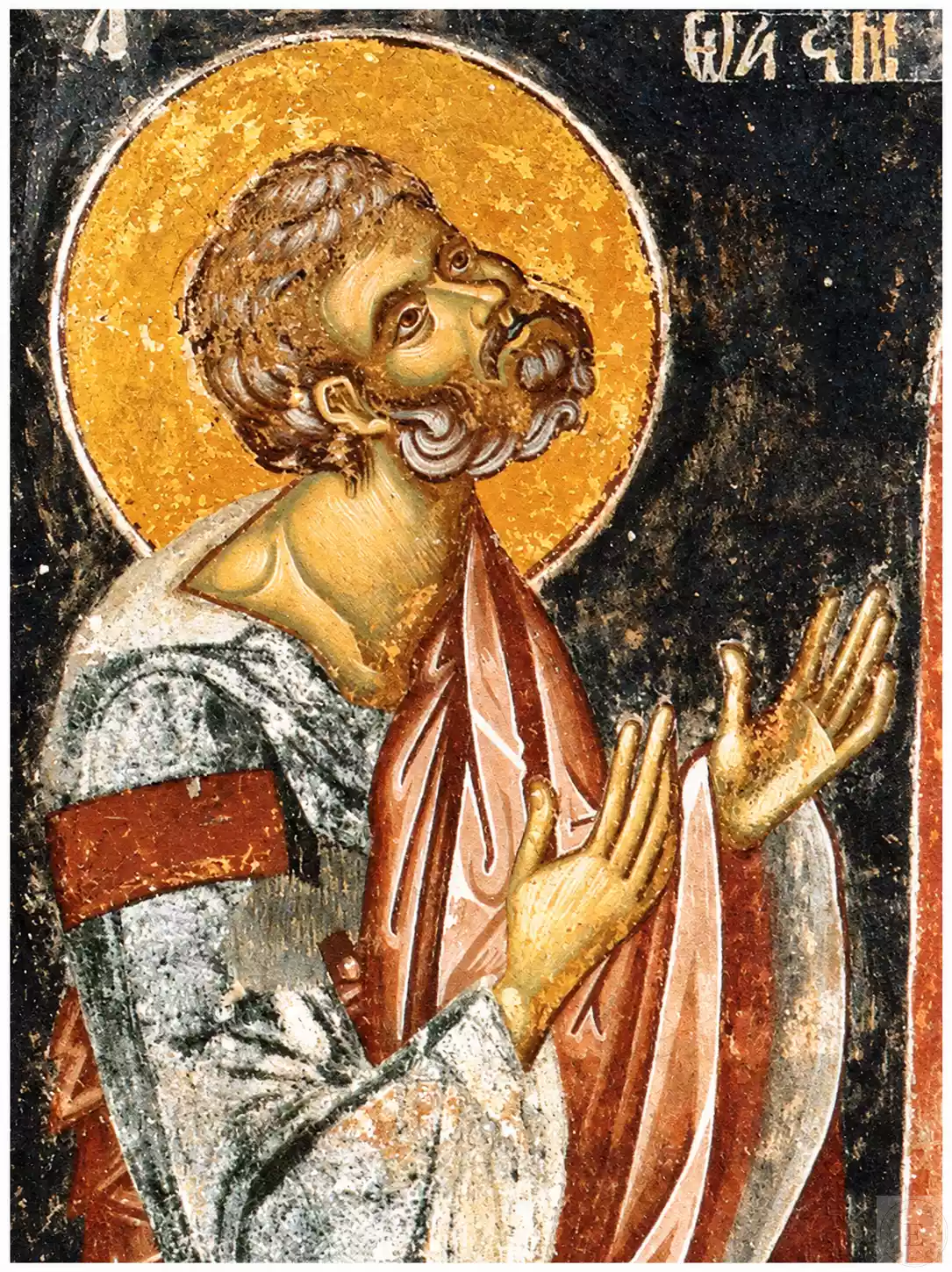 Joachim in prayer, detail. Katholikon of the Pantanassa Monastery, Mystras, 15th century.
The figure moves in two opposing directions. The body advances towards the opening, one foot forward and the knee slightly bent, while the neck stretches back and upwards. The throat is modelled with light planes and dark lines that bring out the tendons. Above it the small head, with short curly hair and a beard, is worked in dense white strokes over a greyish-brown tone. In the face the ochre of the flesh passes into olive-green shadows. White highlights fall on the forehead, the cheekbone and the bridge of the nose, and the large eye turns upwards. The halo, ochre with a white outline, stays behind the movement rather than enclosing it.
The two hands, long-fingered and with open palms, are raised to different heights, one close to the chest, the other higher and reaching further forward. The chiton is a pale grey-blue, almost silver, with a broad reddish-brown band on the upper arm. The pinkish-brown himation crosses the torso diagonally and hangs from the forearm in a long fold. Lower down it wraps around the legs and ends at the ankles in a swirling hem. Its highlights are crisp and angular, at times pointed on the thigh and shin, and convey the rhythm of the fabric more than the volume of the body.
At the top of the field, to the right of the halo, the inscription with his name survives in capital letters. To the left a single letter can be made out, probably part of an abbreviation of his honorific epithet.
Anna and the condition of the paint surface
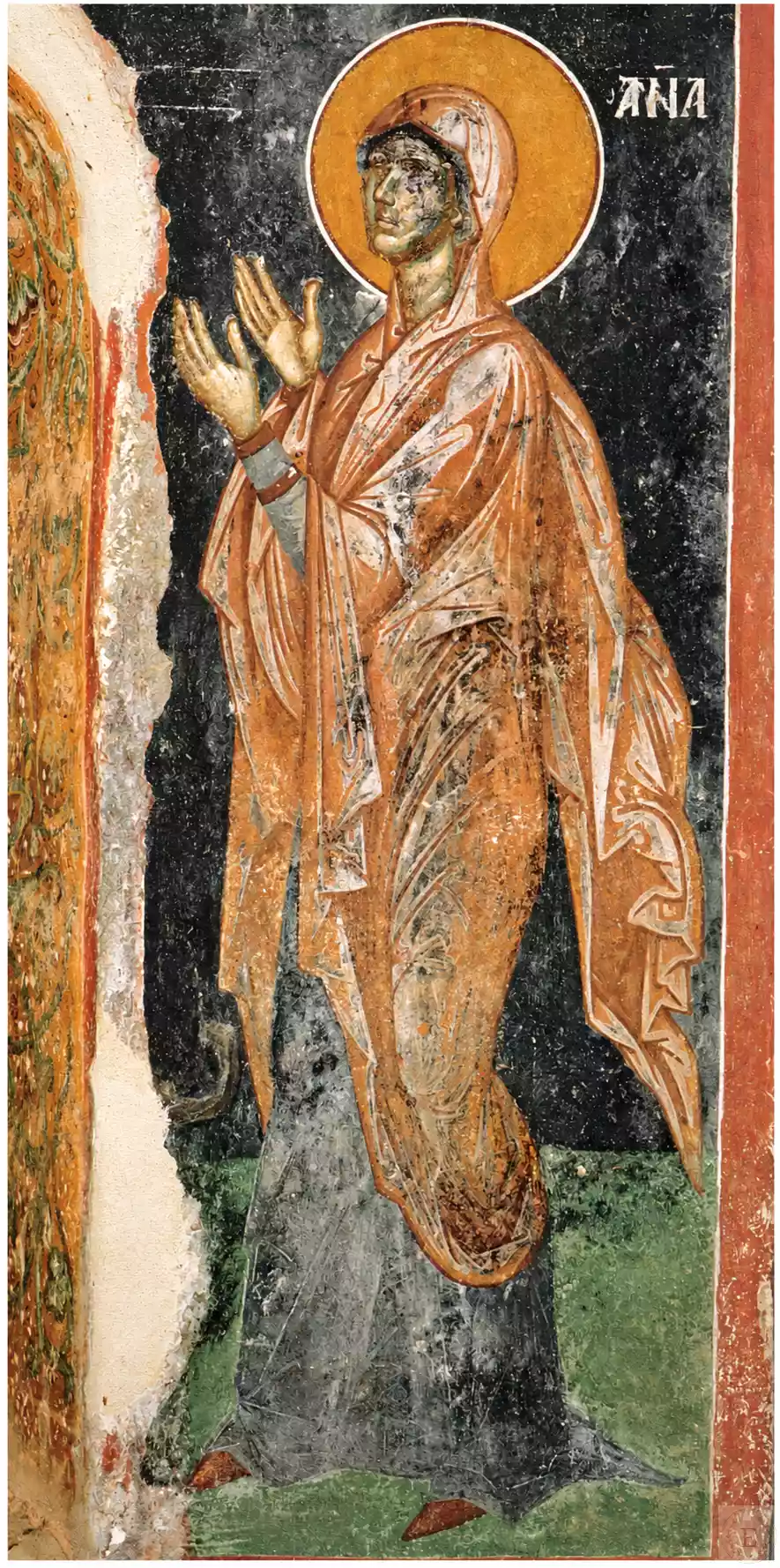 Anna in prayer. Katholikon of the Pantanassa Monastery, Mystras, 15th century.
Anna is turned to the viewer’s left, towards the arch, and her face, in three-quarter view, looks upwards. The maphorion, a vivid red-orange, covers her head and shoulders and falls to below the knees. Its edges hang at the sides in broken, stepped folds, more extensive on the side of her back. Beneath it the dark grey-green chiton reaches to the feet, where a red shoe is visible. She raises both hands in front of her chest, palms open towards the opening. At the wrist the light grey-blue end of the sleeve appears, with a red band.
Of the two figures, Anna has suffered the greater damage. The face has darkened and the features can be made out only faintly. Dark stains spread across the maphorion, and in the lower part of the field the paint surface is fragmentary. Between the figure and the arch a white strip of unpainted plaster breaks the continuity. The inscription with her name survives high up, to the right of the halo.
Colour, line and the painted arch
The colour scheme rests on a few strong contrasts: Joachim’s silvery chiton and rose himation, Anna’s red maphorion, the ochre of the haloes against the dark background. The green of the ground ties them together below. The proportions are slender, the heads small in relation to the tall bodies. The white highlights, laid down in short, assured strokes, organise the surfaces in an almost graphic manner. On the EKBMM website the wall paintings of the Pantanassa are described as a continuation of those of the Hodegetria and the Peribleptos. They are also counted among the most important works of the last phase of Palaiologan painting. The question of the models used by the workshop was examined by Doula Mouriki in a 1991 study of the church’s wall paintings as evidence for the models of a fifteenth-century painters’ workshop.
The arch itself belongs to the composition more than it first appears. Its face and intrados are covered in ochre and reddish tones, over which runs a green scrolling plant ornament. Behind it the white wall ends in a dark opening. The Ancestors of God lean towards each other across this recess, their palms turned in the same direction. The gap between them remains at the centre of the image.


