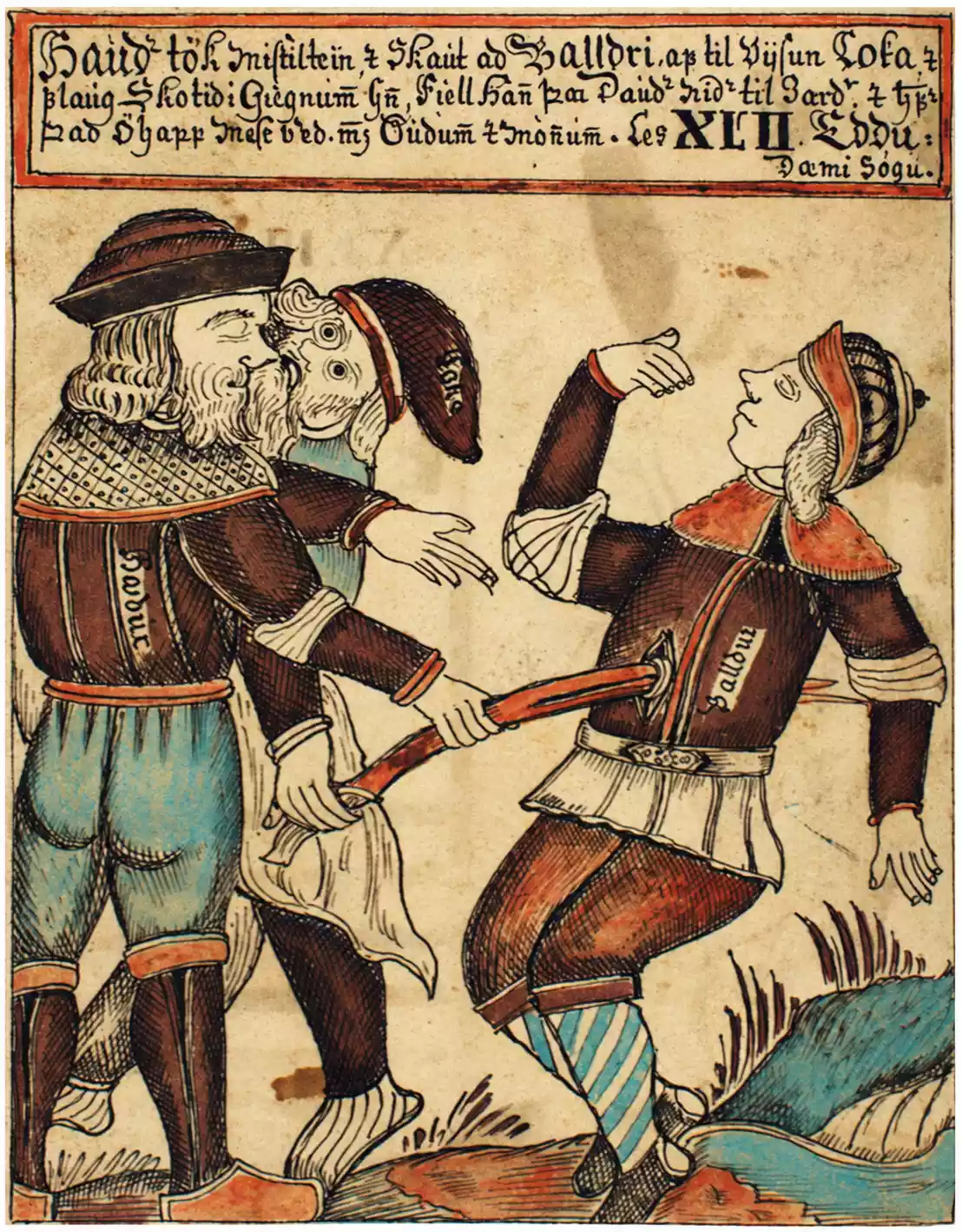
 The death of Baldr, with Höðr on the left and Loki peering over his shoulder. Ink and coloured washes on paper, 1760, attributed to Jakob Sigurðsson. Royal Danish Library, Copenhagen, NKS 1867 4to, fol. 96v.
The death of Baldr, son of Odin and Frigg, is among the gravest losses the gods suffer in Norse mythology, and it belongs to the long descent towards Ragnarök, the final conflict in which the world will be destroyed before it is made new. The familiar story — Frigg’s oath, the mistletoe, and blind Höðr hurling the fatal shaft as Loki guides his hand — is told most fully by the Icelandic scholar Snorri Sturluson. Individual episodes survive in the poetic record, while in the Danish historian Saxo Grammaticus the contest takes quite another shape, with neither Loki nor the fateful plant anywhere in it.
The sources for the myth of Baldr
The most detailed narrative is found in Gylfaginning, “The Deluding of Gylfi”. This is the principal mythological section of the Prose Edda, attributed to Snorri Sturluson (1179–1241) and composed around 1220, roughly two centuries after Iceland formally accepted Christianity in 999 or 1000. A Christian scholar himself, Snorri gathered older material on mythology and the art of poetry, often quoting verses as evidence for what he related. His work therefore bears the stamp of the thirteenth century, even where it preserves traditions far older than that.
Among the Eddic poems, Völuspá, “The Prophecy of the Seeress”, sets Baldr’s fate within a wider account of the world’s beginning and end. Its chief witness is the Codex Regius of the Poetic Edda, a manuscript of about 1270. A different codex, AM 748 I a 4to, written around 1300, preserves the short poem Baldrs draumar, “Baldr’s Dreams”. The dates of the manuscripts fix when the texts were written down; when the poems themselves were composed, and in what successive forms, is still debated.
Older, datable testimony to the god’s funeral comes from the Húsdrápa of the skald Úlfr Uggason, usually placed at the end of the tenth century, around 985. The poem described mythological scenes carved on the wooden panelling of an Icelandic hall, and it survives only in fragments quoted in Snorri’s Edda.
Baldr’s dreams and Frigg’s oath
Snorri presents Baldr as the best of the Æsir, so fair of face that light seems to shine from him. The description lingers on his wisdom and his gentleness before the narrative turns to the troubling dreams that foretell danger to his life.
When Baldr told the gods of his dreams, they took counsel on how to protect him. Frigg exacted oaths from fire and water, from iron and every other metal, from stones, earth and trees, and from diseases, beasts, birds, poisons and serpents, that none of them would harm him. With his safety thought secure, the Æsir began to amuse themselves by putting it to the test: Baldr would stand in their assembly while the others threw missiles and stones at him or tried to strike him, marvelling each time that he came to no harm.
Baldrs draumar says nothing of Frigg’s oath and dwells instead on dread of what is to come. Riding the eight-legged Sleipnir, Odin descends towards the underworld and raises a seeress from her grave, presenting himself to her as Vegtamr. From her he learns that the mead already stands brewed to welcome Baldr, that Höðr will be his slayer, and that Rindr will bear his avenger. Because the poem is silent about other episodes, it can tell us only so much about the shape the whole story had at the time.
The mistletoe and the hand of Höðr
Loki looks on Baldr’s invulnerability with displeasure. Snorri records the reaction without developing any deeper motive and at once shows him, transformed into a woman, calling on Frigg at Fensalir. By questioning her he draws out what he needs to know: west of Valhalla grows a shoot called mistilteinn, that is, mistletoe, from which the goddess took no oath because it seemed to her too young.
Taking the plant, Loki returns to the assembly and approaches Höðr, who stands apart because he is blind. Höðr explains that he cannot see where Baldr is and has no weapon; Loki hands him the mistletoe and promises to show him where to aim, urging him to honour his brother as the others do. The shaft passes through Baldr, and he falls dead.
Snorri’s account uses words for a rod and a missile, and the precise form of the weapon remains unclear. Völuspá, likewise, speaks of the deadly shaft that came from the slender plant. Renderings of it as an arrow or a spear rest on this language; the old sources offer no detailed description of how it was made.
The gods stood speechless over Baldr’s body, and the sanctity of the place forbade immediate vengeance. Odin felt the loss most heavily of all, since he understood more fully than the rest the calamity that had befallen the Æsir.
Hermóðr’s ride and the tear that was never shed
Frigg asked for someone willing to ride to Hel and bargain for her son’s return. The name denotes both the mistress of the underworld and the realm she rules. Hermóðr, a son of Odin, took on the errand, riding Sleipnir.
Meanwhile the gods carried Baldr’s body down to the sea to burn it aboard his ship, Hringhorni. When they could not shift the vessel, they summoned the giantess Hyrrokkin, who arrived riding a wolf with serpents for reins and launched the ship with such force that the earth shook. As the body was carried on board, Baldr’s wife Nanna died of grief and was laid on the same pyre. Thor hallowed it with his hammer, and Odin added the golden ring Draupnir.
After nine nights through dark valleys, Hermóðr reached the river Gjöll and rode on to Hel’s hall, where he found Baldr seated in the place of honour. Hel set one condition for letting him go: that all things in the world, living and dead, should weep for him. A single refusal would keep him with her.
The gods’ messengers asked for this universal mourning, and men and animals, the earth, the stones, the trees and the metals all responded. Snorri recognises their weeping in the moisture that forms when frozen things are brought into the warmth. In a cave, however, the giantess Þökk refused to mourn, declaring that Hel could keep what she had. The narrator passes on the belief that Loki lay behind her disguise, and keeps it framed as an opinion held by others.
Loki’s punishment and the road to Ragnarök
Once Baldr’s return had failed, Loki went into hiding in the shape of a salmon, but the gods caught him. They bound him upon rocks with the entrails of one of his sons, and Skaði fastened a venomous serpent above him. His wife Sigyn stands at his side holding a bowl to catch the venom; when she leaves to empty it, the drops fall on his face and his convulsions shake the earth. So the narrative accounts for earthquakes, and leaves Loki bound until Ragnarök.
In Völuspá, as presented in Edward Pettit’s scholarly edition, stanzas 31–34 of the Codex Regius version link Baldr’s fate to the mistletoe and to Höðr’s throw. There follow vengeance by a newborn brother of the dead god, Frigg’s lament, and the image of a captive who resembles Loki, with Sigyn beside him. The avenger, who in Baldrs draumar is named Váli, turns against Höðr, the immediate agent of the killing.
Later, when the seeress describes the earth rising again after the destruction, Baldr and Höðr appear together once more. Snorri also keeps the tradition of the two brothers’ return, placing them among the gods who will dwell in the renewed world.
Loki’s guilt is attested as well in Lokasenna. In his war of words with the gods at a feast, he boasts before Frigg that he is the reason Baldr is absent and will never again ride into the halls. The testimony matters for the study of the myth, because it ties Loki to the death outside Snorri’s prose narrative too.
The version of Saxo Grammaticus
In the third book of the Gesta Danorum, “The Deeds of the Danes”, a work completed in the early thirteenth century, Saxo Grammaticus tells of a rivalry in both war and love. Within his euhemerist approach, which places the gods in a supposed human past, Hotherus appears as a mortal hero and as the rival of Balderus, son of Odin, for the hand of Nanna.
Nanna prefers Hotherus and becomes his wife, while the conflict with Balderus continues through a series of battles. To overcome his invulnerable opponent Hotherus obtains a marvellous sword from Mimingus, a supernatural being who dwells in the wilderness. With it he deals Balderus a mortal wound, and Balderus dies three days later. Vengeance falls to Bous, son of Odin and Rinda. Frigg’s oath and the mistletoe are absent from this story, and Höðr’s counterpart can see, acting as a deliberate adversary.
The mistletoe and Loki in scholarly debate
In his extensive 2004 study, published in the journal Alvíssmál, Anatoly Liberman examines the difficulties of reconstructing the myth. He notes that mistletoe is not native to Iceland and has only a limited range in Norway and southern Sweden, arguing that Icelandic storytellers most probably knew it at second hand. He also treats the word mistilteinn as a likely borrowing from Old English, and rejects the view that the plant arose from a misunderstanding of the name of some sword.
Following an earlier position of Eugen Mogk, Liberman regards Loki’s complicity as a particular development of the Norwegian-Icelandic tradition. His views are proposals within a long scholarly debate, to which James Frazer’s comparisons with vegetation rituals and the comparative approaches of Georges Dumézil also belong. The distance between the surviving narratives, above all between Snorri and Saxo, leaves open questions about the story’s earliest religious content and about how it changed in transmission.
The illustration in manuscript NKS 1867 4to
The Eddas went on being copied in Iceland into the early modern period, often with pictures that dressed the mythological protagonists in clothing familiar to the artists. The paper manuscript NKS 1867 4to, dated 1760 and held in the Royal Danish Library in Copenhagen, contains sixteen full-page illustrations of Snorri’s Edda and four further images. The MyNDIR digital archive of the University of Victoria attributes the illustrations to Jakob Sigurðsson (1727–1779), and associates the priest Ólafur Brynjólfsson (1713–1765), to whom the manuscript has also been attributed, with its original ownership and textual content.
On folio 96v the scene sits beneath a red-bordered frame bearing an Icelandic inscription. The text summarises the casting of the mistletoe at Loki’s prompting and the death of Baldr, referring to the forty-second tale of the Edda according to the numbering the manuscript follows here.
On the left stands the bearded Höðr, eyes closed and wearing a broad-brimmed hat, gripping with both hands a long red weapon that runs through Baldr’s body. Behind his shoulder Loki leans in, his face near Höðr’s ear and one hand outstretched. Baldr, on the right, sways backwards with bent knees and a raised arm, wearing a headdress that resembles a crown. Names written over the figures help to identify them; reds and browns dominate the clothing, set against blue-green surfaces and striped stockings.
The weapon is drawn schematically, without distinct leaves or any other botanical feature of mistletoe. At the bottom of the image, around the figures’ feet, a few clumps of vegetation and a blue-green band of water complete the ground.


