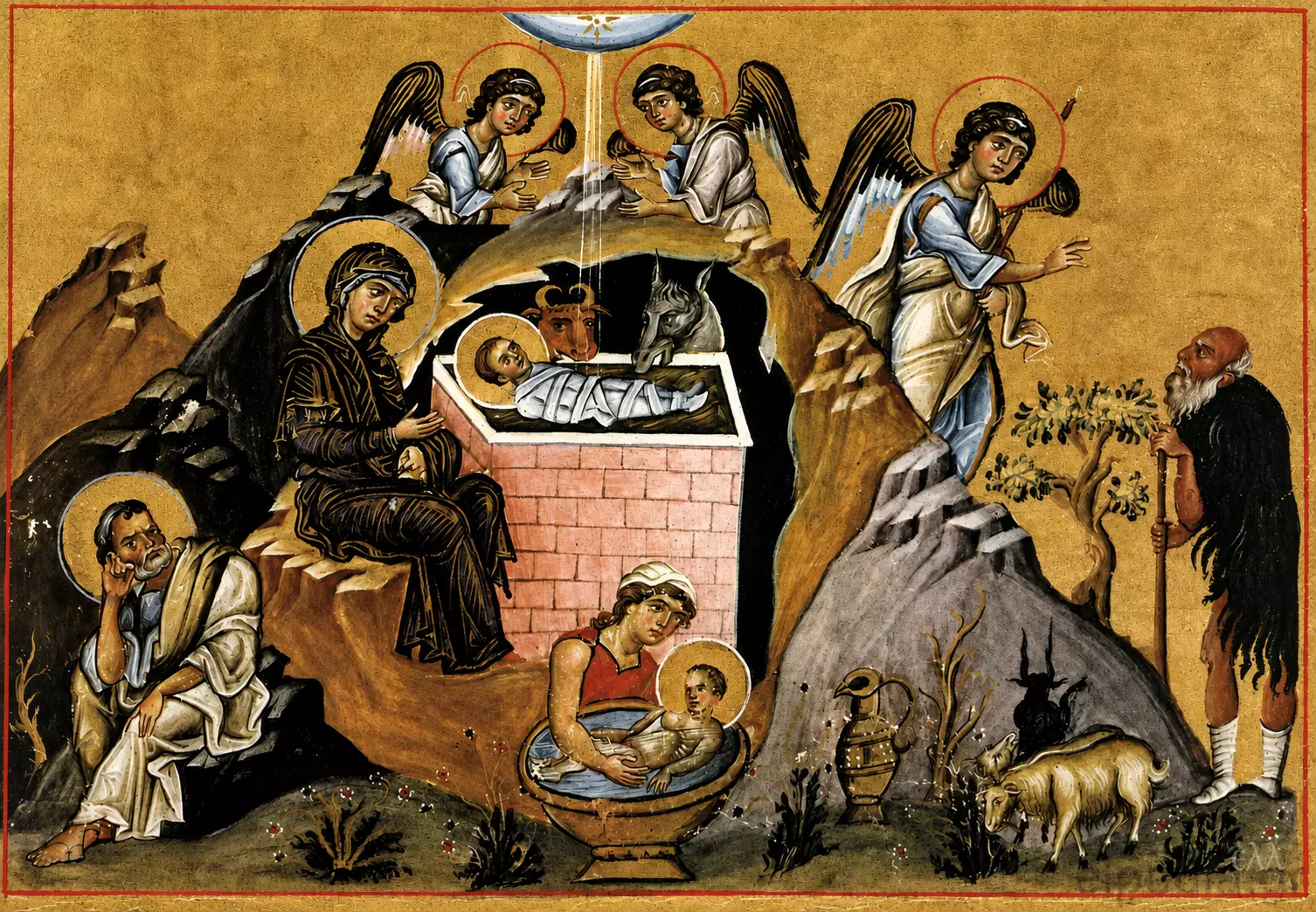
The Nativity of Christ, illuminated by Symeon of Blachernae around 985, belongs to the celebrated Menologion of Basil II, Vaticanus graecus 1613. It appears on folio 271, not folio 371, and is preserved with the manuscript in the Vatican Apostolic Library. Across a gold ground, the illuminator has arranged the birth of Christ within a broken, rocky landscape: the Theotokos beside the cave, the swaddled infant in a masonry manger, Joseph withdrawn at the lower edge, three angels, a shepherd and the bathing of the Child. The narrow red frame holds together a composition otherwise divided by slopes, cavities and abrupt changes of level.
Although conventionally known as a menologion, the codex is more precisely a synaxarion, a collection of short commemorative readings arranged according to the liturgical calendar. Its surviving contents cover September through February. Produced in Constantinople for Emperor Basil II, it brings together approximately 430 entries, each accompanied by an illumination, an exceptional investment in manuscript painting even within the context of imperial patronage. The manuscript has been digitised by the Vatican Apostolic Library, while its date, imperial associations and place within tenth-century Byzantine painting are also recorded by the Foundation of the Hellenic World.
The Byzantine Nativity Miniature and Its Composition
At the centre, Christ lies tightly wrapped in white swaddling bands. His rectangular manger, faced with courses of pink masonry, resembles a small architectural structure inserted into the darkness of the cave. Behind him emerge the heads of the ox and ass. Neither animal appears in the Gospel accounts of the Nativity, yet both had become established elements of Christian imagery through the interpretation of Isaiah (1:3). The black cavern, cutting sharply into the ochre rocks, isolates the luminous body of the infant and gives the scene its strongest tonal opposition.
A ray descends from a semicircular segment of heaven at the upper border, passes between two bending angels and reaches the Child. This vertical line provides the composition with its governing axis. The angels turn inward with open hands, their pale blue, grey and white garments articulated by long linear highlights. On the opposite slope, a third angel inclines towards the elderly shepherd. His extended hand carries the narrative away from the central mystery towards its announcement in the surrounding world.
The Theotokos sits close to the manger, wrapped in a dark maphorion whose narrow gold highlights define the folds. Her upright position differs from the reclining pose frequently encountered in later Byzantine Nativities. One hand is extended towards Christ, while her lowered head introduces a quieter direction into the crowded scene. Joseph, at the lower edge, is physically separated from both mother and newborn. Supporting his face with one hand, he assumes the meditative pose traditionally associated with his perplexity before the circumstances of the birth.
The Bath of the Infant Christ
Below the manger, an attendant bathes the haloed child in a rounded basin. A vessel placed among the grazing animals nearby completes the domestic setting. Derived from apocryphal accounts, the bath entered Byzantine Nativity iconography as an assertion of Christ’s genuine human birth. Its ordinary physical action sits beneath the supernatural revelation above: water and touch below, the celestial ray at the summit.
The narrative therefore unfolds through several registers without becoming rigidly divided. Angels, shepherd, animals, mother, foster father and attendant occupy separate pockets of the landscape, yet glances and gestures connect them. The rocky forms perform much of this organisational work. Their sharp terraces provide seats, enclosures and boundaries, while the gold ground removes any continuous natural horizon.
Symeon of Blachernae and the Imperial Manuscript
Among the eight illuminators named in the margins of the Menologion, Symeon of Blachernae was one. These designations were entered by the scribe and should not be treated as artists’ signatures in the modern sense. Even so, their presence gives the codex unusual importance for the study of Byzantine workshop practice, since most contemporary manuscript painters remain unidentified.
The assured figure drawing, lively gestures and interest in bodily volume place the miniature within the classicising current commonly described as the Macedonian Renaissance. That term remains debated, particularly when it implies a sudden recovery of antiquity, but it usefully identifies the renewed engagement with ancient pictorial conventions visible in Constantinopolitan art. In this miniature, inherited classical devices support a thoroughly Byzantine image: fractured terrain, spatial compression, expressive drapery and a gold field across which earthly time and sacred revelation occur simultaneously.
(The translation was edited by T. Davies.)