Among the illuminations of the manuscript known as the Menologion of Basil II, the Exaltation of the Cross miniature presents one of the clearest visual records of a Byzantine liturgical ceremony. It appears on folio 35 of Vaticanus graecus 1613, a lavishly illustrated codex produced in Constantinople toward the end of the tenth century for the emperor Basil II. The Vatican Library dates the manuscript to the late tenth century; although conventionally called a menologion, it is more precisely a synaxarion arranged according to the ecclesiastical calendar.
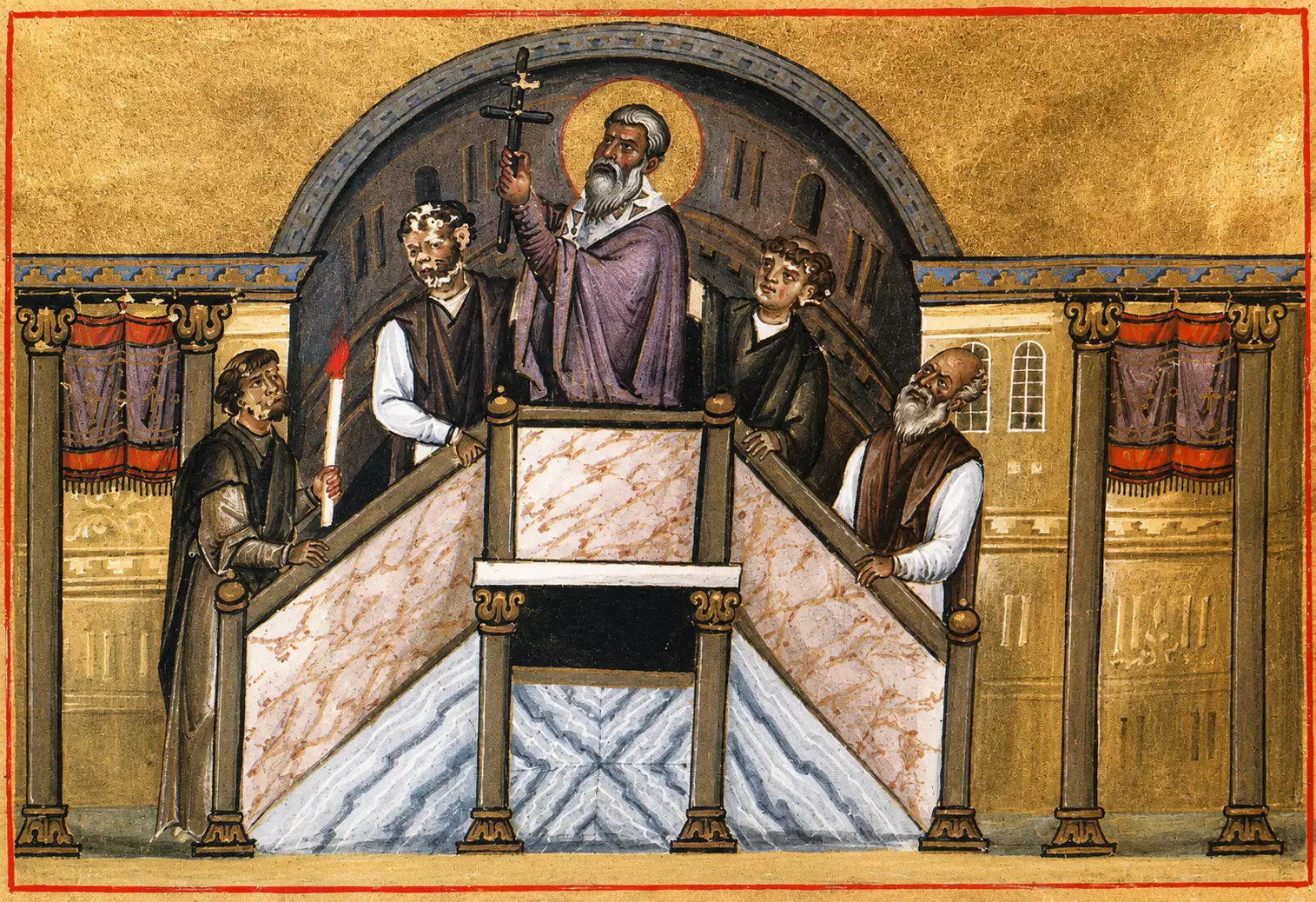
At the centre of the image, a white-haired patriarch stands on the upper platform of a monumental marble ambo. Wearing a muted purple-brown episcopal vestment and a white omophorion, he raises a dark cross above the assembled clergy, and this gesture governs the entire composition. Around him, attendants occupy the stairways and platforms at different levels, their bodies directed toward the elevated celebrant; one carries a tall candle, while others rest their hands along the railings or turn upward toward the Cross. Behind the patriarch rises a broad semicircular architectural form, and beyond it an ordered façade of columns, capitals and suspended red curtains extends across the gold ground.
Exaltation of the Cross Miniature and Byzantine Ceremony
The scene belongs to an extraordinary manuscript containing 430 illustrations, produced through the collaboration of eight painters whose names were recorded alongside groups of miniatures. Such documentation is exceptional within Byzantine manuscript production and gives the codex an unusual place in the study of imperial artistic patronage. Its visual language is that of a narrative manuscript illumination: compressed pictorial space, architectural framing, gold ground, carefully ordered figures and a strongly defined central axis.
The Marble Ambo and the Structure of the Image
Almost half the composition is occupied by the ambo itself, and its scale matters. Wide flights of stairs rise diagonally toward the central platform, creating a triangular structure that draws the eye upward before the figure of the patriarch is reached. The marble surfaces are articulated with reddish and grey veins, some arranged in mirrored patterns that recall book-matched revetment. Dark posts and rails divide the pale stone into firm geometric sections.
Against these diagonals, the patriarch provides an emphatic vertical. His raised Cross carries the movement still higher, toward the upper field of gold. The visual sequence is simple and remarkably effective: stairs, celebrant, Cross. A broad arch immediately behind his head further isolates the figure, while the gold nimbus remains clearly distinguishable against the darker architectural recess.
Through posture rather than dramatic gesture, the surrounding clergy participate in the action. Faces turn upward, bodies lean slightly toward the centre, hands touch the architectural structure. Their varied ages are carefully indicated: dark hair and compact beards among the younger attendants, white hair and longer beards among the elderly. A small flame rising from the candle near the lower part of the staircase supplies another vertical accent, echoed in the slim columns of the architecture.
A Liturgical Act in Constantinople
The illumination is especially significant because it represents the feast through contemporary ceremonial practice. The historical traditions associated with the Exaltation of the Holy Cross include the discovery of the Cross connected with Helena and, in later Byzantine memory, its recovery following the Persian occupation of Jerusalem and the reign of Emperor Heraclius. The artist chooses another moment altogether: the solemn elevation of the relic during worship. A Byzantine description of the feast prescribes repeated elevations of the Cross, and scholarship has specifically connected the miniature on folio 35 with this ceremonial action.
Narrative time is, in consequence, almost suspended. There is no journey to Jerusalem, no excavation, no imperial procession returning a recovered relic. The painter concentrates the meaning of the feast into one controlled gesture. Above the congregation and attendant clergy, the Cross becomes the visual summit of the image.
For this reason, the setting has attracted considerable attention. The elevated ambo, clergy and ceremonial arrangement have been discussed in relation to the liturgical environment of Hagia Sophia in Constantinople, whose monumental ambo played an important part in the ceremonial movement of clergy, readers and singers. Scholarship on Byzantine liturgy treats this illumination as valuable evidence for the visual environment surrounding the rite, even though an illustrated manuscript should be approached cautiously as an architectural record rather than read as a measured reconstruction.
Gold, Architecture and Ceremonial Hierarchy
Around this carefully staged human action, architecture supplies a second system of order. Paired columns and capitals create narrow compartments across the background. Red curtains hang between them, their folds punctuating the long horizontal façade with patches of concentrated colour. Above, the uninterrupted gold field removes any suggestion of an ordinary exterior setting and gives the scene the luminous visual register familiar from luxury Byzantine manuscript painting.
Colour, though restrained, is purposeful. Pale marble dominates the lower half; grey-blue, brown and white garments gather around the central figure; red appears in curtains, architectural borders and smaller details. The patriarch’s halo forms a concentrated disk of gold inside the darker arch, while the Cross itself remains almost black. Against the luminous field, its silhouette is immediately legible.
The manuscript belongs to the artistic culture of the Macedonian period and to the courtly production often discussed under the contested designation “Macedonian Renaissance.” Classical elements appear here without transforming the rite into an antiquarian exercise. The figures retain bodily weight, individual movement and varied physiognomies, yet their placement follows a strict hierarchy governed by function and rank. Imperial manuscript painting could absorb classicizing habits of figure construction while preserving the ceremonial discipline characteristic of Byzantine visual culture. The broader codex, with its hundreds of carefully coordinated scenes, was among the most ambitious illustrated books created around the year 1000.
The Patriarch and the Historical Present
The central hierarch is presented with enough individuality to encourage attempts at identification. Nicholas II Chrysoberges, patriarch of Constantinople during part of Basil II’s reign, has been proposed because his patriarchate overlaps the period in which the manuscript was produced. The identification remains tentative, since the illumination supplies no secure portrait inscription establishing his identity, and the figure can equally function as the patriarchal celebrant required by the ceremony.
That uncertainty matters for the way the image operates. The patriarch’s personal identity yields visually to his office: white omophorion, elevated position, Cross held above the clergy. Around him, rank is translated into space; below, attendants climb or occupy the stairways, while at the summit one figure performs the ceremonial action.
On folio 35, therefore, the Menologion of Basil II preserves the feast as the late tenth-century court could imagine it in its own liturgical present. The discovery associated with Helena and the later memory of Heraclius remain part of the feast’s historical background, while the painter gives visible form to the ritual that repeatedly renewed that memory in Constantinople. Marble stairs, dark Cross, clustered clergy, red curtains, gold: an imperial manuscript has compressed a major public ceremony into the dimensions of a single painted page.
(The translation was edited by A. Orfanos)