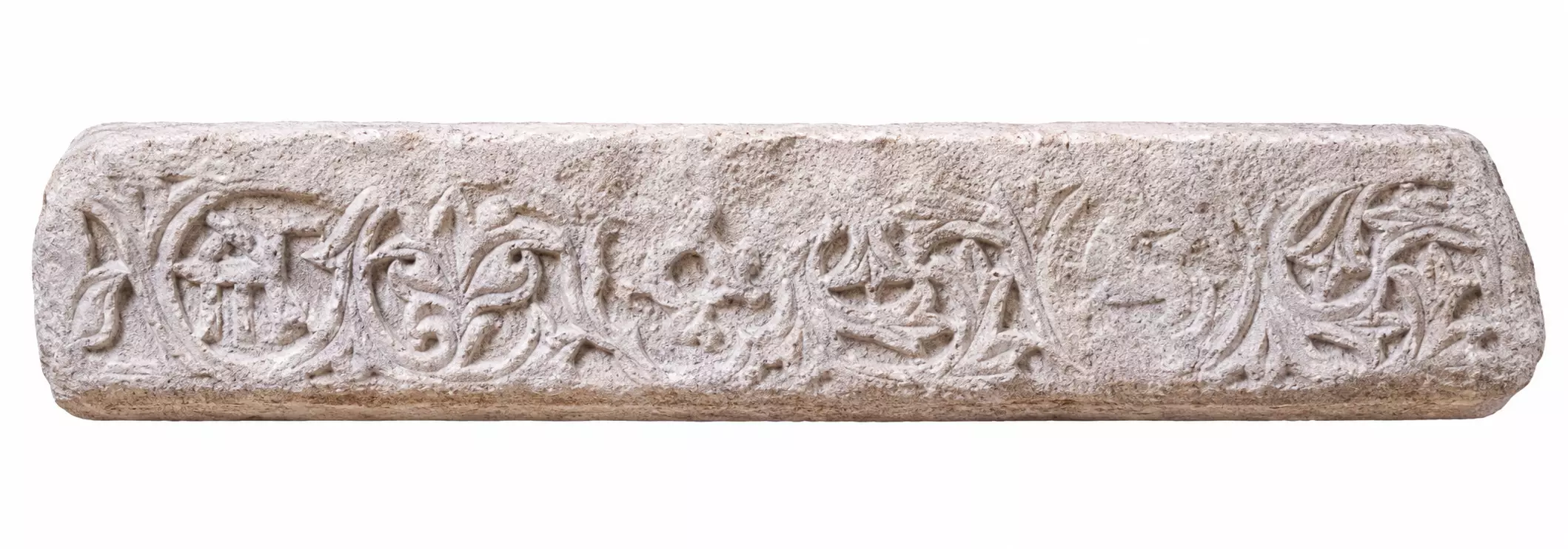
The Palaeologan marble epistyle preserved in the Museum of Byzantine Culture in Thessaloniki is a fourteenth-century fragment of architectural sculpture, probably from the templon of an unidentified church in the city. Carved from marble and measuring 84 cm in length, 18 cm in height and 35 cm in width, it preserves ornament on more than one surface, suggesting a beam designed to be read from several viewpoints within its original ecclesiastical setting. Most distinctive among its features are the dynastic signs incorporated into the decoration: a square monogram formed from the Greek letters Π, Α, Λ and Γ, and an eight-petalled rosette enclosing a square identified by the Museum with the coat of arms of the Palaiologos dynasty.
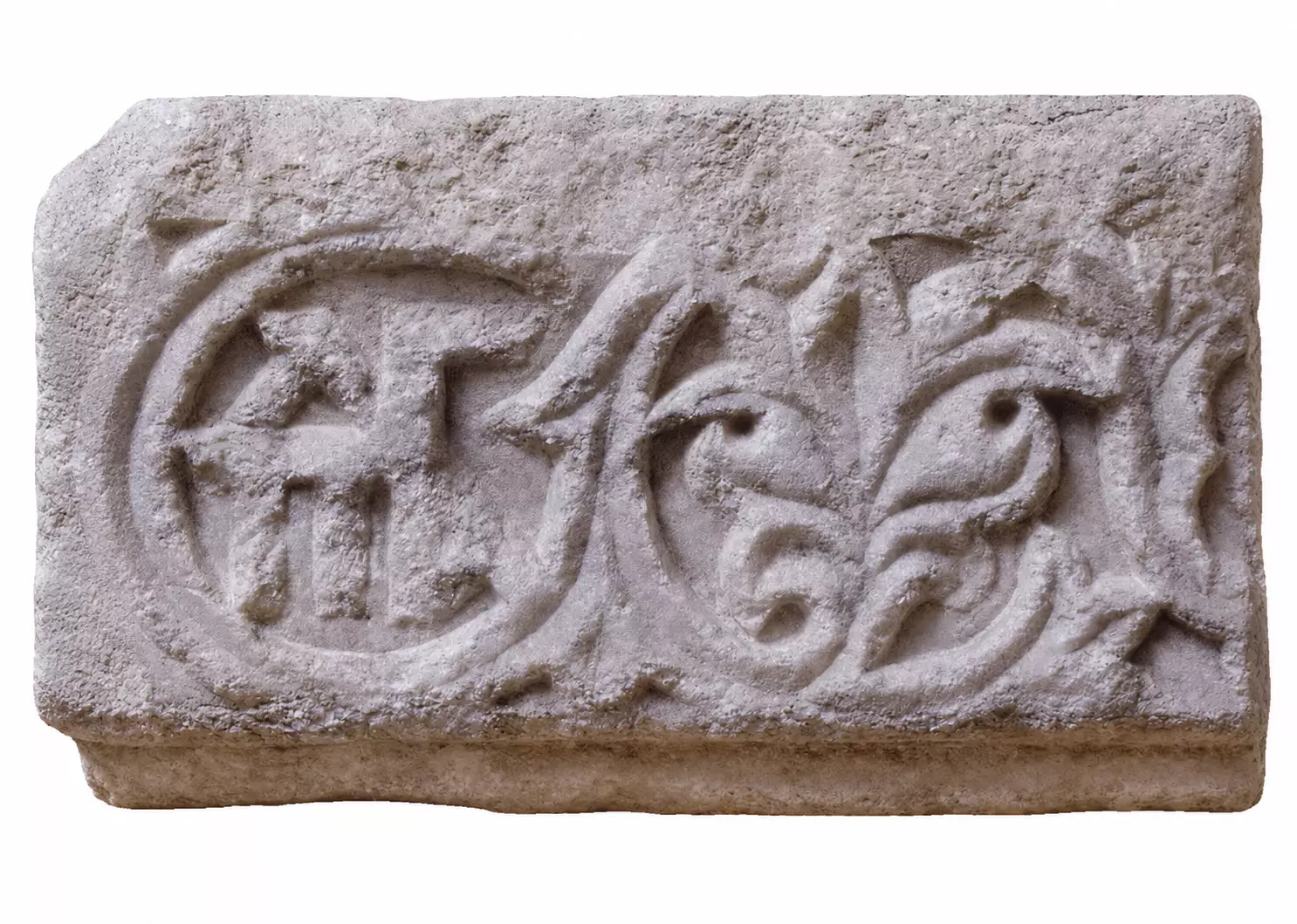
Palaeologan Marble Epistyle: Dynastic Emblems and Relief Ornament
Across the principal face, paired vine shoots unfold into a sequence of linked circular compartments. Within them the sculptor alternated vegetal shapes with emblems and more unusual motifs: the Palaiologan monogram, palmette-like acanthus, the heraldic square within its rosette, a spiral composed of trefoils, and a small animal shown in motion. Upright lotuses occupy the spaces between the circles, changing position from one interval to the next — and it is precisely this shifting placement, rather than any strict repetition, that gives the frieze its sense of movement. The carving is relatively shallow yet strongly graphic, its effect dependent on repeated curving stems, recessed areas and the contrast between raised ornament and the rougher background.
The second decorated surface develops a larger, more compact pattern. Two heart-shaped frames enclose oblique palmette-acanthus shapes, while curling shoots terminate in motifs resembling the fleur-de-lis. At the central axis, these elements meet to form a cross-like arrangement; lotus figures fill the triangular spaces around it. Part of the upper moulding has been lost through surface exfoliation. At one end, left undecorated but for an incised cross, lies the point at which the epistyle joined the abacus of a capital.
Produced during a century of severe political contraction for Byzantium, the epistyle belongs to the artistic environment commonly associated with the Palaiologan Renaissance. The term describes the renewed vitality of art and letters under the dynasty, though the broader use of “renaissance” in Byzantine art history remains a subject of scholarly discussion. Within this Late Byzantine vocabulary, dynastic identity becomes part of the architectural ornament itself: monogram, heraldic device, cross, vine and palmette occupy the same continuous carved field.
(The translation was edited by A. Orfanos.)