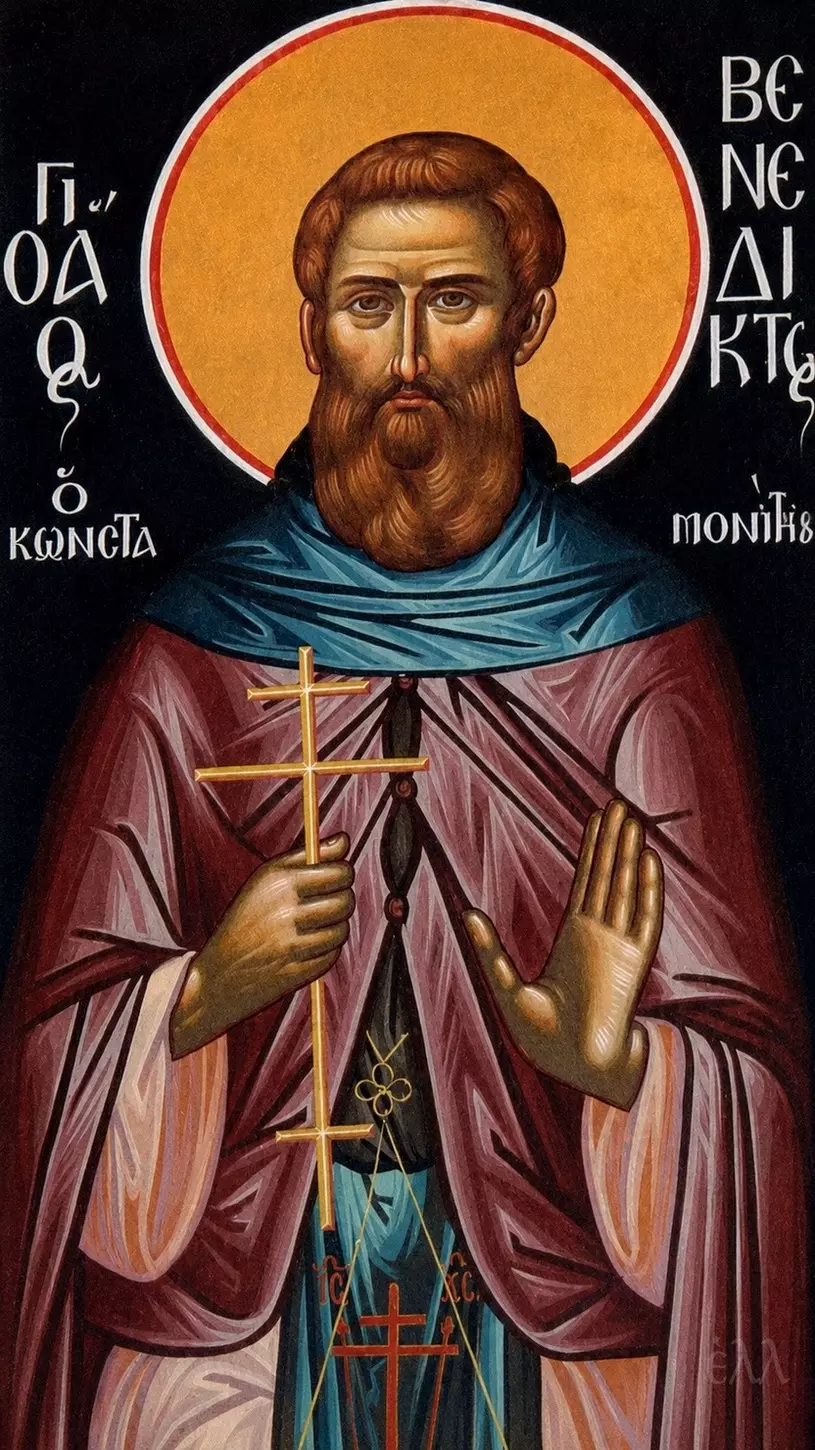
The Hieromartyr Benedictos Konstamonitou is represented frontally, his body aligned almost exactly with the vertical axis of the composition and his direct gaze carrying much of the image’s expressive force. The surviving Greek inscription identifies the figure as Benedictos and connects him with Konstamonitou Monastery on Mount Athos. No secure information concerning the painter, date, support, or original location accompanies the image itself, and these points deserve caution. Its artistic language belongs firmly to the continuing Post-Byzantine and modern Athonite iconographic tradition: a sacred figure isolated against a dark field, defined by linear drapery, restrained modelling, hieratic frontality, and attributes that make his identity immediately legible.
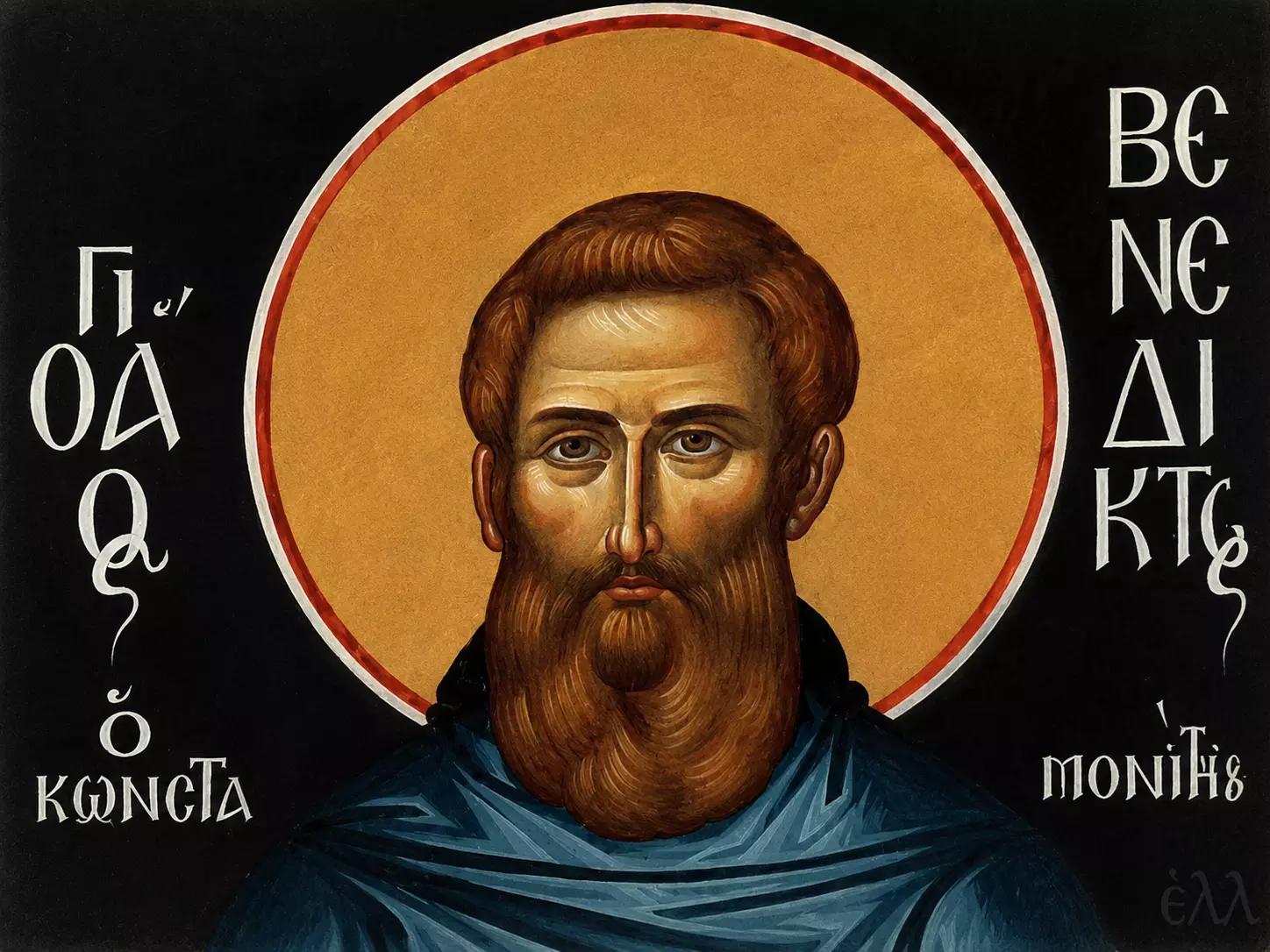
Around the head, a broad golden halo edged by narrow white and red concentric bands frames a remarkably symmetrical face. The short reddish-brown hair follows the curvature of the skull; below it, the beard descends in compact, carefully ordered locks, lengthening the physiognomy and strengthening its vertical character. Light is distributed through narrow planes over the forehead, nose, eyelids, cheeks, and hands rather than through a naturalistic light source. The effect recalls the established vocabulary of Orthodox icon painting, in which flesh modelling is structured through successive zones of shadow, mid-tone, and linear highlight.
The saint’s head is uncovered. Around the neck and across the shoulders lies a dark blue mantle-like monastic garment, its angular folds spreading laterally beneath the beard. Below it appears a muted purple-red outer garment with sharply defined folds, while a darker inner garment runs down the centre. The palette remains relatively restricted. Blue and purple-red dominate the clothing; black surrounds the figure, with ochre flesh tones and the warm gold of the halo and cross carrying the brighter accents.
Hieromartyr Benedictos Konstamonitou and Athonite Iconography
The hands establish the most significant iconographic movement. Benedictos holds the cross in his right hand, which appears on the left side of the composition from the viewer’s perspective. It is a slender gold-coloured cross with several transverse elements, presented upright against the body. His left hand, visible on the viewer’s right, is raised with the palm exposed. Within Orthodox representations of martyrs, the open hand can function as a restrained devotional gesture; visually, it also balances the rigid vertical of the cross with a broader, quieter form. One hand closes around the attribute, the other remains open.
The cross identifies Benedictos through martyrial iconography. It belongs to the widespread repertoire by which martyrs and hieromartyrs are represented outside narrative scenes of their deaths: the historical episode itself disappears, leaving the saint standing in an enduring state of witness. Benedictos is consequently portrayed without descriptive scenery or direct reference to Thessaloniki, the political upheaval of 1821, or the circumstances surrounding his death. Recognition depends instead upon the identifying inscription, his monastic association, the designation of hieromartyr, the cross and halo.
His historical connection with Konstamonitou is supported by an important manuscript tradition preserved by the monastery. Codex 107 contains the New Memorandum of the Newly Manifest Hieromartyrs and Hosiosmartyrs, composed by the Konstamonitou monk Dositheos between approximately 1830 and 1844 and concerned with Athonite monks who died during the upheavals surrounding the Greek Revolution. Apostolos A. Glavinas, in a scholarly Makedonika study, discusses this textual dossier and the manuscript’s importance for the history of the monastery’s nineteenth-century martyrs. Benedictos belonged to this circle and is documented as a monk who later became a priest, hence the designation hieromartyr.
The painted inscription surrounding his head participates directly in this process of identification. Large white letters interrupt the black background on both sides, visually counterbalancing the halo. On the viewer’s right, the name ΒΕΝΕΔΙΚΤΟΣ can be read vertically, while the lower lettering associates him with the monastery; further lettering survives on the opposite side of the figure. Text and sacred likeness operate together according to a practice deeply embedded in Eastern Christian visual culture, the physiognomy supplying a recognisable type while the inscription fixes the identity beyond ambiguity.
A further point concerns the frequently repeated description of this image as a fresco from the refectory of Konstamonitou. The available architectural documentation makes that attribution problematic. The present refectory was reconstructed in 1871, and the official KEDAK record states that it is unpainted and that nothing survived from the painted decoration of the earlier refectory. Without additional archival or photographic documentation connecting this particular image to another painted monastic space, its material classification should therefore remain broader: painted image of Hieromartyr Benedictos associated with Konstamonitou Monastery. The term fresco would also require evidence for the actual wall-painting technique.
Stylistically, the image retains the vocabulary of Byzantine sacred representation while employing a comparatively recent manner of execution. The eyes are large and strongly outlined, the nose long and narrow, the mouth small beneath the moustache. Flesh is modelled with firm transitions and repeated highlights; the garments, constructed from angular and almost graphic folds, gain volume from pale strokes rather than deep spatial recession. There is virtually no setting. Figure, inscription, halo, dark ground: these elements occupy almost the whole pictorial field.
This compression gives the image considerable visual authority. Benedictos fills nearly all the available space, with the halo pressing towards the upper border and the shoulders spreading broadly below. In the closer view, where the hands and lower garments disappear, the face assumes greater emphasis. The dark blue garment around the neck and shoulders functions almost as a secondary frame beneath the halo, while the surrounding black isolates the reddish hair, warm flesh tones and white inscriptional forms with unusual clarity.
Within a long Athonite practice of constructing the memory of recent monastic saints through a visual language inherited from Byzantine prototypes, the image finds its historical and devotional place. Benedictos, a nineteenth-century monk whose life survives in the written records of his monastery, enters an iconographic system shaped centuries earlier. His particular identity is carried by the inscription, his connection with Konstamonitou and his physiognomic type; around these, frontality, the halo, the martyr’s cross, the raised open palm and the compressed background establish the familiar grammar of Orthodox Christian sacred representation.
(The translation was edited by N. Jones.)