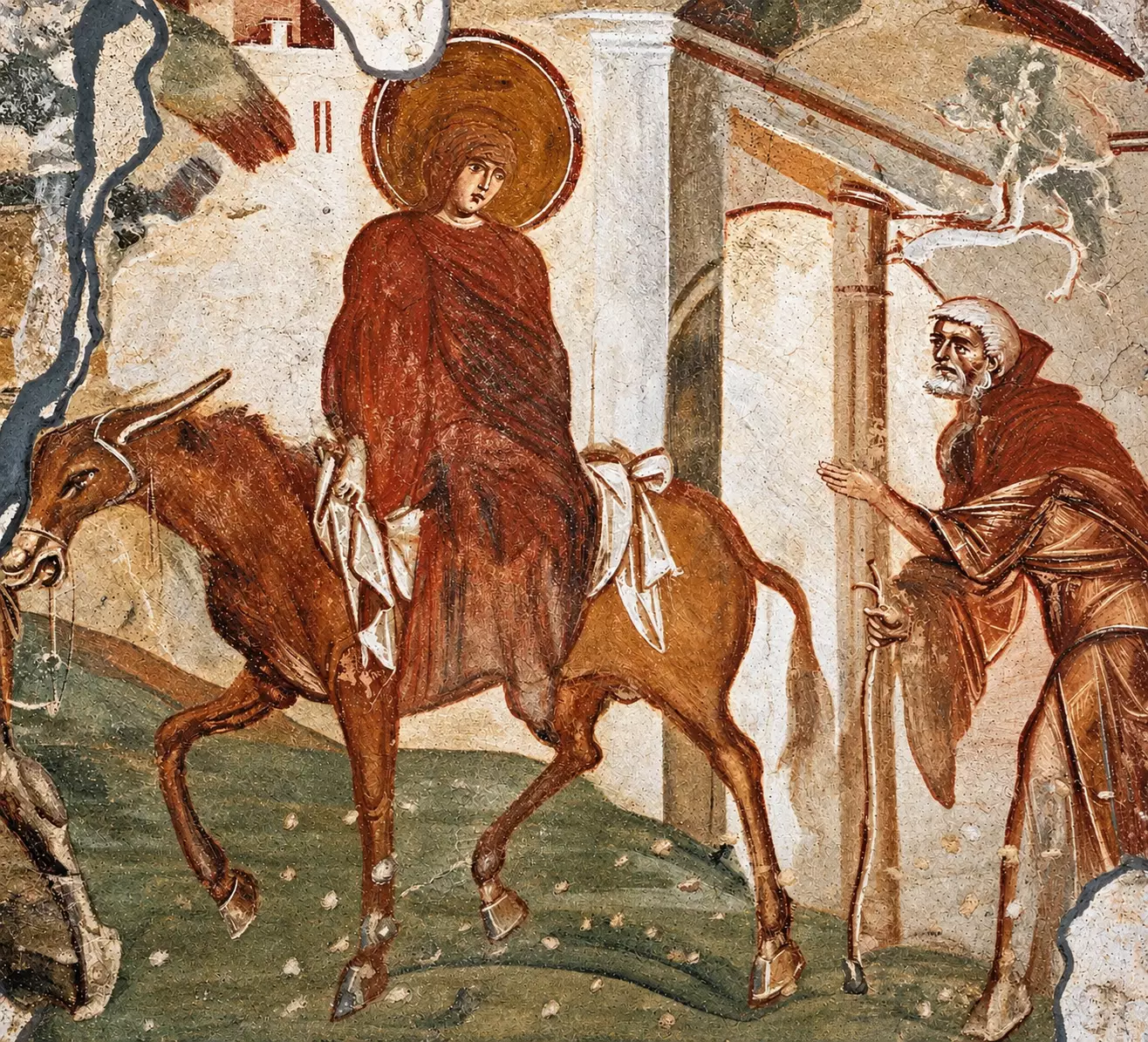
The Journey to Bethlehem is one of the most vivid surviving scenes in the celebrated wall-painting cycle of Santa Maria foris portas at Castelseprio, in Lombardy. A haloed Virgin Mary rides an animal of burden towards a monumental entrance while the elderly Joseph, leaning on a long staff, turns towards her in animated conversation. The paintings occupy the eastern apse of the small triconch church and belong to a broader narrative devoted to the infancy of Christ, arranged in two registers and drawing on both canonical and apocryphal traditions. Their date remains one of the most debated problems in early medieval painting: a seventh- or eighth-century chronology has long been influential, while other proposals extend into the ninth and early tenth centuries.
What gives the scene its particular force is the ease with which sacred story becomes human movement. Mary appears as a young traveller, her body rising vertically above the animal, the dark reddish mantle descending in broad, softly articulated folds. Her head inclines slightly and turns towards Joseph, so that the large halo encloses a face absorbed in thought. Joseph answers this inward mood with physical energy: bent forward, one hand gripping the staff, the other extended in speech. Between them, a measured interval — small but visually decisive — allows the exchange to remain clear while the procession continues across the painted surface.
The Journey to Bethlehem Fresco and Its Classical Pictorial Language
The Journey to Bethlehem fresco belongs to the classicizing current for which the Castelseprio cycle has become famous. Through supple contours and tonal modelling, the painter gives the bodies palpable weight and an unusual lightness of motion. Faces turn naturally; gestures reach into the surrounding space; garments follow the flow of the limbs beneath them. These qualities have encouraged comparisons with Late Antique and Hellenistic painting, a classical inheritance that remained active, in altered forms, within Byzantine visual culture. The frescoes themselves have repeatedly been discussed in relation to the survival of a strongly Hellenizing pictorial tradition.
Around the travellers, architecture participates in the narrative. Pale walls and a broad arched opening indicate an inhabited destination, while slanting rooflines and receding architectural members introduce a surprisingly elastic sense of depth. Systematic linear perspective has no role here. Overlapping forms, angled planes, shifting viewpoints: together they supply enough recession for the figures to move convincingly through the setting. A few tree forms and irregular rocky passages interrupt the architecture, their organic lines giving the route a less formal character.
Across the worn painted surface, reddish browns, ochres and pale neutral tones still establish a coherent chromatic field. The Virgin’s dark mantle forms the densest mass at the centre, Joseph’s garments echo its warm colouring, and the pale structure opens around both figures. Damage, abrasion and losses remain visible throughout, especially in the background and lower portions of the composition, yet the principal contours retain their remarkable clarity.
Dialogue on the Road
The subject draws directly upon apocryphal infancy literature. In chapter 17 of the Protoevangelium of James, Joseph notices Mary’s changing expression and asks why she appears at one moment sorrowful and at another joyful. Mary answers that she sees two peoples: one mourning, the other rejoicing. A seemingly simple journey is thus transformed into a psychological exchange charged with expectation.
That exchange shapes the composition. Joseph’s raised hand reads naturally as inquiry, Mary’s inclined face as a response held inwardly. Her halo establishes sacred status immediately, yet her body remains responsive to movement and gravity. Joseph, older and more heavily articulated, advances with the assistance of his staff. His gesture reaches towards Mary across the open interval between them, almost carrying the spoken question through space.
Below, the animal is treated with comparable attentiveness. The lowered head, articulated legs and forward movement belong to the same storytelling rhythm as the human figures. Nothing is frozen. Mary alone introduces a momentary stillness, a vertical pause set against the diagonal course of road, animal and buildings.
The Marian Cycle at Santa Maria foris portas
The paintings of Santa Maria foris portas form an extensive cycle concerned with the Virgin and the infancy of Christ. Episodes derived from the Protoevangelium of James and other apocryphal traditions appear alongside subjects familiar from the canonical Gospels, all organised within the eastern apse. Their arrangement gives unusual prominence to Marian narration and allows successive events to develop with an almost continuous pictorial rhythm.
Within that programme, the Journey to Bethlehem occupies an especially human register. Its meaning depends upon interaction: a glance, a question, a gesture, the slow movement of travellers approaching their destination. Narrative wall painting, embedded within the architecture and conceived as part of a sequence, provides precisely the spatial conditions required for such continuity.
The Difficult Question of Date and Workshop
Dating the Castelseprio paintings has generated an unusually long scholarly debate. Current heritage sources continue to acknowledge a broad range, with the church generally assigned to the early medieval period and the frescoes variously placed between the seventh or eighth century and the beginning of the tenth. The exceptional immediacy of their classicizing manner encouraged an early date, while archaeological and technical arguments have also supported later chronologies.
Authorship remains equally uncertain. The painter is conventionally referred to as the Master of Castelseprio, yet no documented identity survives. Scholars have variously considered Greek painters working in Italy, artists connected with Byzantine centres, and local painters trained within a strongly Greek-oriented artistic environment. The ease of the drawing, fluid transitions between figures and setting, and confident handling of inherited classical forms explain why the problem remains so compelling.
On the surviving wall, the Journey to Bethlehem preserves that confidence with unusual freshness. Joseph speaks, the animal moves, the setting opens ahead. At the centre, slightly withdrawn into herself, the haloed Virgin introduces a quieter rhythm into the journey.
(The translation was edited by D. Manou.)