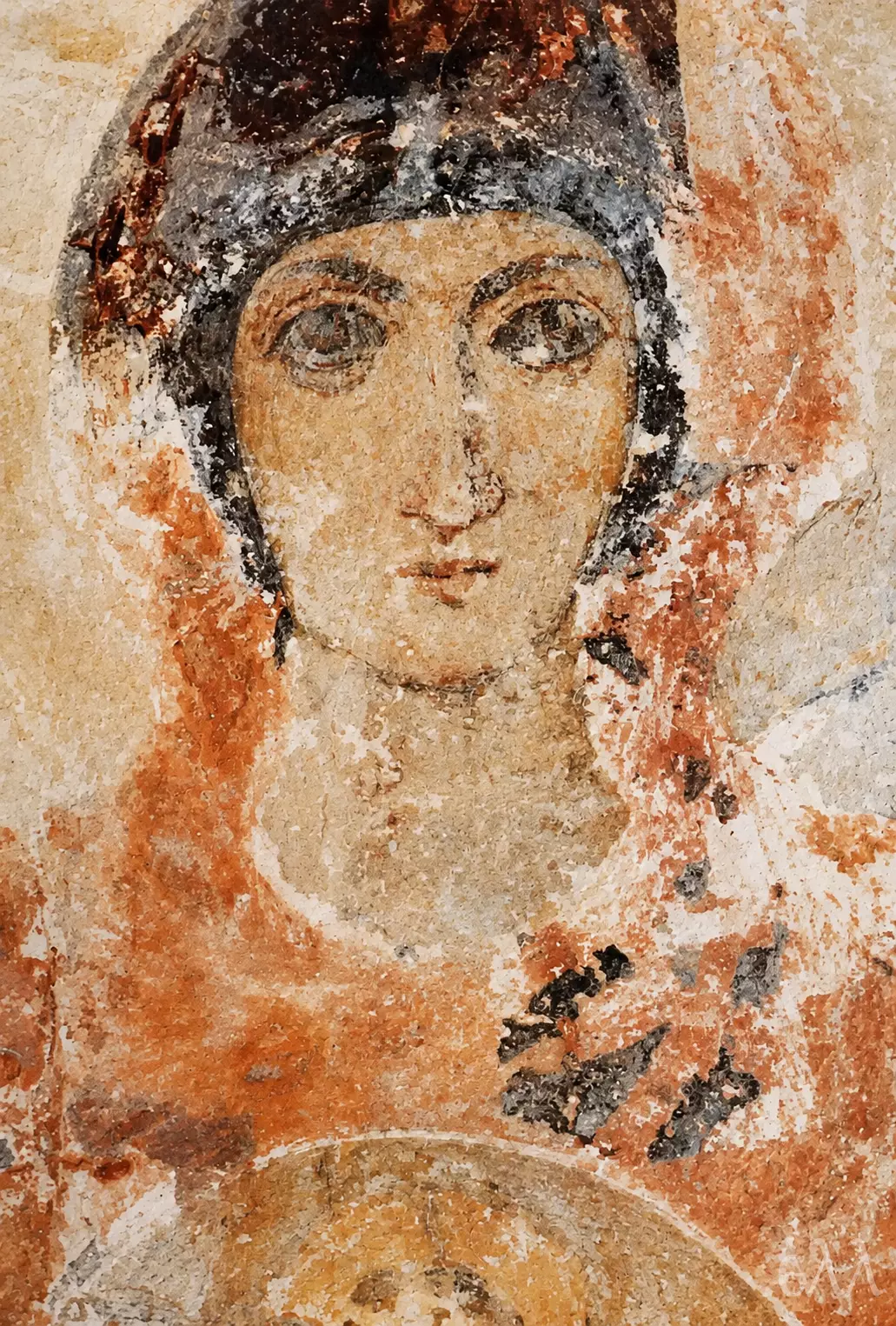
The Panagia Nikopoios in the church of Panagia Drosiani, near the village of Moni on Naxos, belongs to one of the most remarkable surviving ensembles of Early Byzantine monumental painting. Generally dated to the seventh century, and more specifically by some scholarship to its second half, the figure occupies the northern conch of the church. The painter is unknown. What remains, though heavily damaged, preserves an artistic language of unusual refinement for a small Cycladic monument: the solemn frontality of the Theotokos is moderated by a face whose modelling still carries a distant classicising softness. Within the wider seventh-century programme at Drosiani appear the Ascension in the sanctuary apse, the exceptional double representation of Christ in the dome, and an early Deesis beneath the Nikopoios.
The surviving face dominates the wall painting. Broadly oval, it is framed by the dark remnants of the maphorion; the large eyes are strongly outlined, the brows gently arched, the nose narrow and prolonged, the mouth small. Across the cheeks and forehead, ochre flesh tones pass through reddish and lighter passages without the severe fragmentation of form familiar from much later Byzantine painting. Much has disappeared. Abrasion, pigment loss, exposed plaster: these interrupt the neck, garments and surrounding field, while surviving areas of muted grey-blue and warm red disclose only portions of the original chromatic arrangement. Amid the damaged painted surface, the direct gaze remains remarkably coherent.
Panagia Nikopoios and the Early Byzantine Programme at Drosiani
The iconographic identification as Panagia Nikopoios, a title conventionally associated with the Virgin as “Bringer of Victory”, rests upon the larger composition rather than upon the surviving facial fragment alone. In this type the Theotokos is represented frontally, holding before her breast a medallion containing Christ. At Drosiani the composition forms the upper part of the northern conch, above the five-figure Deesis. The placement, because the image belongs to a carefully conceived iconographic programme rather than to an isolated votive representation, is particularly important. The official monument record likewise identifies the northern conch with the Panagia Nikopoios and the Deesis, while noting that the earliest paintings of the church belong to the seventh century.
Its artistic character deserves attention apart from the unusual iconography. The face has an almost portrait-like immediacy: the eyes are enlarged yet remain organically set within the facial structure, the cheeks retain breadth, and the contour of the jaw descends without the extreme attenuation found in many later sacred figures. Dark lines around the eyes and eyebrows establish the principal structure; colour works more quietly within it. Beneath the accumulated losses one can still detect the relationship between warm flesh tones and cooler passages around the head. Restrained in its spatial construction, the composition depends above all upon frontality.
Such qualities have helped scholars situate the paintings within the complicated artistic world of the seventh century, when Late Antique modes of modelling remained available alongside increasingly abstract approaches to sacred representation. Nikolaos Gkioles, in his 1999 study of the earliest Drosiani paintings, placed them in the second half of the century and emphasised their strong Hellenistic or classicising reminiscences. He also related the iconographic programme to the Christological controversies of the period, particularly those preceding the Sixth Ecumenical Council of 680–681. The historical argument extends beyond what can be read from the Nikopoios alone, though it matters for understanding why Drosiani has attracted sustained scholarly attention.
Within the church, the Virgin therefore participates in a theological and pictorial environment of unusual density. The double image of Christ in the dome, the Ascension, the Deesis and the Nikopoios bring several formulations of Christological imagery into close architectural proximity. Preceding the Iconoclastic crisis, the surviving painting also possesses exceptional documentary importance for the history of Byzantine representations of the Theotokos. Very little monumental painting of comparable date has survived with its original ecclesiastical context substantially intelligible.
Time has altered the image severely. Large areas have become pale, broken or nearly illegible, and the warm background now merges in places with exposed plaster. The face has resisted this dissolution more successfully. Its steady gaze, broad modelling and surviving linear accents preserve something of the painter’s original conception, while the uneven surface makes the long material history of Drosiani inseparable from the image now seen. Through this damaged sacred figure, Early Byzantine monumental painting on the Aegean islands remains available for direct examination, its material surface carrying the losses accumulated across centuries.
(The translation was edited by A. Williams.)