
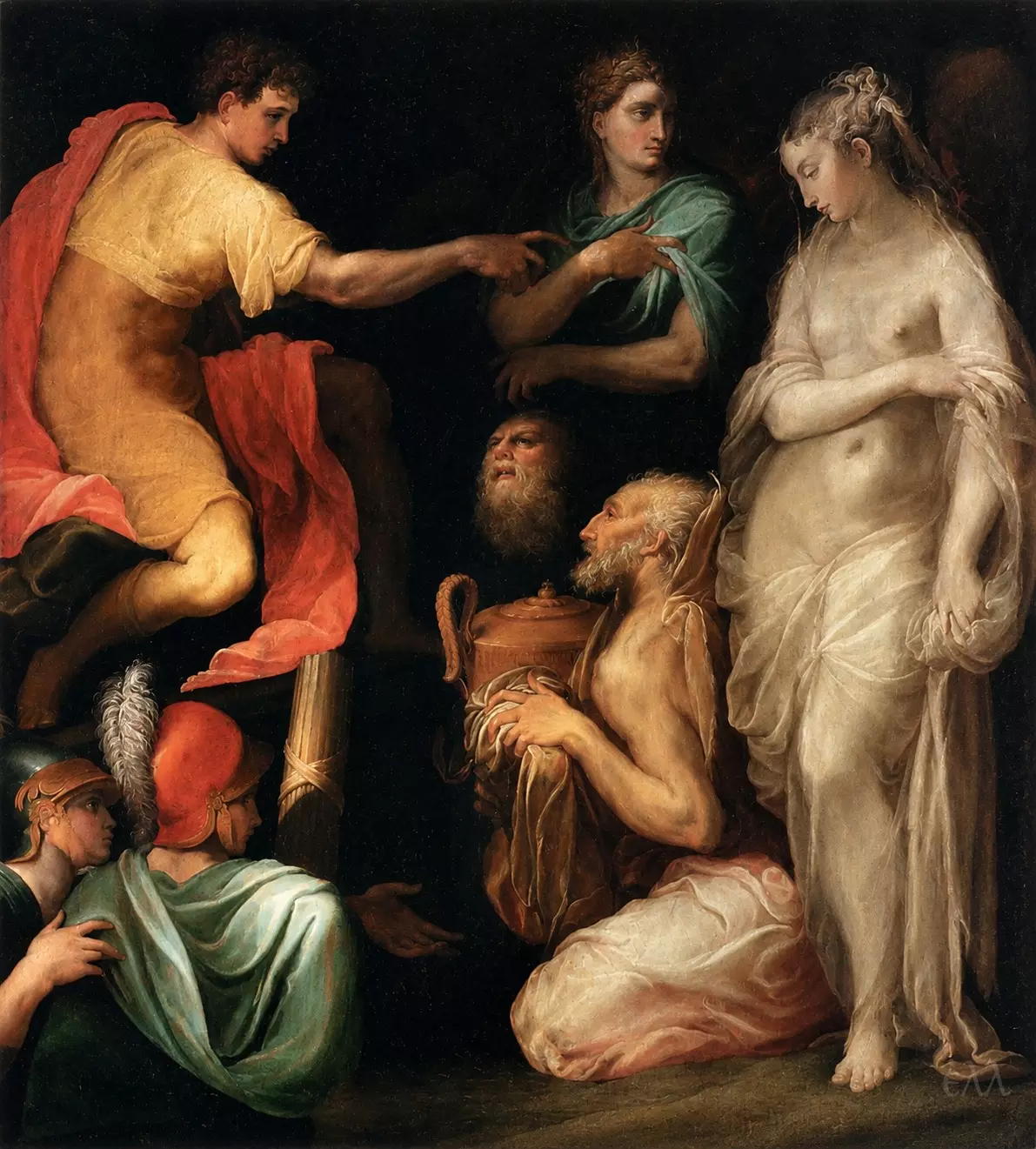
The Continence of Scipio, painted around 1555 by Niccolò dell’Abate, belongs to the years immediately following the Modenese painter’s move to France. Executed in oil on canvas and preserved in the Musée du Louvre in Paris, the work transforms an episode from Roman history into an unusually concentrated arrangement of figures, gestures and colour. The Louvre dates the piece to the third quarter of the sixteenth century, around 1555; its present catalogue measurements are 124.9 × 120.1 cm, while older published measurements differ slightly. Dell’Abate had arrived at Fontainebleau in 1552, entering the artistic environment of the French court as an assistant to Francesco Primaticcio.
The subject derives from Livy’s account of Scipio Africanus after the Roman capture of New Carthage in 209 BC (Livy, Ab Urbe Condita 26.50). A young Celtiberian woman, already betrothed to the prince Allucius, was brought before the victorious commander. Scipio arranged for her return and subsequently gave back the wealth offered by her family, directing it toward the marriage. Livy presents the episode as an exemplary demonstration of the Roman general’s self-command and generosity. Dell’Abate selects the encounter itself, compressing military authority, supplication, wealth and the young woman’s presence into a dark, shallow pictorial field.
Scipio occupies the elevated position at the upper left. His body turns sharply across the scene, one leg bent beneath him, while a broad golden-yellow tunic and sweeping red mantle give his figure immediate chromatic prominence. Almost horizontal, the extended arm crosses a substantial portion of the canvas and directs attention toward the standing youth in green and, beyond him, the young woman — the gesture itself carrying the weight of the entire narrative. Scipio’s authority is therefore expressed through position and movement: elevated seat, expansive reach, commanding stillness.
The Continence of Scipio: Composition, Gesture and Fontainebleau Style
Opposite the commander stands his counterpart, her head inclined and her gaze lowered. A translucent veil and pale drapery pass across the body with extraordinary delicacy, allowing her to appear almost sculpturally exposed while preserving a sense of courtly refinement. Her stillness creates a marked visual interval within the crowded scene. Around her, the palette becomes considerably lighter — ivory, cream, pale flesh tones — against the dense black background.
Between the two principal sides of the composition, hands carry much of the story. The standing youth, generally identified as Allucius, turns toward Scipio while extending one hand across his chest. Scipio points toward him; the gestures nearly meet. Below, kneeling figures create another sequence of upward movement, their faces directed toward the commander. One elderly man supports an elaborate lidded vessel whose warm brown surface catches the surrounding light. Within the context of Livy’s story, the conspicuous vessel evokes the wealth offered to Scipio and associated with the bride’s return and marriage.
At the lower left, helmeted soldiers establish the military setting with only a few compact forms, their armour, plumes and red headgear partially cut by the edge of the canvas, making the gathering appear to extend beyond the visible field. Above them, Scipio’s red mantle descends in a broad irregular curve before rising again around his seated body. Red recurs across the left half of the picture, binding soldier, commander and drapery into a single chromatic zone.
Space is remarkably compressed. Bodies overlap in successive layers, yet the dark ground offers very little architectural or landscape recession; consequently, it is the bent knees, turned shoulders, extended arms and overlapping profiles that assume greater importance than setting. From the soldiers below to Scipio above, then across the standing youth and down through the kneeling men, the eye follows a restless sequence of diagonals before reaching the pale vertical figure at the right.
Mannerist Bodies and the Fontainebleau Context
The treatment of the human form places the painting firmly within the refined Mannerist language cultivated by dell’Abate during his French period. Limbs lengthen, torsos twist, poses develop through calculated bends and rotations. Scipio’s body moves with an almost elastic quality, while the young woman’s proportions are attenuated and her drapery adheres closely to the contours beneath it. The kneeling man near the centre turns his bare upper body upward with a complicated relationship between shoulders, neck and head, introducing another strong torsional movement.
Colour contributes equally to this artificial elegance. Golden yellow beside vermilion, deep green against black, luminous flesh tones and translucent white create separated areas of high intensity. The dark background suppresses incidental description and allows each hue to acquire an almost enamelled clarity. On the young woman especially, very gradual tonal modelling gives flesh and fabric a cool luminosity; beside her, the more vigorous bodies of the male figures are defined through stronger transitions between highlight and shadow.
Such qualities belong naturally to dell’Abate’s Fontainebleau environment. Primaticcio’s influence was especially important after the painter’s arrival at the French court in 1552, where dell’Abate took part in a decorative culture that favoured elongated figures, sophisticated poses, classical subjects and highly controlled elegance. Revealing in this respect is the attribution history of the painting itself: the Louvre records former attributions to Primaticcio and, later, Toussaint Dubreuil, evidence of how closely the work became associated with the artistic language surrounding the First School of Fontainebleau.
Within this refined vocabulary, Scipio’s celebrated virtue receives a distinctly courtly form. Violence from the preceding conquest remains outside the depicted moment; attention falls instead on conduct — the commander’s expansive indication, the young man’s response, the offered wealth below, the restrained posture of the woman at the right. Set against the darkness, her pale body forms the final vertical accent of the composition, while the translucent veil descends from her hair to the folds gathered beside her bare feet.
(The translation was edited by A. Orfanos.)