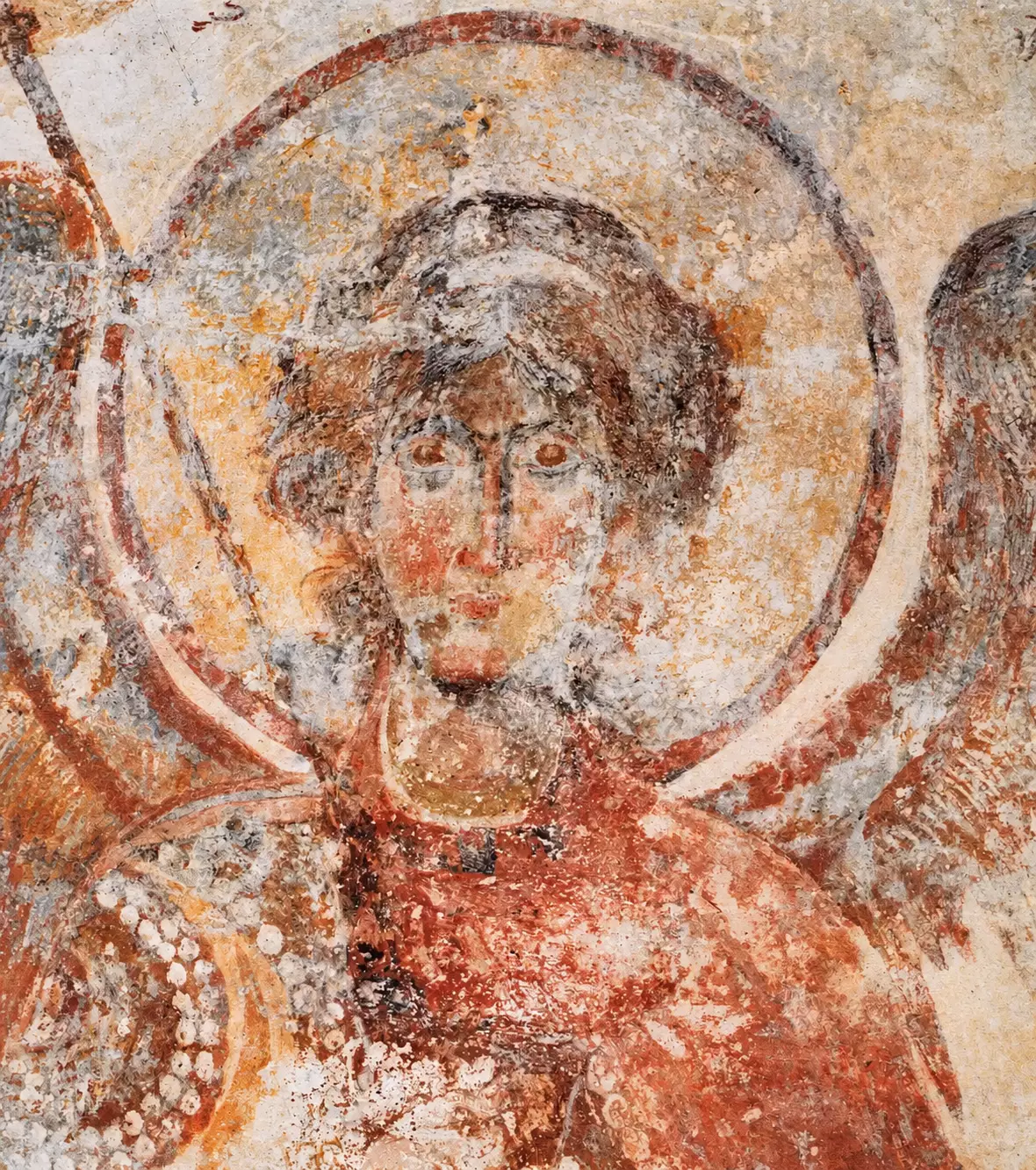
The archangel preserved in the Church of Panagia Drosiani on Naxos belongs to one of the most remarkable bodies of Early Byzantine wall painting to survive in the Aegean. An anonymous painter set the figure on the intrados of the sanctuary arch, as one of two frontal archangels associated with the apse decoration. The earliest painted programme of Drosiani has been assigned broadly to the seventh century, although the precise chronology remains debated. A major scholarly re-examination placed the murals in the second half of that century, relating their iconographic programme to contemporary Christological controversies and noting their pronounced classicizing reminiscences. The church itself preserves an architectural core generally associated with the late sixth or early seventh century.
Within this setting the archangel is striking for the concentration of the image. The figure faces forward, enclosed by a large circular nimbus outlined in reddish pigment, while the wings spread laterally behind the shoulders. A red garment occupies much of the lower surviving field. Age and material loss have broken the painted surface into irregular passages of pale plaster, earth tones, red, grey and dark brown, yet the frontal structure remains immediately legible. The monumental image has suffered heavily, but its central axis has not disappeared: hair, brows, nose and mouth still gather the composition around the unwavering gaze.
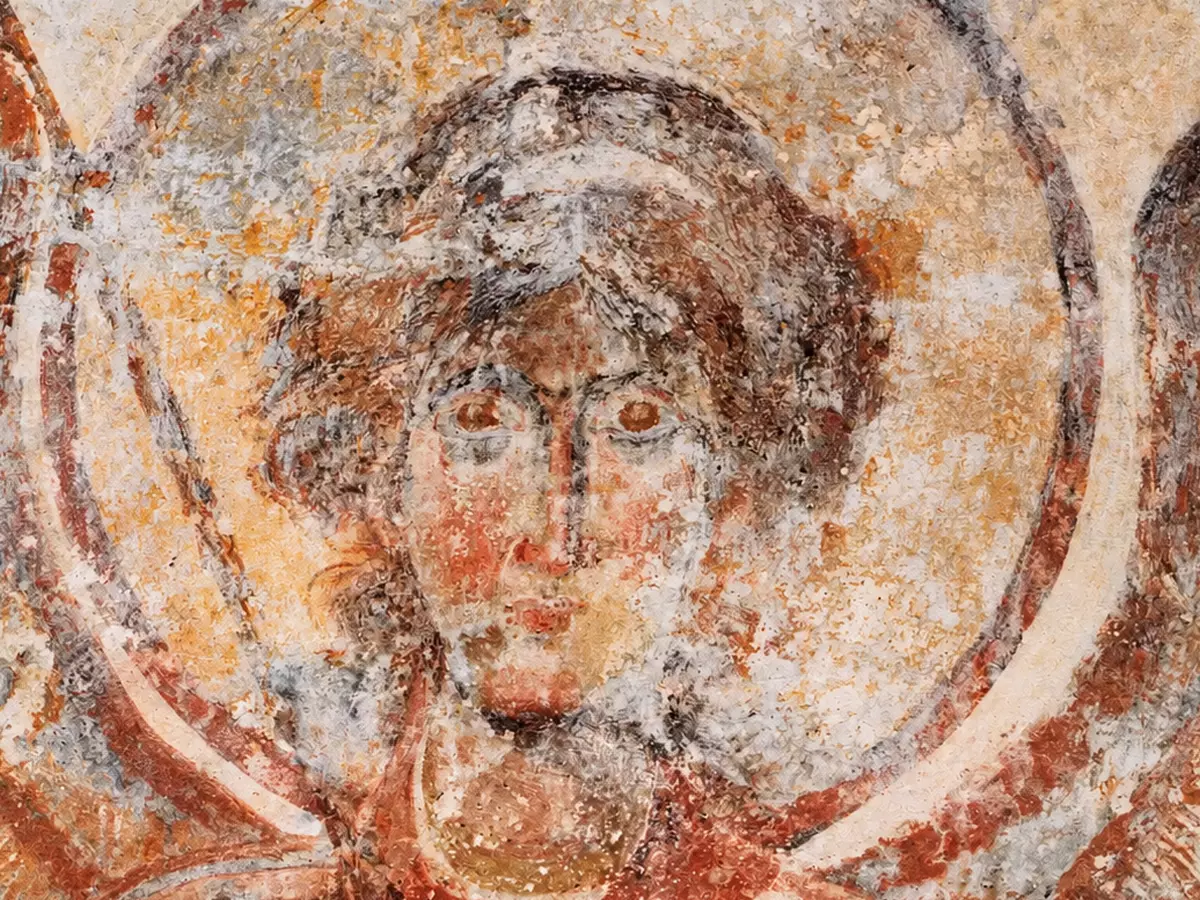
The Drosiani Archangel Fresco in Close View
Seen at closer range, the physiognomy carries much of the painting’s expressive force. The face is long and softly oval, with a narrow chin, a straight, emphatic nose and a small mouth touched with red. Most persistent are the eyes. Large, nearly symmetrical and directed outward, they are articulated by dark contours and reddish-brown pupils; the surviving lines around them are economical, with little attempt at illusionistic depth. The painter did, however, avoid reducing the head to a purely graphic formula. Pale passages across the forehead, cheeks and neck, together with warmer russet areas, suggest an originally modulated flesh tone whose transitions are now interrupted by abrasion and paint loss.
The hair forms a dusky mass around the upper head, divided near the centre and treated through curving strokes that remain visible despite the damaged surface. Its weight contrasts with the paler facial field. Around the head, the broad nimbus is defined more through its circular contour than through preserved internal decoration. This geometry matters visually: against the restless, granular condition of the plaster, the arc steadies the figure. The wings, more fragmentary at the sides, extend the composition beyond the visage and make the angelic identity unmistakable without depending upon an inscription or handheld attribute.
Such frontality belongs naturally to the monumental language of the sanctuary. Scholarship on Drosiani has emphasized the unusual coherence and theological density of its early pictorial scheme, which includes the celebrated double representation of Christ in the dome and other pre-Iconoclastic compositions. The archangel therefore formed part of a carefully organized sacred environment, not an isolated decorative portrait. The original arrangement has also been linked with a donor milieu broader than a single anonymous commission. Epigraphic evidence from Drosiani records Bishop Sisinnios of Naxos among figures associated with patronage, giving the pictorial decoration a more specific ecclesiastical and social setting than its anonymous authorship might suggest.
What survives of the archangel also complicates any easy division between “classical” naturalism and abstraction in seventh-century Byzantine painting. The face preserves hints of volume, especially in the broad cheeks and modelling around the eyes, while the symmetry, frontal pose and strong contour compress the image toward the wall plane. One influential study of the Drosiani murals described the ensemble as among the relatively few surviving works of the period with strong classicizing memories. In this figure those memories are not expressed through movement or spatial depth. They persist in the painter’s concern for a coherent human countenance, a measured facial type and a certain softness beneath the more hieratic organization of the whole.
The close detail makes the condition of the mural impossible to separate from its present appearance. Numerous losses expose whitish areas of the plaster substrate; darker strokes survive in broken islands, and rust-toned zones fluctuate from dense colour to almost transparent traces. Yet the damaged state does not erase the painter’s control. The archangel’s gaze, the curve of the nimbus and the shadowed framing of the locks still hold together an expanse that has otherwise become materially discontinuous. That persistence is one reason the Drosiani paintings continue to hold such importance for the study of Byzantine visual culture before Iconoclasm.
(The translation was edited by D. Manou.)