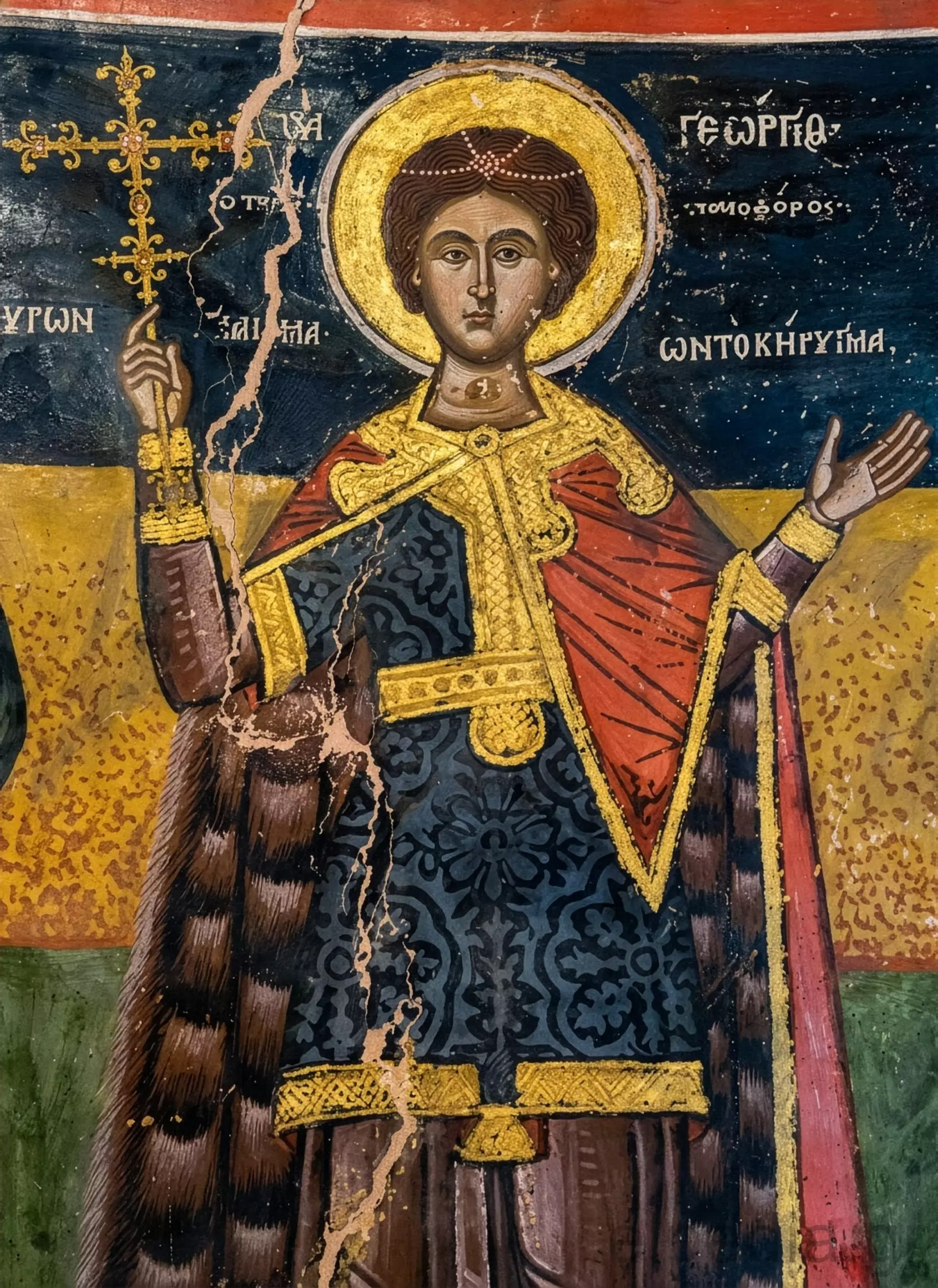
Saint George, the Post-Byzantine wall painting from Panagia Pelekiti Monastery, presents the military martyr as a full-length, frontal figure, standing against a strongly divided field of deep blue, ochre and green. His name, ΓΕΩΡΓΙΟΣ, is painted in pale letters beside the gold halo, while a second inscription, partly interrupted by losses in the surface, appears to preserve the familiar epithet Tropaiophoros, “Trophy-Bearer.” The monastery itself rises on a steep rock above Karitsa in the Agrafa region, at about 1,400 metres, and its present complex developed from the late fifteenth century into the sixteenth and seventeenth centuries.
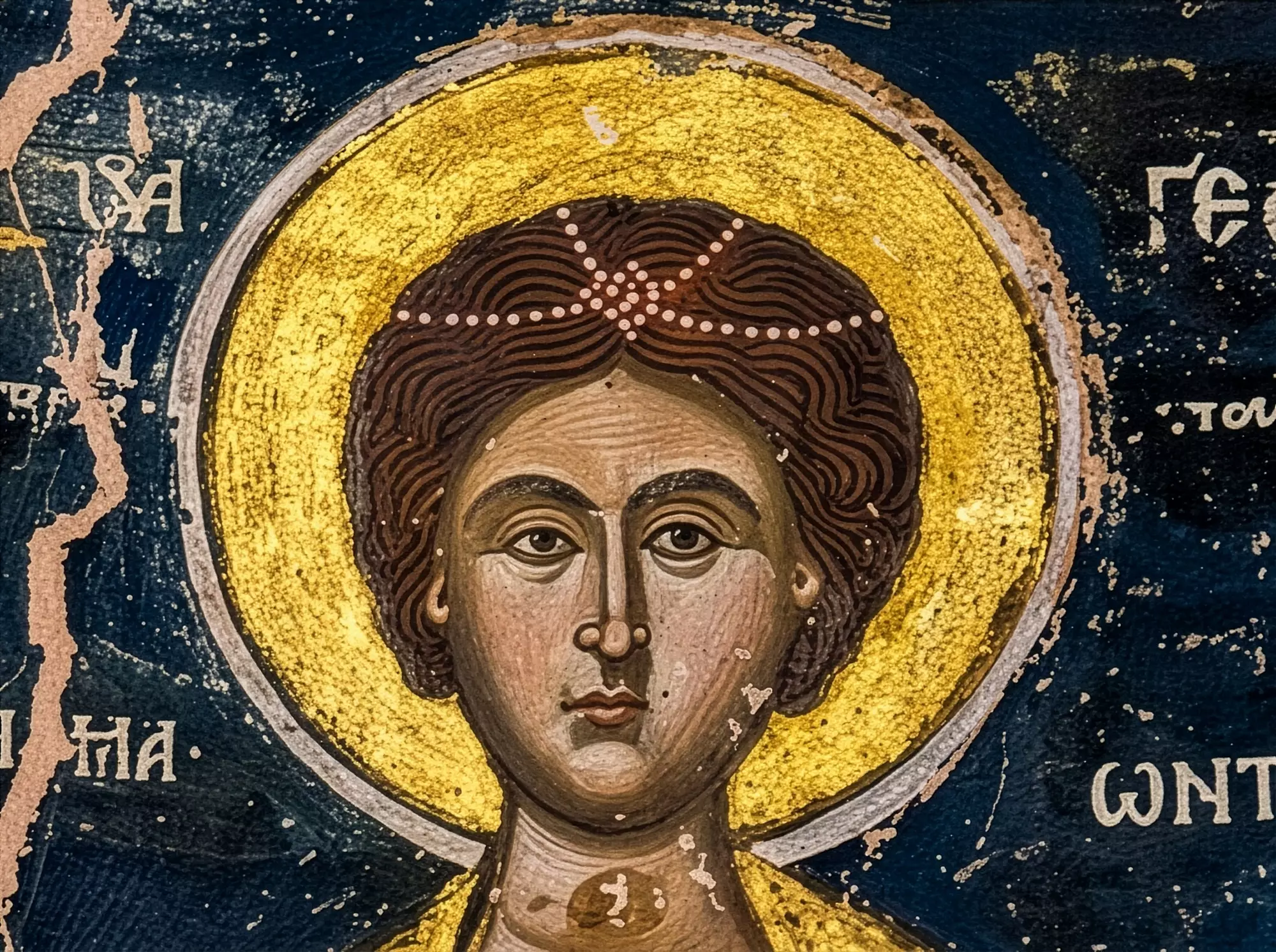
Immediately striking is the martyr’s youthful physiognomy. The painter constructs the face through firm contour, broad areas of brown and rose flesh tone, and a small number of lighter accents across the forehead, nose, cheeks and neck. Large almond-shaped eyes meet the viewer directly; the brows form long dark arcs, the nose descends in a narrow vertical line, and the compact mouth gives the expression an austere stillness. Around the face, carefully ordered curls are gathered into a rounded mass of dark hair, crossed by strings of pearl-like ornaments, and against the gold nimbus, this intricate patterning becomes one of the most refined passages in the figure.
Saint George at Panagia Pelekiti Monastery
The military costume is considerably richer. A dark blue tunic, densely covered with black floral and foliate patterns, is enclosed by broad gold bands at the shoulders, chest and hem. A red mantle falls diagonally across the saint’s left side, while additional brown and dark striped elements frame the body. Gold cuffs, borders and jewellery-like details establish a decorative rhythm across the otherwise rigid frontal pose. In his right hand the martyr holds a tall cross-staff, its upper section expanding into an elaborate gold cross. His left hand is raised with the palm open, fingers separated and clearly delineated. The gesture, set away from the body, gives the static figure a measured rhetorical emphasis.
Across the painting, line carries much of the visual structure. The hair is described by repeated curved bands of dark paint; the fingers by parallel contours; the garments by sharply controlled borders and dense ornament. Modelling remains restrained, especially in the face, where a few tonal transitions create volume without dissolving the linear framework. The broad gold halo and the extensive use of yellow-gold ornament around the shoulders and tunic add luminosity against the blue background.
Linear Style, Ornament and Preservation
Substantial and visually important is the damage that scars the surface. A wide vertical loss descends from the upper border through the cross, the martyr’s right arm and the lower part of the figure, exposing the underlying plaster in irregular pinkish-beige areas. Smaller abrasions, scratches and pigment losses scatter across the blue field, halo and face. Even so, the figure’s identity, pose and principal attributes remain legible, as do large parts of the ornamental system.
The exact painter of this figure cannot be securely isolated from the surviving evidence. The monastery preserves two documented seventeenth-century painting campaigns: the Church of the Ascension was painted in 1654 by Ioannis, the priest Nikolaos and the hieromonk Iakovos, while the church of Panagia Faneromeni received wall paintings in 1666 and a further campaign in 1674 by Iakovos and his son Dimitrios. Without a secure identification of the precise church surface to which this Saint George belongs, assigning the figure to one of those named hands remains uncertain.
Within this mountainous monastic setting, and belonging as it does to the continuing Post-Byzantine visual language of the military saints, the image gathers its familiar elements: frontal presence, explicit inscription, cross as a martyrial attribute, rich ceremonial dress, disciplined contour. Its force lies equally in the preserved paint and in the fractures that now cut through it, leaving the gold halo, dark patterned tunic and unwavering gaze prominent across the damaged wall.
(The translation was edited by P. Alexiou.)