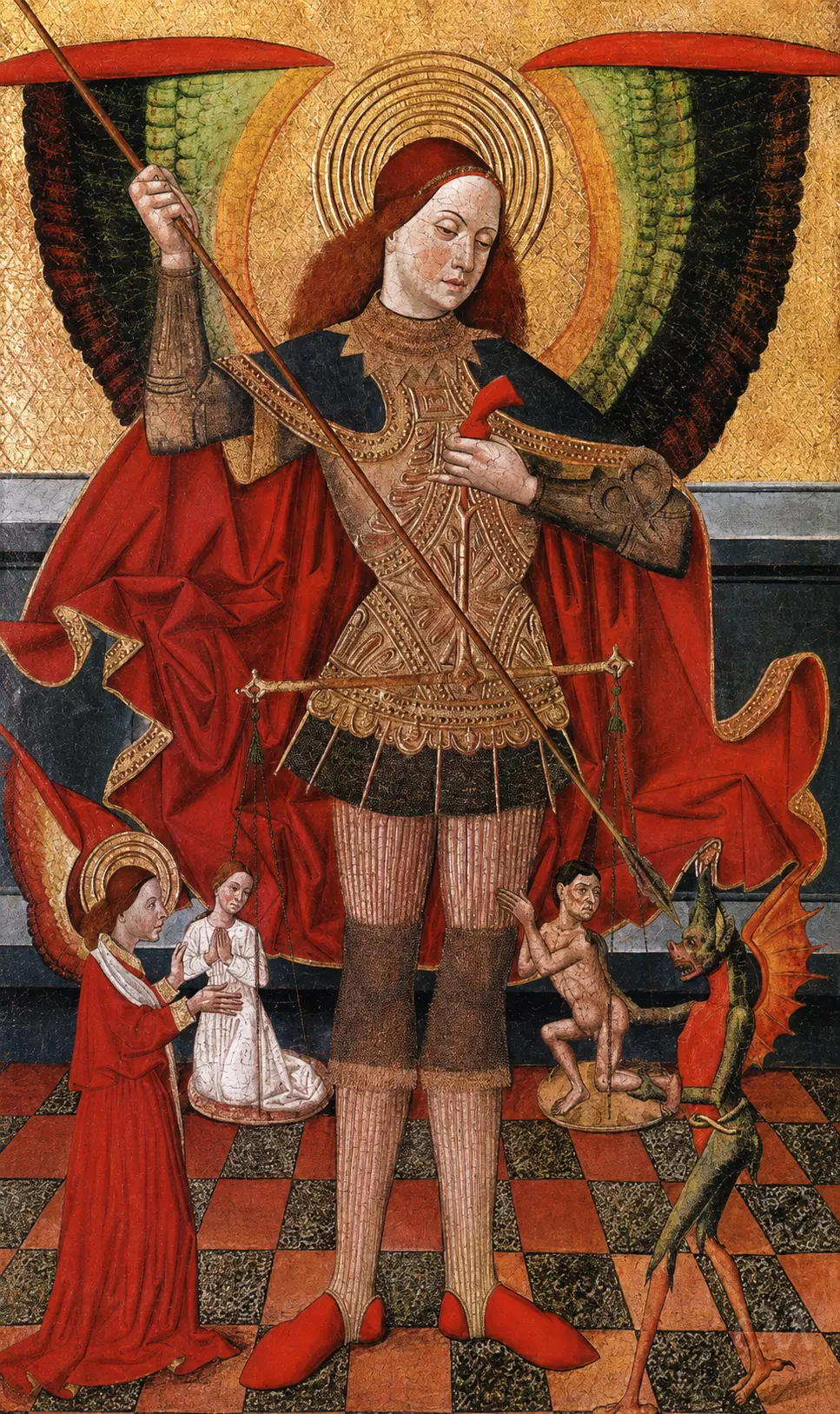
Juan de la Abadía‘s Saint Michael Weighing Souls, painted in Aragon during the closing decades of the fifteenth century, places the Archangel Michael at the centre of a compact vision of judgment. The Museu Nacional d’Art de Catalunya dates the panel to about 1480–1495 and identifies Abadía, known as the Elder, as a painter active in Huesca from 1469 to 1498. The work measures 127.7 × 76 × 6 cm and combines tempera, stucco relief, gold leaf and metal plate on a wooden support. It probably formed the central compartment of an altarpiece dedicated to Saint Michael and may have come from Liesa, in the province of Huesca.
At almost the full height of the panel, Michael stands frontally in elaborate armour, his enormous wings spreading behind him and his red mantle falling in angular folds around his body. In his right hand he holds a long spear; with his left, the balance in which two human souls are weighed. Below, the image divides into two opposed groups. At Michael’s right, a smaller angel attends a clothed female soul, kneeling with joined hands. At his left, a fantastic winged demon interferes with the opposing pan beside a naked male figure. The scene therefore combines ceremonial stillness with narrative action: Michael himself remains composed, almost remote, while the struggle surrounding the scales unfolds near his feet.
Saint Michael Weighing Souls: Judgment, Armour and the Balance
The principal iconographic theme is the weighing of souls, or psychostasis, a subject closely associated with Michael’s role in images of the Last Judgment. By converting an abstract reckoning into something immediate and measurable, the balance gives visible form to judgment. Juan de la Abadía makes the episode unusually tangible. The scales hang from a horizontal beam, thin cords descend towards the two pans, and the souls occupy them as small human figures whose opposing destinies are already beginning to take shape.
Michael’s military identity remains equally prominent. His body is enclosed in richly ornamented armour, its surface treated almost as precious metalwork. Repeated punched and relief-like patterns articulate the breastplate, sleeves, belt and protective elements around the shoulders and arms. The cuirass is especially elaborate: raised lines, beaded borders and symmetrical vegetal forms cover a panoply that seems designed for ceremony as much as combat. Cutting diagonally across the vertical figure, the spear passes from the raised right hand towards the lower edge, introducing one of the strongest directional movements in the composition.
Against this metallic density, the red mantle expands in broad angular folds. It emerges behind the arms, falls around the legs and spreads laterally across much of the lower register. Red also appears in Michael’s footwear and in smaller accents near the upper wings, establishing a chromatic rhythm against the dark blue-black of the shoulder covering, green feathers and extensive gold ground.
The material structure contributes greatly to this effect. The museum identifies tempera, stucco reliefs, gold leaf and metal plate on wood, techniques that allow areas of actual relief and reflective metal to coexist with painted modelling. The distinction between gold leaf as a material and gold ground as a visual field is especially useful in describing a surface of this kind. Behind Michael, the gold is densely patterned with intersecting ornamental lines, so that even the apparently empty background becomes active.
Another concentration of ornament appears in the halo. Several raised concentric rings surround Michael’s head, each differentiated through repeating punched or incised designs. Beyond them, the great wings form a second enclosing structure. Their feathers are organized in bands of green, dark red and almost black, with individual rows carefully distinguished. The result is highly controlled: halo, wings and shoulders create successive curved frames around the face.
The Two Souls and the Intervention of the Demon
At the lower level, proportion changes abruptly. Michael is monumental; the subsidiary figures are markedly smaller. The hierarchical scale allows the archangel to dominate the entire field while still leaving enough room for a miniature drama of salvation and condemnation beneath his arms.
The soul associated with the angel is clothed in white and kneels with hands joined. The accompanying angel bends towards the figure, one arm extended in a protective or guiding gesture. Across the composition, the second soul is naked, kneeling awkwardly as the demon presses into the scene. The Museu Nacional describes the demon as attempting to cheat the weighing by tilting the scale in its favour. Its interference transforms the otherwise orderly balance into a narrative contest.
The demon itself belongs to a deliberately grotesque visual register. Its attenuated limbs, claw-like extremities, pointed head, exaggerated mouth and membranous pinions separate it sharply from the measured geometry of Michael’s body. Its green-black surface is interrupted by reddish and ochre passages, while the contorted pose produces an angular silhouette. Nearby, the naked soul appears physically vulnerable beside this agitated creature.
Michael, although the contest unfolds directly beneath him, scarcely reacts. His face remains lowered and restrained, while the spear establishes his power through its presence across the picture. Such emotional economy intensifies the hierarchy of the scene: disorder gathers below; above it, the archangel maintains the controlled bearing of a judge and heavenly warrior.
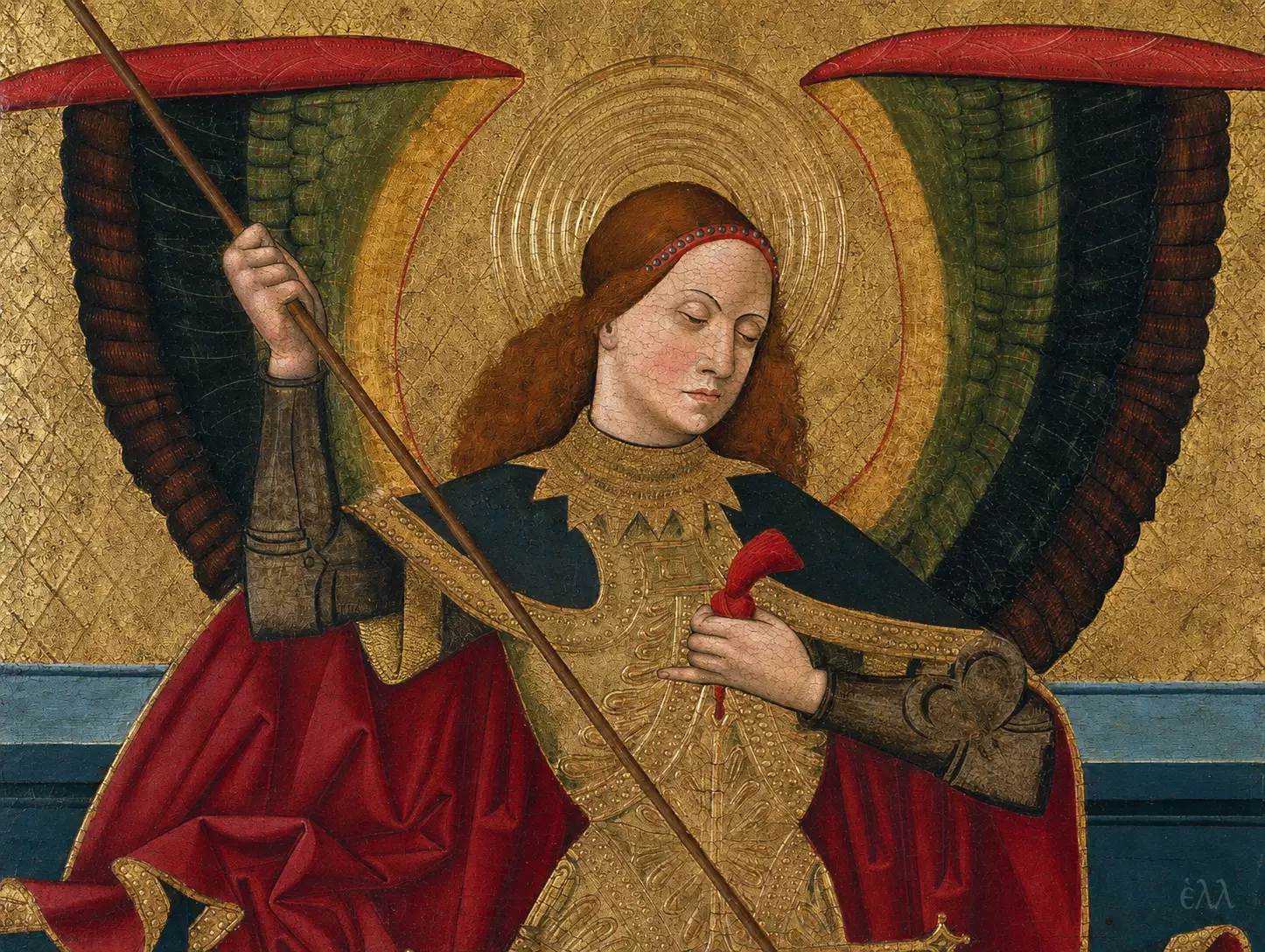
Detail of the Archangel Michael: Face, Halo and Wings
Seen closely, Michael’s face introduces a quieter form of observation. The head inclines gently towards his left hand and the scales. A high forehead, narrow arched brows, lowered almond-shaped eyes, long straight nose and small red mouth give the physiognomy an idealized refinement. Subtle pink modulation appears across the cheeks and around the eyes, while fine dark contours define the eyelids and facial features. The expression is introspective, with little trace of the violent confrontation taking place below.
The hair spreads across the shoulders in a mass of reddish curls, meticulously separated into small undulating strands. Above the forehead, a narrow decorated band holds the hair away from the face. Then comes the halo: ring after ring of raised ornament, progressively enlarging around the head and creating an almost architectural frame.
Surface, at this proximity, becomes central to the experience of the work. The gold background carries a dense lozenge diaper filled with small vegetal or foliate motifs; the cuirass is covered by another vocabulary of repeated ornament; feathers overlap in orderly rows. Flesh alone offers a relatively calm field. The pale face, lightly modelled and enclosed by red hair and gold, becomes the visual pause within an image saturated with pattern.
Juan de la Abadía worked within the vigorous environment of late Gothic painting in Aragon. Scholarly studies of the period place him among the significant painters active around Huesca during the later fifteenth century, when Aragonese painting participated in the broader exchange of models and techniques associated with Hispano-Flemish art. Across fifteenth-century European painting, the increasing attention given to sharply observed surfaces, textiles, metal, facial characterization and small narrative incident had already become a powerful artistic language.
In Saint Michael Weighing Souls, those interests are absorbed into the structure of a Spanish Gothic altarpiece. Monumental scale, gilded relief, elaborate armour and emphatic hierarchy remain central, while the smaller figures introduce gesture, individualized action and moral drama. Acquired with the Plandiura Collection in 1932, the panel now belongs to the Museu Nacional d’Art de Catalunya, although the museum currently records it as not on view. The full composition and its enlarged detail also reveal how much of Abadía’s effect depends upon the meeting of distance and proximity: commanding silhouette from afar, minute tooling, curls, feathers and modelling of the features at close range.
(The translation was edited by D. Manou.)