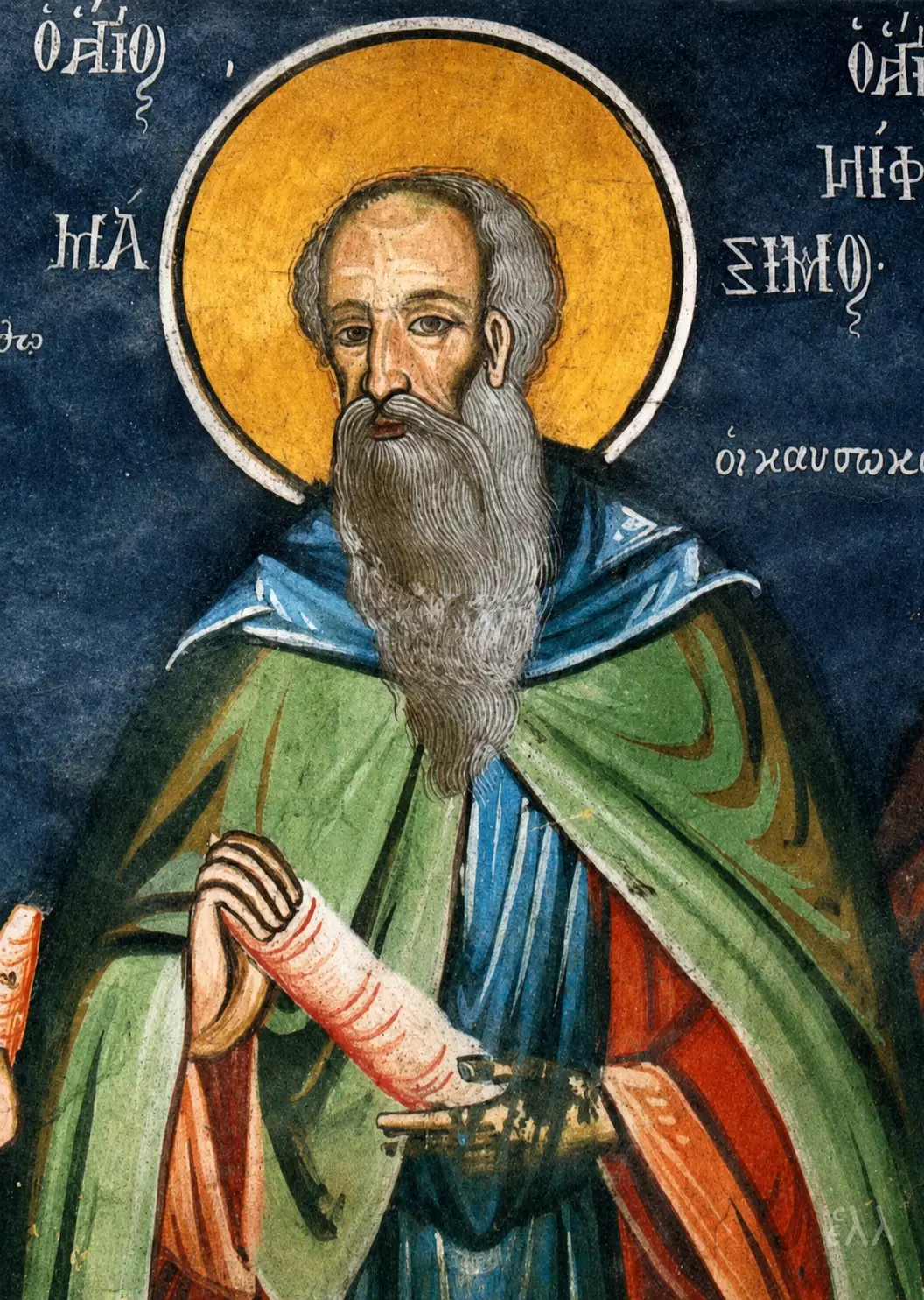
In the dark blue background of the Kyriakon of Nea Skete, dated to the 18th century, the anonymous hagiographer depicted the figure of the Venerable Maximos the Kafsokalyvitis, the ascetic who lived on Athos in the 14th century and remained in the memory of the monastic tradition for the life of poverty and unceasing prayer. The title “Kafsokalyvitis” is no random designation.
It refers to his habit of constructing makeshift huts out of branches and grass, which he delivered to the fire as soon as he judged that the place had become too familiar, an act which the painting depicts him carrying even within his gaze. The fresco belongs to that great family of post-Byzantine compositions that filled the churches and the Kyriaka of the sketes of Mount Athos, where painting continued, with local nuances of style, the iconographic standards which the Cretan school of the 16th century had bequeathed. Upon the dark background, beside the head, two inscriptions identify the figure, as was customary in every monumental composition of this kind.
Post-Byzantine Fresco of Venerable Maximos the Kafsokalyvitis
The face dominates within a halo circle of deep yellow colour, with a white outline that separates it cleanly from the dark background. The hair has turned white, thinning at the forehead, while the beard, long and silvery, descends in broad waves covering almost the entire chest. The gaze, dark and steady, does not seek the viewer so much as it looks at him already, as if it had anticipated him. Over the body spreads a green mantle, with golden edges that form wavy patterns, beneath which is discerned a light blue tunic and, deeper still, a warm red fabric that emerges at the sleeve.
The right hand, open, points the palm outward, a symbol of virginity and ascetic purity according to the iconographic tradition, while the left restrains, higher up, the edge of a deep red scroll that unfolds between the fingers. No detail appears random, not even the rusted hue at the lower part of the hand, a trace of wear that time left without asking permission. Thus remains, within the dark background of Nea Skete, a figure that the art of the 18th century managed to keep almost present.
(Translated from the Greek text by K. Pappas.)


