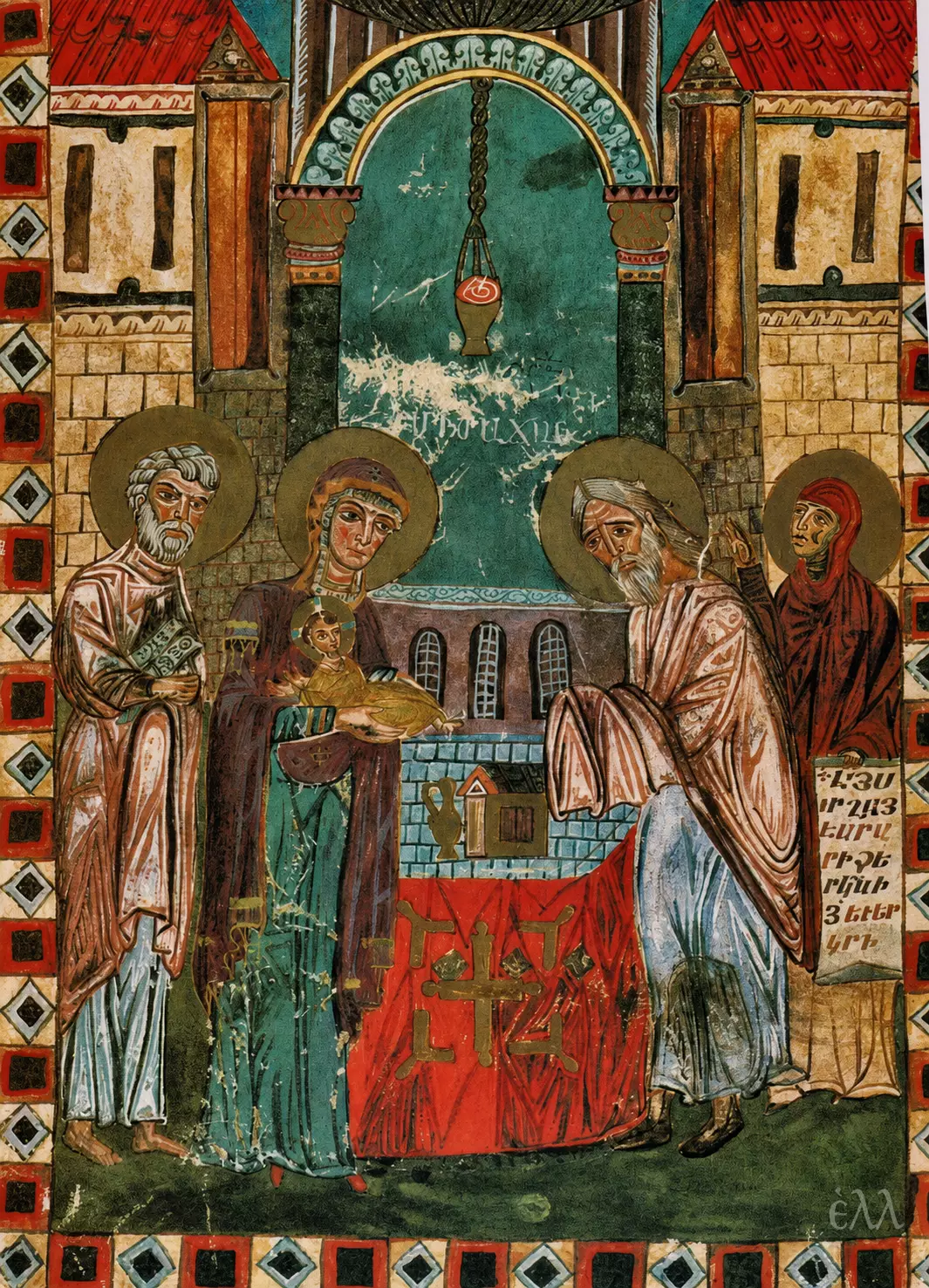
The Presentation of Jesus in the Temple, commonly associated with Hovhannes Sandghkavanetsi, belongs to the Moghni Gospels, an Armenian Gospel book produced in 1060 and preserved in Yerevan as Matenadaran MS 7736. The attribution of MS 7736 to Sandghkavanetsi has a recognized place in modern scholarship. Four haloed adults and the Christ Child stand before a compressed architectural setting whose arches, masonry, roofs, columns, hanging vessel, and patterned borders turn the Temple into both setting and ornament.
At the centre, the Theotokos holds Christ close to her body, directing him toward the elderly Simeon. The liturgical exchange remains unrealized in this suspended instant, which lends the miniature much of its tension: Simeon bends forward, his hands enveloped in the folds of his mantle, while the Child rests securely within his mother’s embrace. Joseph stands apart at the opposite side, carrying the sacrificial offering connected with the rite described in Luke (2:22–24). Behind Simeon appears the prophetess Anna, holding a scroll and completing the assembly of witnesses.
The figures are large in relation to the architecture. Firm contours, narrow bands of light, abrupt changes of tone, and a graphic treatment of drapery folds—defined without dissolving into soft modelling—articulate the faces, hands, and garments. Eyes are enlarged, gestures concentrated, and bodies elongated without losing their weight. Against saturated green, red, ochre, and pale blue fields, the carnation acquires an enamel-like luminosity.
Presentation in the Temple and Armenian Manuscript Art
The scene belongs to the Armenian tradition of Gospel illumination in which narrative miniatures of Christ’s life could form a prefatory cycle before the sacred text. Such cycles did not follow a fixed twelve-feast scheme in the eleventh century; their number and selection varied, and the Presentation was among the subjects available to Armenian illuminators. Luxury manuscripts of the period could absorb Byzantine iconographic and stylistic elements while retaining distinctly Armenian habits of decoration and page construction.
That double movement is visible throughout this illumination. The iconography is recognisable across Eastern Christian art: Mary, Christ, Simeon, Joseph, and Anna, the sanctuary indicated by masonry, the ritual offering, and the altar-like furnishing between the principal actors. Yet the painter does not construct deep architectural space. Buildings rise vertically in stacked planes, their red roofs pressing toward the ornamental frame. A turquoise wall crosses the middle of the composition like a band, behind which another structure with narrow arched windows appears; perspective remains strictly subordinated to clarity.
Especially forceful is the red frontal structure below Christ and Simeon. Its patterned surface carries a decorative energy comparable to the border surrounding the miniature, whose repeated black, white, green, and red geometric units make the page behave almost as a textile. Architecture, furnishing, and frame participate in one surface rhythm. Even the suspended vessel above the central arch, hanging from a twisted cord, occupies the vertical axis with the precision of an emblem.
The chromatic scheme relies upon decisive juxtaposition rather than atmospheric transition, with large areas of pigment bounded sharply across the composition. White highlights articulate foreheads, noses, cheeks, beards, and drapery ridges. Simeon’s pale garment, crossed by reddish linear folds, sets his bent figure against the darker architectural field; Mary’s deeper robe gathers the Child into a compact central mass. Joseph’s grey hair and beard establish a slower counterweight at the other side of the folio.
The Central Encounter in Detail
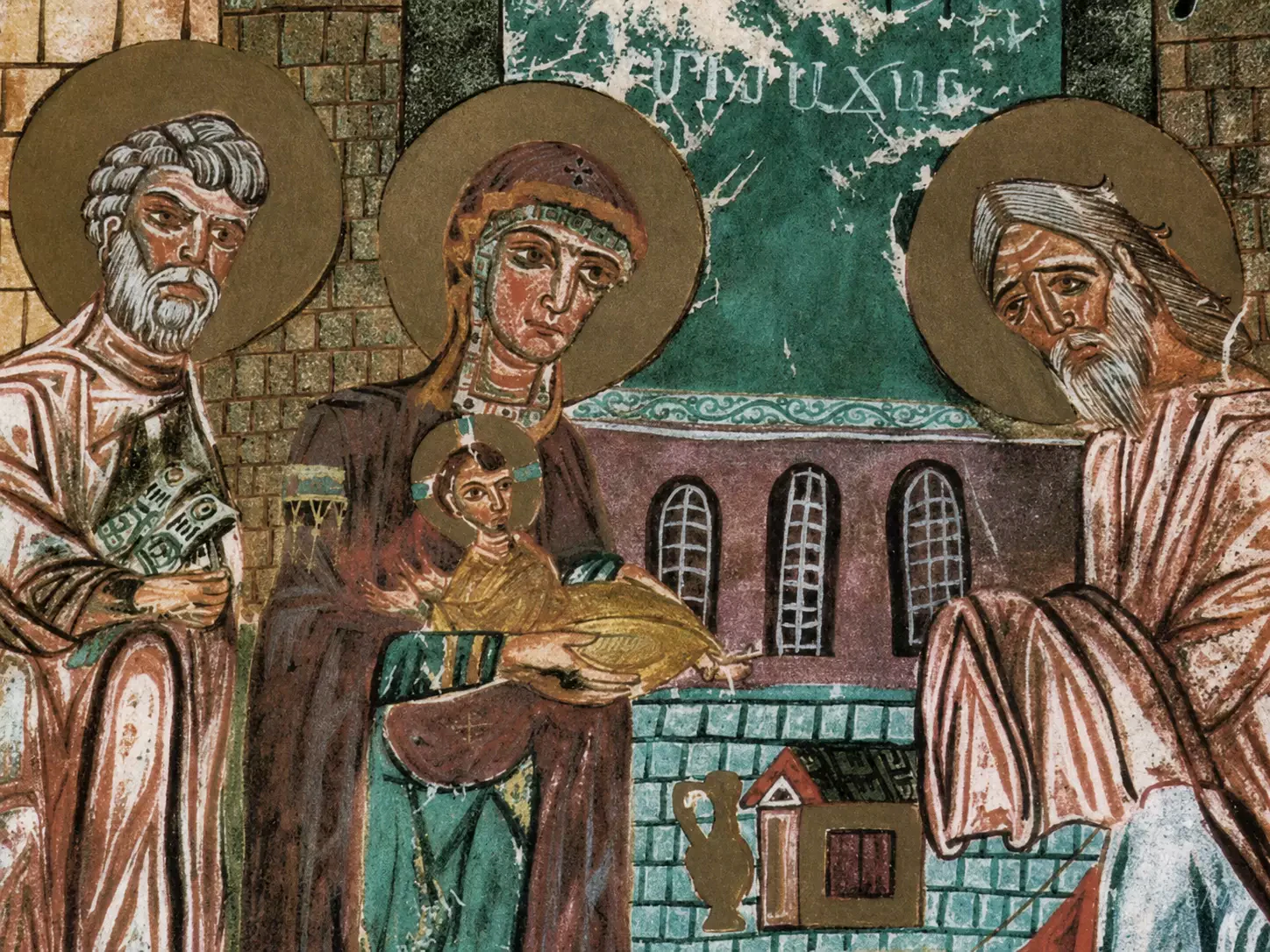
In the enlarged central passage, the psychological construction becomes easier to read. Mary’s head inclines gently toward Simeon, but her gaze remains free of sentimentality. The Child is small, frontal enough to remain legible, his cruciform halo carefully enclosed within the larger silhouette of his mother. Simeon answers through posture: his back curves, his head inclines, and his covered hands extend. Between them lies only a narrow interval of painted space, an open interval preserved deliberately by the artist.
The miniature represents a meeting through approach, glance, and bodily inclination rather than theatrical movement. The architecture behind the figures reinforces the pause: vertical windows, horizontal masonry, and the low barrier beneath the scene hold the bodies in place, while the arch above concentrates attention toward the centre. The painter’s linear language can appear severe at first, particularly in the angular drapery and sharply delineated faces, but within those limits the smallest deviations matter: Simeon bends, Mary inclines, Christ turns outward, and Joseph remains upright.
The Moghni miniature condenses narrative, ornament, and liturgical architecture into a dense painted page. Its forms are emphatic, its transitions crisp, its colours luminous, and its spatial logic deliberately compressed. Most vivid is the precision with which the encounter has been organised around the Child, held between possession and reception, before the movement is completed.
(The translation was edited by M. Taylor)