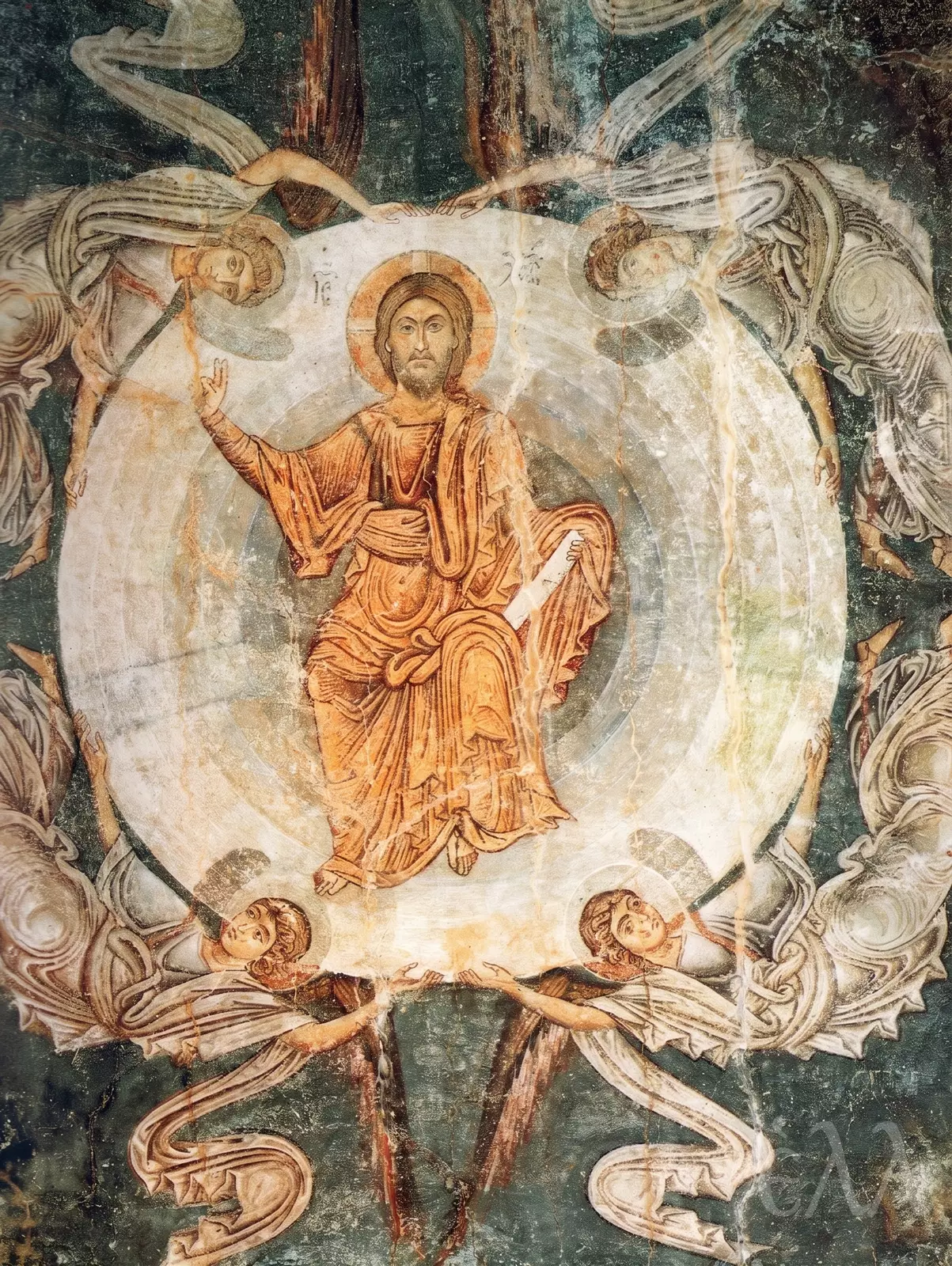
The Ascension of Christ in Ohrid (Acts 1:9–11), painted in the sanctuary vault of Hagia Sophia during the episcopate of Archbishop Leo (1037–1056), belongs to one of the most ambitious monumental programmes surviving from the eleventh-century Byzantine world. The cathedral itself, when Leo undertook the rebuilding of an earlier church on the site, assumed the form of a large three-aisled basilica with a narthex and an originally different upper architectural configuration. Leo, a Constantinopolitan prelate, connected Ohrid through his patronage with the intellectual and artistic culture of the imperial capital. The painted decoration is generally dated within his tenure, although its precise chronology remains debated.
In the surviving central field of the Ascension, the image is governed by a remarkable tension between immobility and movement. Christ occupies the exact visual centre, seated frontally within a vast luminous mandorla, while four angels curve around its perimeter in opposing directions. Their extended arms touch or support the great circular form; their bodies bend, turn, descend, rise. Christ does none of these things. His frontal presence establishes the composition’s axis and gives to the surrounding movement its measure.
The colour has aged, the painted surface carries losses, abrasions and fissures, yet the structure remains extraordinarily legible. Around Christ concentrate warm ochres and reddish tones; through the angelic garments and mandorla, pale greys and whites expand against the darker blue-green field. What survives is severe and animated, hieratic and unexpectedly mobile.
Ascension of Christ in Ohrid: The Heavenly Register
Across the sanctuary vault, the Ascension was conceived on a scale appropriate to its position above the altar. Its central image does not read as a small narrative episode enlarged for architectural convenience. The painter has transformed the event into an apparition. Christ, seated in glory and enclosed within concentric bands of light, becomes the fixed centre of a pictorial field that unfolds outward through the four angels.
Their arrangement deserves particular attention. Two descend from the upper part of the composition, their bodies almost inverted as they incline towards the mandorla; two rise from below, looking upwards while extending their hands towards its lower circumference. A circular rhythm results, though it is not mechanically symmetrical. Heads turn at slightly different angles, wings overlap the dark background unevenly, garments open into broad curving folds. One movement answers another across the composition, creating a visual rotation around the enthroned figure.
The drapery carries much of this energy. Pale garments, strongly outlined and crossed by dark linear folds, stretch, twist and curl around the angels’ bodies. At several points the cloth seems almost to detach itself from the anatomy and continue the movement independently, forming loops and sweeping contours against the background. The effect remains disciplined. Line is expressive, sometimes insistent, but the figures do not dissolve into ornament.
At the centre, by contrast, Christ is constructed through weight. His body sits firmly within the mandorla, one knee raised slightly higher than the other, the long garments falling in accumulated folds around the legs. His right hand — appearing on the viewer’s left because the figure is frontal — is raised in a gesture of benediction. His left hand, on the viewer’s right, holds a closed scroll. The distinction, clear in the closer view, matters here: nothing in the gesture suggests a spear, staff or another object. The scroll belongs to Christ’s left hand; the blessing gesture to his right.
Around his head appears the cross-inscribed halo, visually distinct from the much larger mandorla surrounding his body. The face is frontal and grave, with wide eyes, a long nose, a short beard and centrally parted hair falling beside the cheeks. There is no suggestion that Christ is being physically lifted with effort. The angels accompany and articulate his ascent; they do not diminish his authority by turning it into an act of bodily transport.
That distinction helps explain the unusual power of the scene. Movement belongs to the surrounding celestial order, while sovereignty remains concentrated in Christ. In the broader iconographic programme of the vault, beyond the limits of the views reproduced here, the apostles were distributed across the two sides, responding with gestures of astonishment and awe. The Theotokos stood among them in prayer, and two angels directed the earthly witnesses towards the ascending Christ, recalling the words concerning his future return (Acts 1:11). At the extremity of the southern half, the exceptional inclusion of the Prophet David associated the composition with Psalms celebrating the exaltation and kingship of God.
Thus the heavenly and terrestrial portions of the Ascension were conceived together: above, the controlled circular movement of glory; below, human reaction, supplication, prophetic witness. The vault itself mediates between them. Architecture and image cooperate, the curve of the surface encouraging the figures to move around rather than across a flat pictorial plane.
This monumental organisation belongs to the broader artistic character of Hagia Sophia under Archbishop Leo. Middle Byzantine painting of the period increasingly united hieratic compositional order with stronger plastic modelling and more animated bodily movement. At Ohrid this development acquires unusual force. The Ascension has consequently been recognised as an important stage between the measured solemnity of eleventh-century painting and tendencies that would become more pronounced during the Komnenian period.
The patronage behind the programme is equally significant. Branislav Todić has argued that Archbishop Leo should be understood as a decisive intellectual agent in the formation of the cathedral’s iconographic programme and has proposed a narrower dating in the 1050s. Such an interpretation places the paintings within the ecclesiastical and theological debates in which Leo himself participated.
The sanctuary decoration, in this view, was neither an arbitrary collection of prestigious subjects nor a provincial repetition of standard Constantinopolitan formulas. Its individual themes were selected within a highly organised theological system. Alexei Lidov has likewise examined the wider transformation of Byzantine sanctuary imagery during the eleventh century, when liturgical themes assumed increasing prominence and new relationships developed between pictorial programmes, Eucharistic theology and ecclesiastical identity.
Ohrid nevertheless preserves its own pictorial temperament. The Ascension possesses monumentality without immobility. Its central symmetry is repeatedly disturbed by angled wings, oblique arms, curling hems, differing inclinations of heads. From a distance the design appears almost geometrical; on closer inspection, its equilibrium is built from controlled irregularities.
Christ within the Mandorla: A Close View
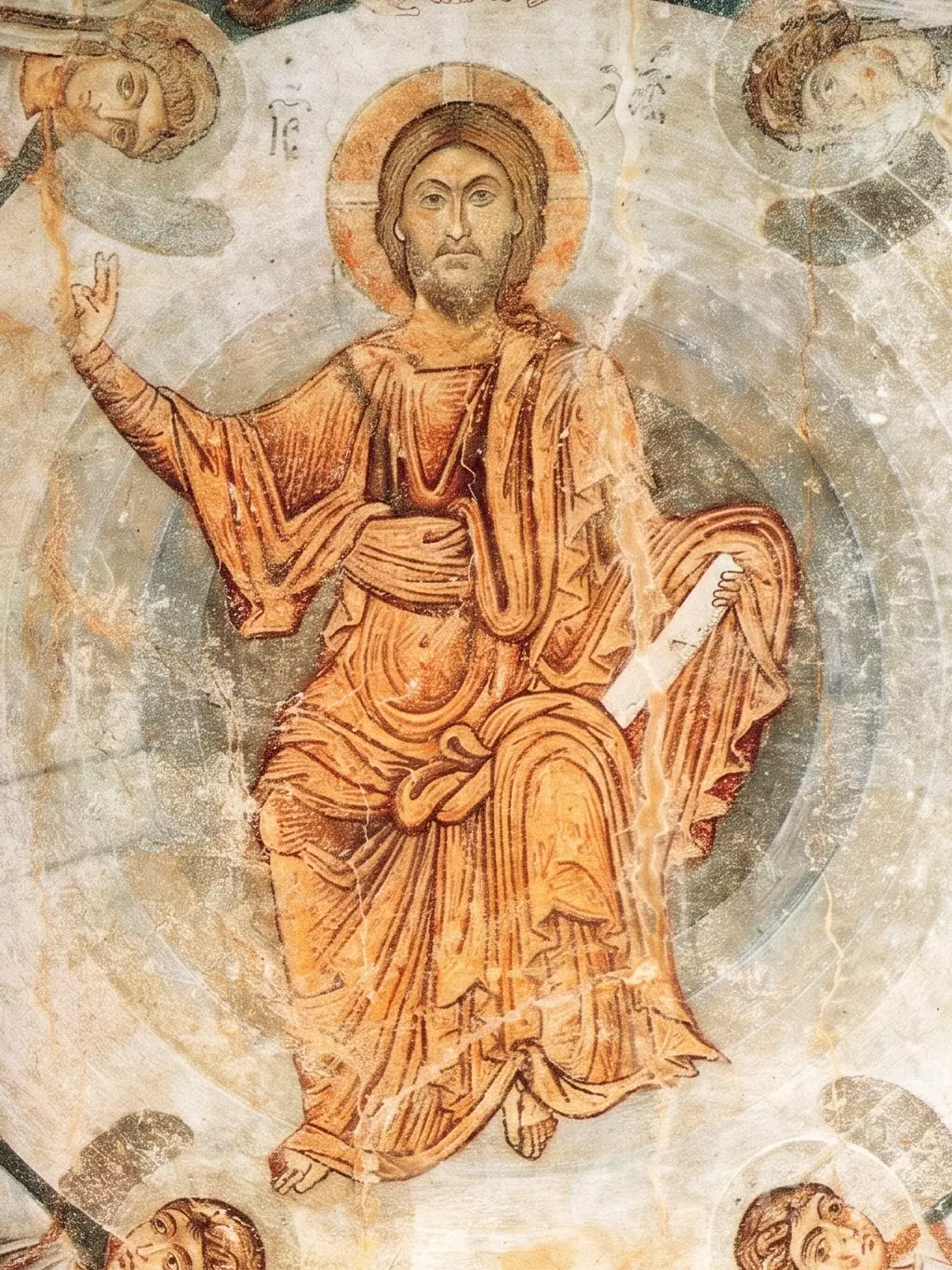
The enlarged view of Christ changes the character of the painting. What appears from farther away as an emphatically hierarchical image reveals, on closer examination, a considerable degree of painterly modelling around the face and neck. The features are delineated with dark contours, yet the cheeks and forehead retain tonal transitions. Narrow highlights define the bridge of the nose, the brow and the upper facial planes. The expression depends less upon exaggerated emotion than upon the sustained directness of the gaze.
Around this face, the cross-inscribed halo forms a compact ring of ochre and muted red. Behind it the mandorla expands through broad concentric zones of pale grey, bluish grey and white. The distinction in scale is striking: halo close to the head, mandorla surrounding the whole manifestation. The latter is not a decorative enlargement of the former. In Byzantine iconography the two forms perform different visual functions, and the Ohrid painter makes the difference unmistakable.
Christ’s garments introduce another layer of rhythm. Long linear folds descend vertically across the torso and legs, then bend around the raised knee and collect in denser loops at the waist. The palette is dominated by warm reddish ochres, now softened by age and surface wear. Along certain ridges of the drapery, lighter strokes clarify the volume without attempting naturalistic textile effects. The body is modelled, certainly, yet the line retains authority over mass.
The scroll in the left hand is nearly white and therefore stands apart sharply from the surrounding garment. Christ grasps it near the upper end while the lower portion descends diagonally beside the thigh. This modest diagonal answers the raised right arm on the opposite side, producing an asymmetry within an otherwise frontal body. The right hand itself is slender and emphatically outlined, two fingers lifted in the blessing gesture while the remaining fingers bend towards the palm.
Surface damage remains visible throughout the close view: small paint losses across the face and halo, abrasions over the mandorla, cracks and broader vertical areas of disturbance to the right. These interruptions should not be mistaken for original highlights or iconographic marks. Even through them, the principal relationships of colour, line and figure remain intact.
Perhaps the most revealing element is the junction between Christ and the surrounding angels. At the upper corners of the detail, angelic heads and hands enter the luminous field without competing with the central figure. Their bodies lie outside it; their hands approach its boundary. Christ remains enclosed, frontal, immovable. Around him the composition bends, flies, reaches — a celestial framework in motion around a figure of extraordinary stillness.
(The translation was edited by A. Williams.)