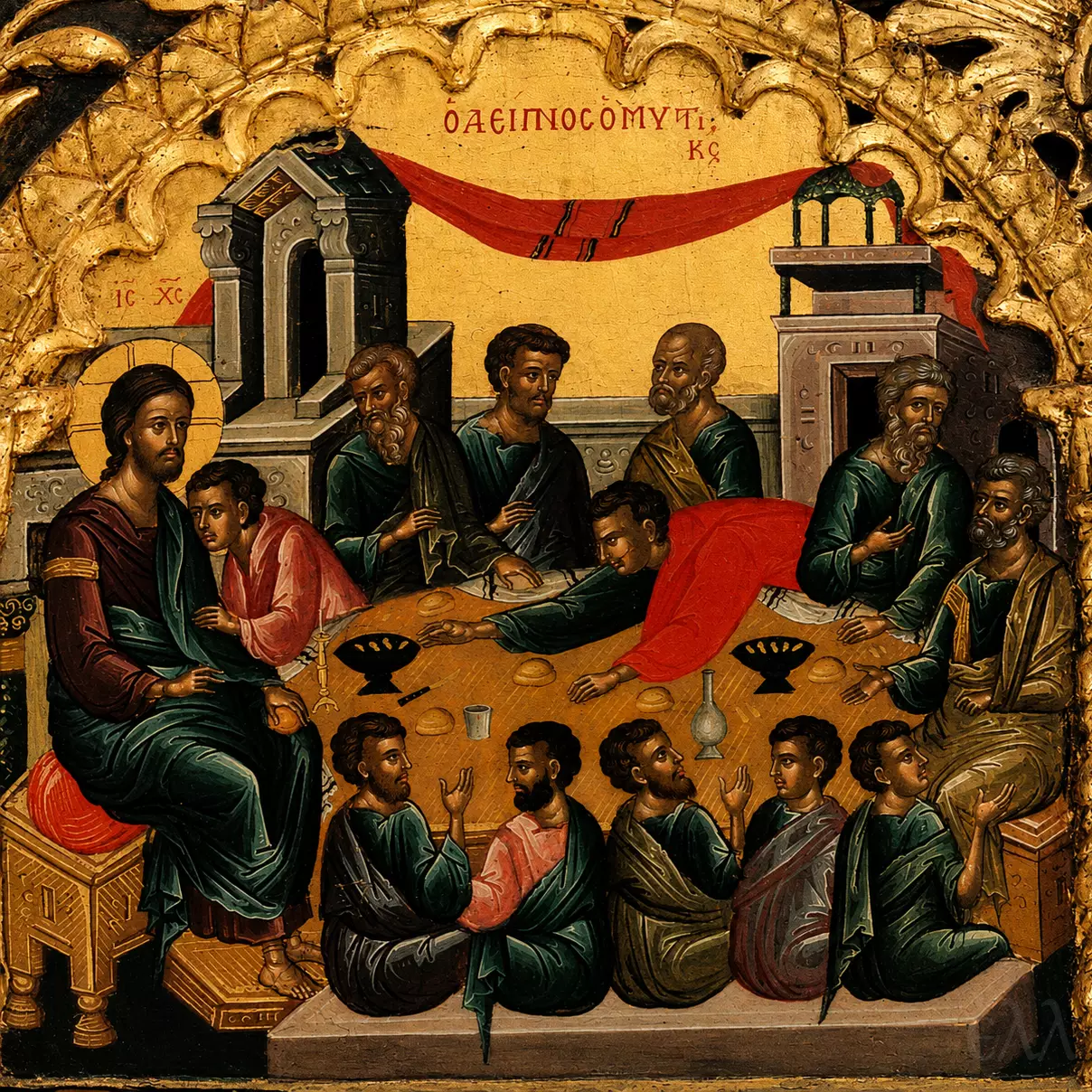
A single mantle of deep red interrupts an otherwise consistent field of blue-green drapery, and it is around that interruption that the whole composition seems to organise itself. The panel belongs to a section of templon epistyle on which three scenes from the Passion cycle survive, painted in the second quarter of the sixteenth century and attributed to Theophanes Strelitzas Bathas, the Cretan monk-painter whose signed work at Meteora and on Mount Athos placed him among the most consequential figures of post-Byzantine monumental and panel painting. Measuring 1.47 by 0.46 metres, the epistyle belongs to the Monastery of Iviron on Mount Athos, generally dated to the period 1535–1545 — a decade in which Theophanes was already an established master working across several Athonite foundations.
The scene renders the Last Supper, the meal at which Christ shared bread with his disciples and foretold his betrayal (Matthew 26:26–29), a subject central to the Dodekaorton cycle and to the decorative programmes of Orthodox templa throughout the Palaiologan and post-Byzantine periods. Even a viewer with no prior familiarity with the iconographic type will recognise its essentials here: a long table crowded with figures, a seated central presence identifiable by the cruciform halo and the IC XC monogram, and a group of men whose postures range from quiet attention to visible agitation. What distinguishes this particular rendering is less the subject itself, which is one of the most frequently painted in Byzantine art, than the specific compositional lineage it continues and the pointed emphasis it places on a single figure among the twelve.
Theophanes Strelitzas and the Iviron Last Supper
The composition follows closely the iconographic scheme already established in an earlier icon of the Last Supper associated with the Koutarelis Collection, itself adapted here to fit a semicircular compartment dictated by the curved profile of the epistyle. The shape of the table — echoing the arc of the panel it occupies — was clearly chosen because it served this structural requirement particularly well: Christ occupies the same position, the disciples appear in the same type and in the same sequence around the table, and five of them have been brought forward, seated on a low pedestal in front of the table rather than behind it, so as to fill the lower register of the semicircle. Behind Christ and to the sides, an architecture of paired ciborium-like structures frames the scene, a gold ground rising above them and a length of red cloth slung between the two flanking buildings. The building on the left, which in the earlier fifteenth-century model was rendered in some structural complexity, appears here considerably simplified — reduced with an evident ease that does not diminish its presence in the scene, only its density of incident.
That simplification did not originate with the Iviron panel. Its earlier form appears in the frescoed Last Supper in the church of Ayios Nikolaos Anapafsas at Meteora, part of the wall-painting programme Theophanes signed there in 1527, roughly a decade before the Iviron epistyle is thought to have been painted. The prototype standing behind both the fifteenth-century icon of the Koutarelis Collection and the Anapafsas fresco remains unidentified. The suggestion that the Koutarelis icon itself might have served directly as Theophanes’s model has been considered and set aside as improbable; the question of what common source, if any, underlies both works remains open.
Christ, the Beloved Disciple, and the Apostles Around the Table
Christ is seated at the left side of the table, his halo and the Christogram identifying him unmistakably. He blesses with his right hand held low, near the knee, while his left hand, resting on the same support, holds the bread — a pairing of gestures that follows established convention for this scene rather than introducing any deviation from it. To his left the youthful and beloved disciple, John, leans in against his chest, a detail of physical proximity that Byzantine and post-Byzantine painters used consistently to mark John’s identity within the group without recourse to an inscription. Behind the curved side of the table, six further disciples are arranged in sequence: first Matthew, then Luke beside him, followed by Judas, Simon, Andrew, and finally Peter, who sits directly opposite Christ across the width of the table. The five remaining apostles occupy the low pedestal before the table, turned partly toward one another in postures of conversation and gesture rather than stillness — hands raised, heads inclined, an animation that contrasts with the more composed grouping behind them.
Judas and the Gesture Toward the Dish
It is Judas who carries the scene’s dramatic weight. Fallen forward across the table with both arms spread over its surface, he reaches with his right hand toward the dish set near Christ — the detail identified in the Gospel account as the sign of the betrayer, the one who dips his hand into the same bowl (Matthew 26:23). The same significant motion recurs in the Koutarelis icon that supplied the composition’s general scheme, but here it is given with greater clarity and a more deliberate emphasis, not least because Judas’s mantle is the single garment in the entire composition painted in that saturated red, setting him apart chromatically from the blue-green and ochre draperies worn by every other figure at the table. The choice reads as compositional strategy as much as coloristic habit: in a crowded semicircular field where twelve men in closely related dress might otherwise blur into a single mass, the eye is directed, almost against its will, toward the one figure whose garment refuses to match.
A Wider Cretan Context: The Byzantine Museum Icon and Questions of Origin
A further point of interest lies outside the Iviron panel itself, in a miniature representation set within the frame of an icon in the Byzantine Museum whose central subject is the Virgin in the Epi Soi Chairei type. That composite, densely populated icon has long been treated as an early example of fifteenth-century Cretan painting, the narrative scenes running around its frame having been used elsewhere to help reconstruct the iconographic schemes Theophanes drew upon in his early Cretan output. Yet the frame scenes of the Epi Soi Chairei icon show their own affinities with the fourteenth-century Passion cycle in the Theoskepastos church at Trebizond — an affinity visible in a summary, unrefined handling of forms and in an ethos noticeably less classicising than that of mainstream Constantinopolitan or Cretan work of the period. Combined with the work’s recorded Asia Minor provenance in the Byzantine Museum’s own archives, this has led some scholars toward the possibility of a workshop origin in that region, a view with earlier precedent in the scholarship on Asia Minor painting workshops.
Attribution and Workshop Practice on Mount Athos
The Iviron Last Supper, which shares its compositional grammar with the Anapafsas frescoes, and which finds further correspondence in other Athonite commissions from the following decades, is attributed to Theophanes Strelitzas Bathas on stylistic and compositional grounds rather than on a surviving signature on this particular panel. Such attributions are common practice for Cretan-school production of the period, where workshop continuity, repeated compositional formulas, and closely related hands make firm documentary evidence the exception rather than the rule. What the Iviron epistyle demonstrates clearly enough, whatever the precise resolution of its authorship, is the way a Cretan master of the first half of the sixteenth century could take an inherited fifteenth-century scheme, adapt it to an awkward semicircular field, simplify its architectural apparatus without weakening it, and still find room, within those constraints, to sharpen the visual identification of Judas through a single, deliberate choice of colour. Manolis Chatzidakis’s research on Theophanes remains a principal point of reference for situating this kind of compositional transmission within the painter’s broader Athonite career.
(The translation was edited by A. Orfanos.)