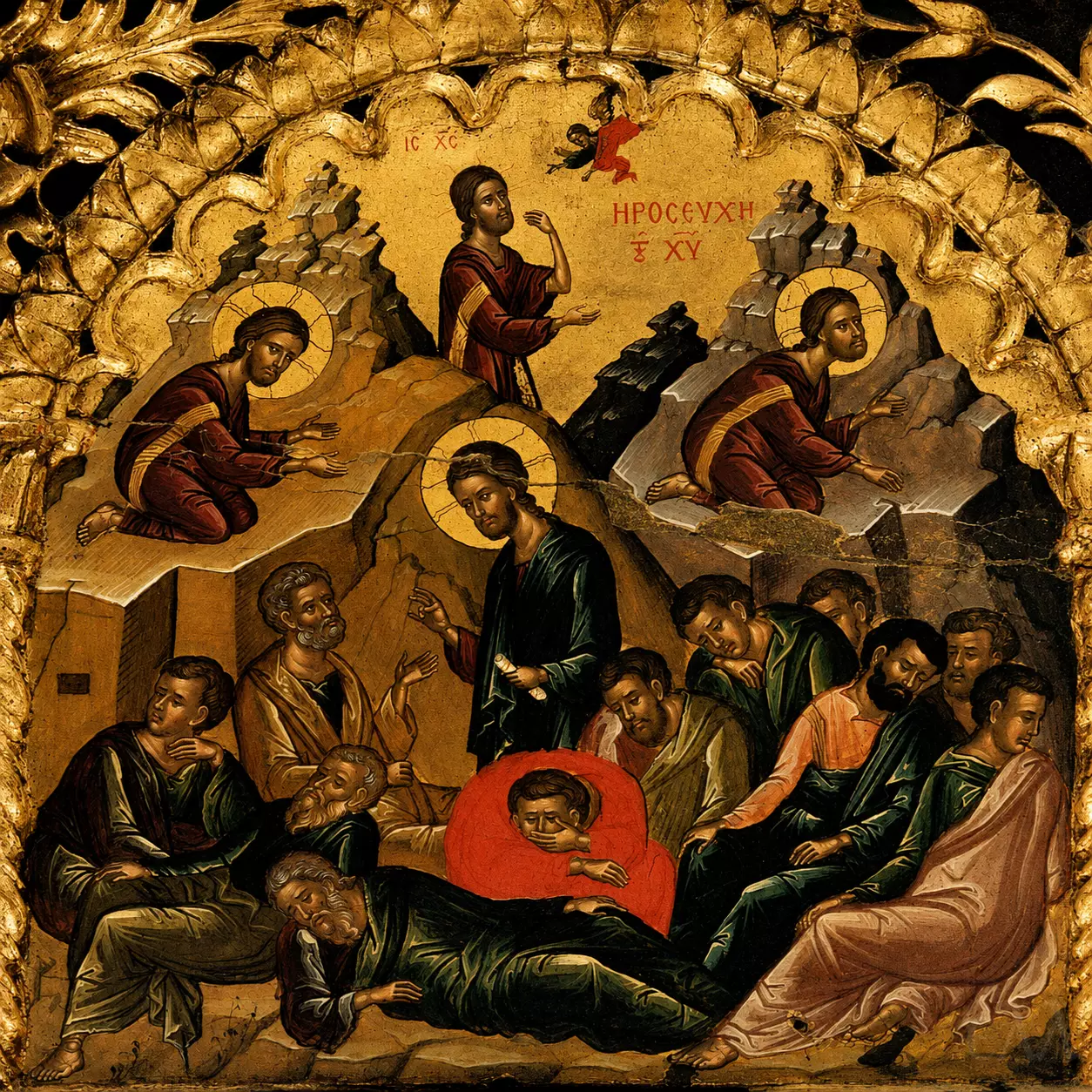
The Last Supper on the Iviron epistyle, as the eye travels along the same carved and gilded beam, gives way to a second Passion episode: the moment at which Christ withdraws into the garden of Gethsemane to pray before his arrest (Matthew 26:36–46). A red inscription set into the gold ground names the scene directly — ΠΡΟΣΕΥΧΗ, “Prayer,” followed by the customary abbreviation for Jesus Christ — and the composition attributed to Theophanes Strelitzas Bathas, generally known in the scholarly literature as Theophanes the Cretan, unfolds across the semicircular field of the templon compartment much as the Last Supper does on its neighbouring panel, dated on stylistic grounds to 1535–1545 and belonging to the same Iviron beam described by Efthymios Tsigaridas in his study of the monument (Tsigaridas 1992).
A composition built in tiers
The rocky terrain rises through the panel in successive outcrops, jagged and faceted in the manner typical of Cretan painting of the period, their edges picked out in pale highlights against a warm ochre ground. Two haloed apostles kneel on ledges at either side of the upper zone, bent forward with their arms extended in the low, folded posture conventionally used to indicate sleep rather than adoration; a third figure, distinguished by a slightly larger halo and positioned centrally between them at a lower level, echoes their pose while occupying the pictorial hinge between the upper register and the crowded assembly below. This threefold division — Christ shown twice, once at prayer near the summit and once again lower down among a larger body of apostles — belongs to an established compositional habit in the iconography of the Agony in the Garden, in which more than one narrative moment is compressed into a single unbroken field rather than separated into distinct scenes.
The upper register: Christ at prayer
At the crest of the rock, Christ stands in a mantle of deep red over a paler tunic, his halo cutting into the gold ground, his head inclined toward a small angel who descends from an arched opening at the very top of the panel, robed in the same vivid red and barely larger than a hand’s span. He raises his right hand toward the messenger in a gesture of address rather than blessing, the fingers loosely open, while his body remains turned toward that side of the composition — consistent with the moment described in the Gospel accounts in which an angel appears to strengthen him during his vigil (Luke 22:43). The inscription sits beside this group — a detail easy to pass over against the brightness of the gold — in a red that matches both his mantle and the angel’s robe.
Peter, James and John asleep on the rock
Flanking this central episode, the two kneeling apostles occupy raised, faceted outcrops of their own, isolated from the ground below by an interval of bare rock. Their garments follow the reddish-brown and ochre palette common to the rest of the panel, and their hands are extended forward in a manner that recalls prayer more than genuine repose, a convention frequent in Palaiologan and post-Byzantine renderings of this subject, where sleep is signalled through posture and drooping heads rather than through closed eyes alone. No attempt has been made here to individualise the three through attribute or inscription; their identity as Peter, James and John rests entirely on their conventional place within the scene rather than on anything legible in the panel itself.
The gathering below
The lower register is considerably more populous. Christ appears a second time at the centre, this time in a dark green chiton beneath a reddish mantle, turning toward a cluster of apostles seated and reclining at the base of the rock. Peter is recognisable among them by his characteristic grey, curling beard and by his slightly forward posture, one hand raised as though responding to Christ’s address; behind him a further group of bearded and youthful apostles sit pressed closely together, several with heads bowed in sleep, their green and ochre garments creating a dense, overlapping mass that fills the width of the panel. In the foreground, one apostle lies stretched full-length across the rock, his body wrapped almost entirely in a mantle of brilliant, saturated red, so that only his face and a single hand emerge from the enveloping cloth. The device is a striking one, and it recalls — without needing to repeat it — the equally arresting red used for Judas’ mantle in the companion Last Supper panel of the same epistyle, where, in a composition painted by the same hand only inches away, the same pigment is reserved for a single figure singled out from the group. Here the colour appears to serve a comparable compositional function, drawing the eye to one sleeping apostle among many rather than identifying him individually, since nothing in the panel names him.
Behind this group, a low structure with a dark doorway occupies the left edge of the composition, a modest architectural note that anchors the scene near the entrance to the garden rather than in open landscape, while the surrounding frame — a deep, continuous band of gilded relief carving in vine and foliate scrollwork — belongs to the epistyle itself rather than to the painted surface, confirming that this panel, like its neighbour, was designed from the outset to be read within the architecture of the templon rather than as an independent icon.
Style and attribution
The elongated, angular treatment of the rocks, the concentration of the narrative within a shallow foreground band, and the reliance on a restricted palette of red, green and ochre against gold are all consistent with the documented work of Theophanes at Stavronikita and on the Meteora frescoes of Agios Nikolaos Anapafsas, executed only a few years before this epistyle is thought to have been painted, reinforcing the case for a shared workshop hand. The attribution to Theophanes, like that of the Last Supper panel beside it, rests on this stylistic continuity rather than on a signature, and the precise iconographic model behind the composition — whether transmitted through an earlier Cretan panel or through the painter’s own workshop practice — remains undetermined; no securely dated Cretan prototype for the scene has yet been identified in the surviving corpus.
(The translation was edited by D. Manou.)