
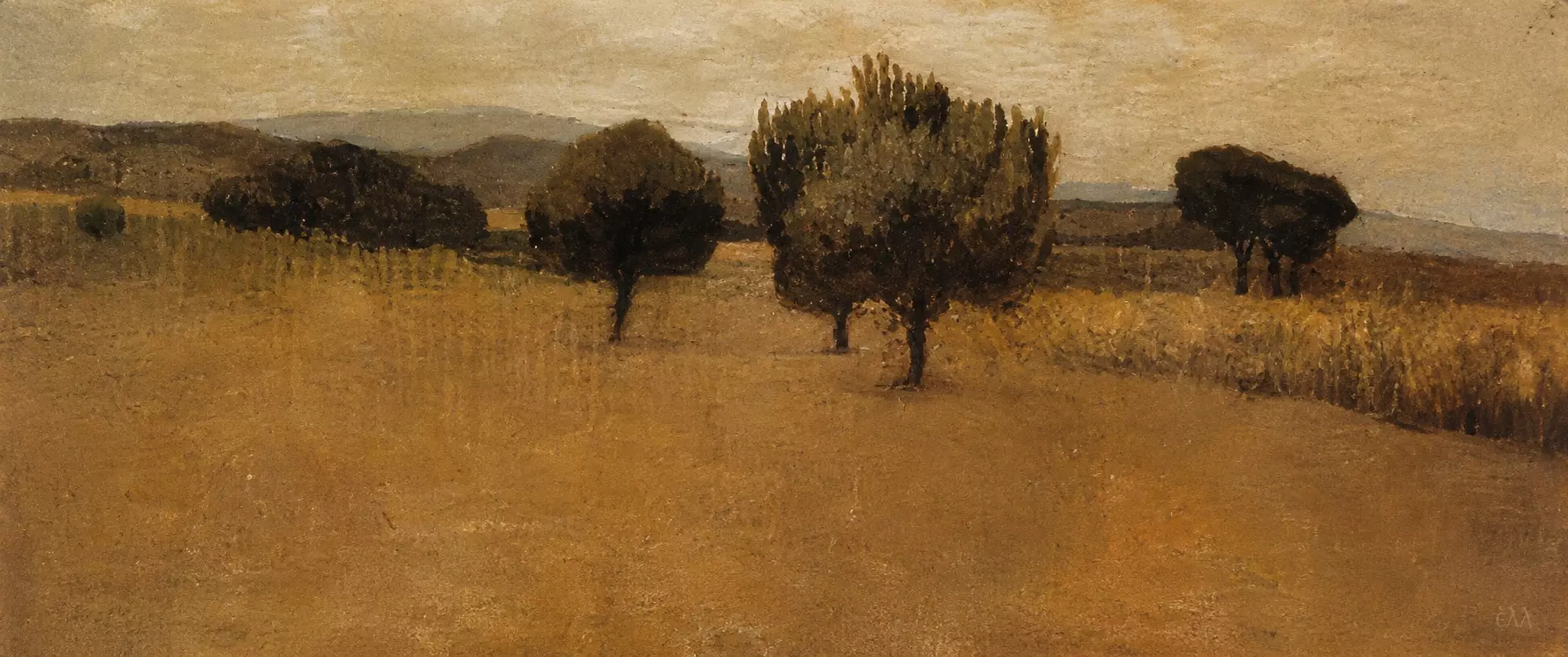
Giuseppe Abbati painted Landscape at Castiglioncello in 1863, transforming a modest stretch of Tuscan countryside into a remarkably concentrated study of light, colour and spatial rhythm. Executed in oil on panel and measuring only 10 × 30 cm, the painting belongs to the collection of the Galleria dell’Arte Moderna at Palazzo Pitti in Florence. The unusually elongated support immediately conditions the image: land unfolds laterally, trees punctuate the middle distance, a pale sky presses gently across the upper edge.
Across the foreground, Abbati lays out an expansive ochre field with very little descriptive incident. Small variations of tone disturb its surface, yet no figure or anecdotal motif interrupts the openness. Towards the dark vegetation beyond, the eye consequently travels, following the long sweep of earth before encountering a sequence of trees arranged almost as isolated masses. Some are low and compact; others rise sharply, particularly the dense group slightly right of centre. Between their trunks and crowns, narrow intervals disclose further strips of cultivated ground and the distant hills.
The landscape belongs to the years in which Abbati was closely associated with the Macchiaioli, the group of painters active around Florence whose experiments with tonal relationships, outdoor observation and strongly defined areas of light and shadow played an important role in nineteenth-century Italian painting. Castiglioncello, on the Tuscan coast, became one of their principal working grounds during the 1860s, attracting Abbati along with artists including Giovanni Fattori and Odoardo Borrani. One of the younger members of the circle, Abbati was particularly responsive to the clear light and restrained hues of the area.
What gives Landscape at Castiglioncello its particular force is the extreme economy with which the visible world has been organised. The countryside remains recognisable, yet its forms have been compressed into broad zones: warm earth, yellow vegetation, dark foliage, distant blue-grey ridges, pale sky. Against the extensive foreground, every tree acquires unusual visual weight. Abbati builds their crowns as compact silhouettes whose irregular edges retain the character of living vegetation without dissolving into botanical detail.
Especially important is the relationship between these dark forms and the sunlit field. A large rounded tree near the centre stands on a narrow trunk, its shadowed crown almost detached against the lighter countryside. Farther right, several trees overlap into a denser vertical grouping. Their foliage rises and falls unevenly, interrupting the painting’s otherwise insistent horizontality, while three slender trunks descend from the mass towards the ground. Beyond them runs a brighter band of yellow growth, directing the eye towards the right-hand side.
Landscape at Castiglioncello: Light, Mass and Tuscan Space
This concentration on tonal masses corresponds closely to the artistic investigations associated with the Macchiaioli. Their approach placed considerable emphasis on relationships between illumination and volume, encouraging painters to simplify the observed landscape into coherent areas of light and dark. Direct observation of nature and the study of light upon solid forms, as the Uffizi Galleries describe them, stand central to this pictorial culture, which developed partly in opposition to conventional academic practice. In Abbati’s small panel, the principle becomes almost unusually clear: foliage gains substance from darkness, the field from luminosity, distant hills from their cooler and softer tonal range.
Colour, meanwhile, is held within a narrow register. Browns, muted yellows and olive tones dominate the earth and vegetation, with deeper brown-black accents concentrated in the trees. Above them, the distant landscape shifts towards subdued grey-blue. The sky carries warm beige and cream tones, its thin variations suggesting atmospheric light without elaborate cloud formations. Warmth spreads across almost the entire panel. Only the remote hills introduce a cooler interval, sufficient to establish recession behind the strongly defined middle ground.
Across such a narrow horizontal panel, composition becomes an exercise in measured intervals. Abbati avoids a commanding central motif. Instead, visual attention moves from one dark mass of trees to another: a cluster on the left, the rounded forms closer to the centre, the taller vegetation beyond them, then the separated groupings near the right edge. Empty land is as important as foliage. Long stretches of ochre allow the eye to rest before the next concentration of dark paint.
The Long Horizontal Format
The distant hills strengthen this lateral movement. Their contours pass quietly behind the trees, softened by atmosphere and reduced to overlapping bands. Depth emerges through tonal gradation and overlapping, without an emphatic perspectival construction. Near ground, middle-distance trees, remote ridges, sky: four broad spatial zones, each clearly legible despite the panel’s exceptionally small height.
A landscape in which such investigations could be pursued directly, Castiglioncello offered itself to Abbati and his companions. The locality became closely associated with a subgroup of the Macchiaioli during the 1860s, and Abbati’s views from the area occupy an important place in that development. His attention remained fixed on ordinary terrain—fields, trees, coastal countryside—and on the changing relations created among them by daylight.
Small in physical dimensions, the 1863 panel possesses an unexpected breadth. The nearly empty foreground gives the countryside distance; the isolated trees establish measure and rhythm; the muted palette binds the separate zones together. Even the brushwork remains subordinate to the larger organisation of the view, tightening within the dark foliage and spreading more quietly through the open field. Along the lower expanse, tiny irregular touches remain visible within the ochre surface, minute interruptions inside an otherwise remarkably spacious piece of painted ground.
(The translation was edited by D. Manou.)