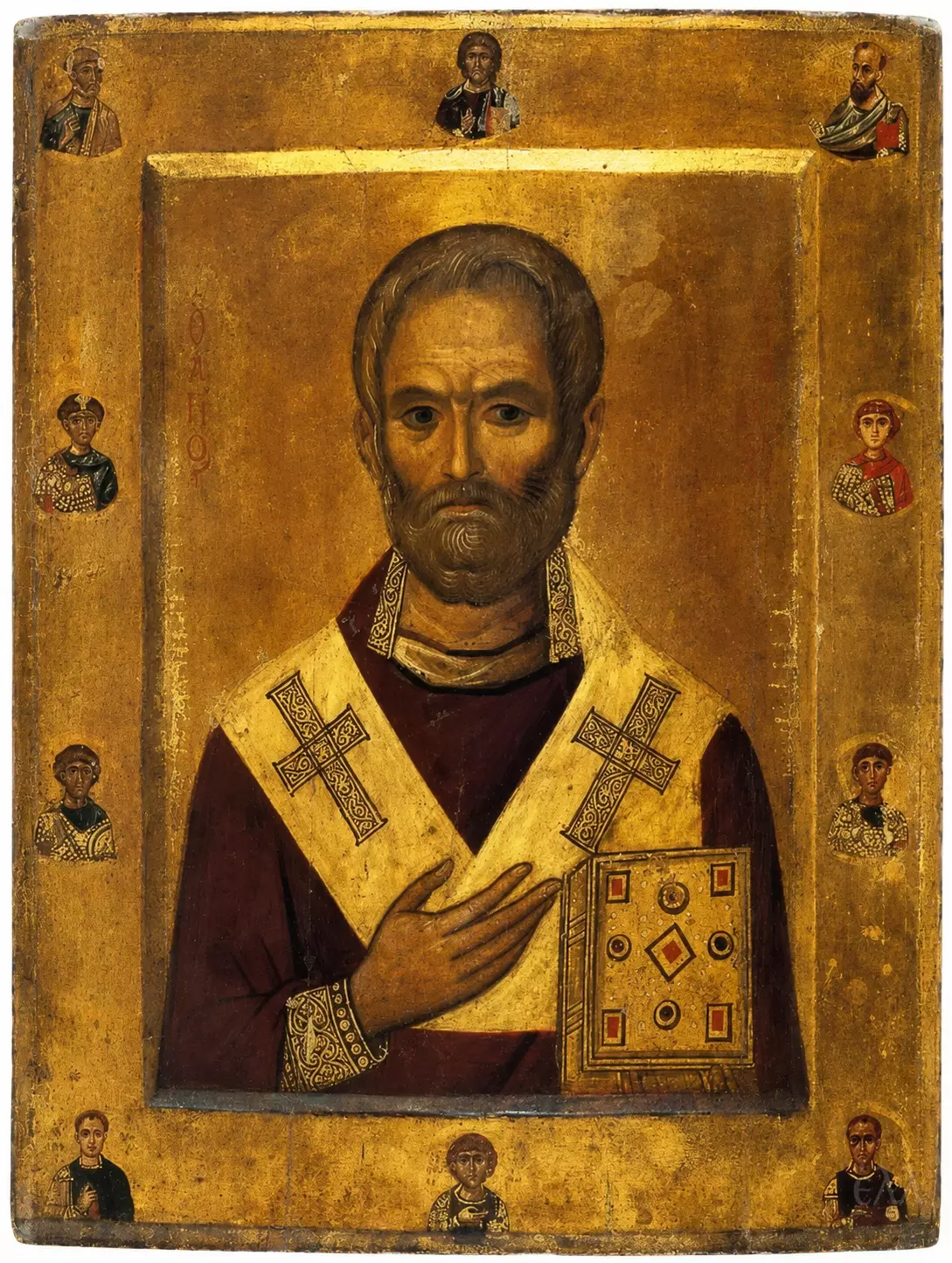
Preserved since the 11th century on a small, time-worn wooden panel measuring forty-three by thirty-three centimeters, the icon of Saint Nicholas stands as one of the most precious relics of Saint Catherine’s Monastery in Sinai. While the name of the painter who crafted it remains unknown, the tradition of the workshop that operated within the monastery during the Middle Byzantine period is well-documented—producing high-quality works for the monks and pilgrims arriving from every corner of the empire. Depicted in a frontal bust, his gaze fixed directly upon the viewer, the saint wears his episcopal vestments and holds a closed Gospel book. This composition, known in Byzantine iconography as a frontal bust, is not merely an artistic choice but a theological message, conveying to the pilgrim a sense of immediate episcopal presence and the didactic authority the saint embodies as a shepherd of the Church. The study of such works reveals aspects of Sinai’s artistic production that remain, to some extent, undervalued in modern research. It is a form of painting not solely intended for liturgical use; rather, it constitutes a historical document of a visual tradition that has persisted through revisions and adaptations to the present day.
The Iconographic Composition
Dominating the composition, the face of the saint fills almost the entire visual field with an immediacy that leaves no room for narrative distraction. His hair, grayish and thinning at the forehead, reveals a middle-aged man, not yet the elder with stark white hair and deeply hollowed cheeks who would become the standard in his later depictions. Beneath thick eyebrows, his gaze, dark and intense, focuses squarely on the viewer without the slightest deviation. At chest level, the right hand is raised in a gesture of blessing—a simple movement that encapsulates the hierarch’s entire didactic function. The left hand holds a closed Gospel book featuring an exceptionally ornate cover, studded with red and dark stones arranged in a strict geometric pattern, alternating rhombuses and circles with almost mathematical precision. The attire is composed of a deep red tunic and a white omophorion, embroidered with black crosses at regular intervals, falling diagonally from the shoulders to the knees. The folds in the fabric are austere, almost linear. Their edges occasionally form a characteristic hooked termination, a stylistic element pointing directly to 11th-century Constantinopolitan workshops.
Arranged around the central figure on the gold background are ten small medallions, each hosting a bust of a saint in a much smaller scale than that of Nicholas—some youthful and radiant in appearance, others elderly and somber. At the pinnacle, Christ is flanked by the two preeminent apostles, Peter and Paul, a triad signifying the unbroken chain of apostolic succession. On the two vertical columns, left and right, four military saints, Demetrios, George, Theodore, and Procopios, guard the composition, recalling the martyric dimension of the faith. At the bottom are three more figures: Cosmas, Panteleimon, and Damian, the healing saints whom tradition has always associated with bodily restoration. This selection forms a complete theological program, where authority, martyrdom, and healing coexist around the figure of the hierarch.
A Monumental Hieratic Style
The gold background, uniform and immaterial, strips the scene of any sense of space, placing the saint in a dimension that transcends a specific location. Traces of a faint, almost erased figure can be discerned in the upper right section of the background, likely a remnant of an earlier repair left untouched by time. The dating of the work relies primarily on comparisons with later icons of the same saint, where his figure gradually becomes more ascetic, with entirely white hair and deeply sunken cheeks—features wholly absent here. The overall style, spiritual, slow in rhythm, with a balanced arrangement of figures, belongs to what research has characterized as the monumental hieratic style, an artistic language that dominated the entire empire until the rise of the Komnenian dynasty. The halos, with their rough, in-relief surface, are a technical feature found almost exclusively in the monastery’s works, reinforcing the attribution of the piece to a local Sinai workshop.
The icon of Saint Nicholas does not stand alone in the history of Byzantine painting. It belongs to a broader family of works that Saint Catherine’s Monastery, founded in the 6th century by Emperor Justinian at the foot of the mountain where tradition places the theophany to Moses, preserved due to its isolation and uninterrupted liturgical life. Destructions that nearly eradicated all traces of early iconography elsewhere never reached this place. Icons from the 6th, 7th, and even 8th centuries survived at Sinai, offering researchers a rare archive of an art’s evolution that is otherwise known only in fragments.
When standing before such a work, the modern viewer is invited to observe it through two lenses simultaneously. One recognizes it as a devotional object, the bearer of a spirituality that remains alive in Orthodox worship to this day. The other, equally legitimate, examines it as a historical document: the product of a specific workshop, a distinct era, and artistic conventions that evolved to become the standard for subsequent generations of painters.
Ultimately, both perspectives behold the same figure: a middle-aged man, with an austere forehead and an unwavering gaze, holding a closed book with a rich, inlaid cover that no visitor will ever see opened.