
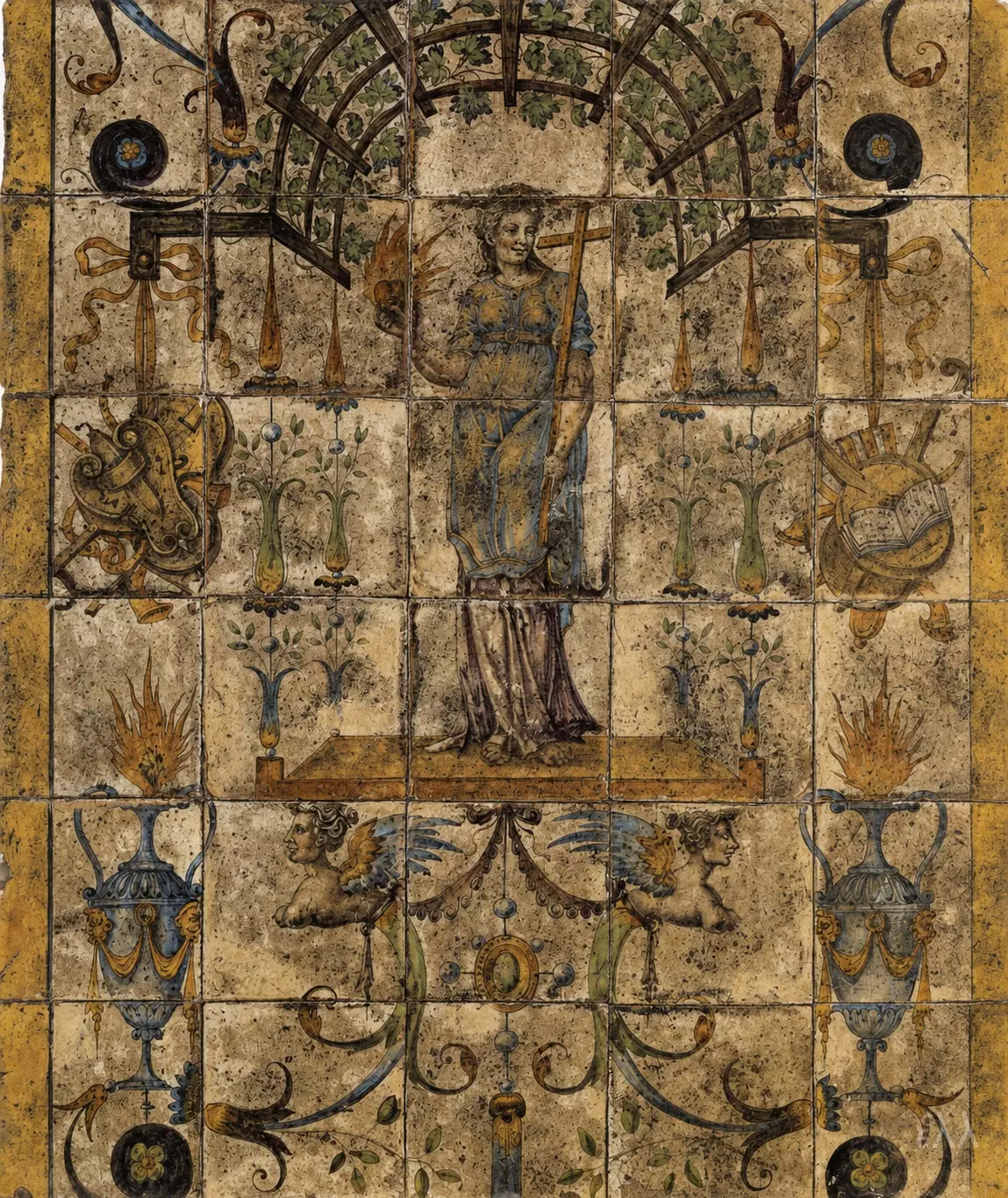
Masséot Abaquesne’s Ceramic Floor of 1557 belongs to the ambitious decorative projects that brought Renaissance imagery into French ceramic art on an architectural scale. Produced in Rouen, the surviving pavement formed part of the altar step in the chapel of the Château de la Bâtie d’Urfé and was commissioned by Claude d’Urfé, a former ambassador of Henri II in Rome. The Louvre identifies the complete ensemble as nine slabs, each composed of thirty tiles arranged six by five, with an overall extent of approximately 183 by 324.5 centimetres. Made from tin-glazed earthenware and decorated by the grand feu process, it is now preserved in the Musée du Louvre in Paris.
Across the tiled surface, Abaquesne treats the floor almost as a large painted field. Tile divisions remain plainly visible, yet the design passes across them: branches continue from one square to another, architectural and ornamental forms cross the joints, and the standing figure at the centre occupies several separate ceramic units. Regular and geometric on one hand, full of curling stems, suspended ornament and delicate asymmetry on the other, the physical grid and the painted composition therefore operate together.
Masséot Abaquesne Ceramic Floor and Renaissance Ornament
At the centre stands a female allegorical figure in a long blue and ochre garment, holding a tall cross while presenting another attribute in her raised hand. The cross connects her with the allegory of Faith, one of the personifications recorded in the Louvre description of the work. Around her spreads an elaborate ornamental framework: leafy branches climb across a trellis-like structure overhead, while slender plants, vessels, ribbons, shields, scrolling forms and fantastical human elements populate the surrounding field. In the lower section, two winged busts turn away from the central axis and frame a suspended medallion.
The pale ground is essential to the effect.
Against it, blue, green, yellow and brown-purple details remain sharply legible even within passages crowded by ornament. Such a chromatic range is characteristic of grand feu faience, in which metallic oxides were applied in connection with high-temperature firing; the technique naturally favoured a relatively restricted group of strong colours. Comparable Rouen faience associated with Abaquesne demonstrates the same technical tradition.
Ornament governs the image, but never quite overwhelms the central figure. From the trellis at the top to the paired vessels below, motifs are repeatedly balanced across a vertical axis. Then the symmetry loosens: small leaves project at irregular angles, curled stems turn in different directions, and floral forms expand into empty spaces. This mixture of geometric control and proliferating invention belongs to the Renaissance vocabulary of grotesque decoration explicitly identified by the Louvre in its catalogue record.
Across the complete assemblage the imagery was still more complex. The Louvre records allegories of Faith and Justice, a triangular device accompanied by a ram burning upon a sacrificial altar, and papal parasols associated with Paul IV. The painted date 1557 appears in yellow within a cartouche on the central section. These motifs connected ornamental splendour with a carefully constructed emblematic programme appropriate to the chapel for which the floor was designed.
For Abaquesne, commissions of this kind occupied an important place within a broader production of Renaissance faience at Rouen. Museum research has emphasized the scale of his pavements and his work for prominent patrons close to the French royal court, alongside his production of vessels and other ceramics. To this mature phase of his activity belongs the Bâtie d’Urfé commission.
Removed from its original architectural setting, the work entered the Louvre through the donation of the collectors Beurdeley père et fils in 1880. Its present museum display necessarily changes the original encounter with the piece: conceived beneath the feet and immediately before an altar, the ceramic surface combined architecture, ornament and figurative imagery within a single carefully measured field.