
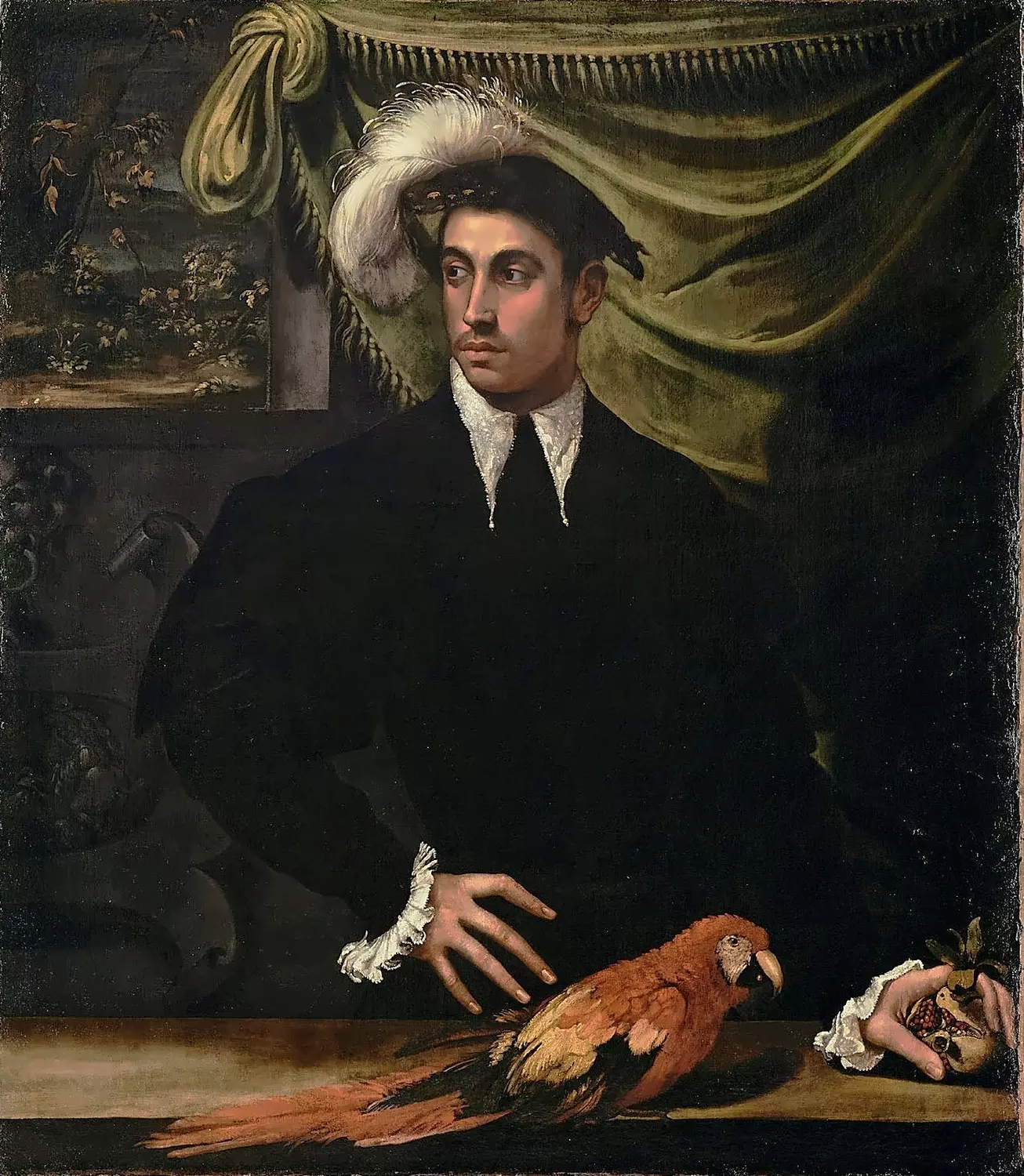
A young man in black turns his face away from the frontal axis, his attention directed beyond the limits of the composition, while a brilliantly coloured parrot occupies the ledge before him. Niccolò dell’Abate’s Man with Parrot, an oil painting on canvas measuring 125 × 109 cm, belongs to the Kunsthistorisches Museum in Vienna. The museum currently dates it to 1535/1540 and classifies it as an Italian, specifically Emilian, painting; other cataloguing traditions have placed it more broadly in the 1540s.
The picture belongs to the earlier phase of dell’Abate’s career, before his departure for France in 1552 and his later work at Fontainebleau with Francesco Primaticcio. Born in Modena, the painter developed within the artistic culture of Emilia, and his early production reveals affinities with the elegant, elongated language associated with Parmigianino. In Man with Parrot, that refinement appears in a quieter form, since the sitter possesses neither the rigid frontality of an official state portrait nor an elaborate architectural setting. Instead, costume, gesture, a landscape opening, a green curtain, the exotic bird and the pomegranate generate a carefully controlled image of cultivated presence.
Man with Parrot: Courtly Identity and Pictorial Refinement
Represented at approximately half length behind a horizontal ledge, the young man wears black clothing that absorbs much of the available light and initially seems almost continuous with the dark interior around him. From that expanse emerge the face, the sharply contrasting white collar and cuffs, and the hands. Dell’Abate uses these illuminated passages sparingly, so that the visual hierarchy of the work depends on tonal concentration: face first, then hands, then the startling red body of the parrot below.
Black dress carried particular pictorial possibilities for sixteenth-century portraitists. Here it allows the painter to suppress distracting surface pattern and concentrate attention on bearing and physiognomy. The young man’s costume nevertheless appears carefully fashioned. A dark cap sits low across his forehead and supports an exceptionally large pale feather, its soft fibres curving above his head before dissolving into the darker background. Behind it, the folds of a heavy green curtain spread across the upper right portion of the canvas. Feather and curtain answer one another through sweeping curves, one light and mobile in appearance, the other weightier and more architectural.
Turned in three-quarter view, the figure’s eyes move further to the side, giving the impression that his attention has momentarily shifted toward something outside the painted field. Dell’Abate avoids an exaggerated emotional expression. The closed mouth, long nose, carefully modelled cheek and watchful gaze create a degree of reserve, though the face remains individualised rather than impassive. In discussions of dell’Abate’s manner, the National Gallery of Art has noted the painter’s characteristic precision, mannered physiognomies and sometimes metallic colour effects; that precision is especially evident around the eyes and in the transition from illuminated cheek to shadow.
The Parrot and Pomegranate
Across the foreground runs an entirely different sequence of colour. The parrot, predominantly red with yellow and darker feathers in its wing, stands on the ledge with its long tail extending towards the left. Its pale hooked beak and lighter facial area are sharply defined against the black clothing of the young man. Large enough within the composition to function as a secondary protagonist, the bird is explicitly identified, together with a pomegranate, among the portrait’s attributes in historical descriptions of the work.
At the extreme right, another hand emerges from the darkness of the sleeve. The black fabric makes the arm itself difficult to distinguish at first, while the white cuff establishes the transition between garment and flesh. Anatomically, the position of the wrist and the continuation of the dark costume indicate that this hand belongs to the same figure. It holds an opened pomegranate, exposing a dense cluster of red seeds, together with a small group of leaves.
The painter has therefore concentrated several chromatic accents along the lower edge: flesh, white linen, crimson bird, yellow plumage, red fruit, green leaves. Against the almost uninterrupted black of the torso, they acquire unusual intensity. The bird turns towards the pomegranate-bearing hand, linking the two sides of the foreground and producing a small narrative tension without converting the work into a narrative scene.
A pomegranate could carry several associations within Renaissance imagery. Its many seeds were used in Christian contexts to suggest unity, while other traditions connected the fruit with fertility and abundance; in religious painting it could also acquire associations with sacrifice and Resurrection. Applying any one of those meanings rigidly to dell’Abate’s picture would go beyond the surviving evidence, since the unidentified young man, secular setting and combination with a parrot leave the precise significance open.
The same caution applies to the bird. Parrots possessed symbolic meanings in European religious imagery, yet their exotic character also made them remarkable objects of possession and display. Renaissance and early modern European interest in such birds was closely connected with their rarity and with long-distance movement of luxury goods and living animals. In this work the parrot can be read, at minimum, as an intentionally conspicuous presence: expensive-looking, vividly coloured, visually unusual. Whatever further associations a contemporary viewer may have recognised, dell’Abate made its material splendour impossible to overlook.
Interior, Landscape and the Construction of Depth
Behind the young man, the composition divides into two markedly different spatial zones. The green curtain closes the upper right side, its gathered fabric forming broad descending arcs. On the left, a rectangular opening reveals a dark landscape with slender trees and scattered foliage. Subdued, almost nocturnal in its tonal restraint, the landscape nonetheless prevents the picture from becoming a simple figure against a neutral backdrop.
That small opening also establishes recession. Bounded at the front by the ledge and at the rear by curtain and wall, the figure belongs to a shallow interior space, while beyond the opening lies a second, more distant world. Dell’Abate would later become strongly associated with landscape and elaborate decorative compositions, particularly during his French career; the National Gallery describes independent landscapes alongside his work in the extensive decorative campaigns at Fontainebleau. Within this earlier picture, landscape is compressed into a secondary passage, a glimpse rather than an independent subject.
The ledge is equally important. It creates a horizontal boundary immediately before the young man, yet the hands, bird and fruit activate that boundary and visually bring the composition forward. The parrot’s tail lies almost parallel to it before turning diagonally across the lower left. Above, the visible hand descends towards the same plane, its widely separated fingers introducing another oblique movement.
Between these diagonals and the great curves of the curtain, the composition becomes considerably more animated than the young man’s restrained expression might suggest, with feather above, curtain behind, hands below and bird across the foreground.
An Early Portrait by Niccolò dell’Abate
Produced before dell’Abate’s decisive move into the French court environment, the painting belongs to a career that began in Modena and later developed in Bologna before he left for France in 1552, becoming one of the Italian artists associated with the School of Fontainebleau. Man with Parrot consequently belongs to an Italian phase in which the artist was already exploring the elongated refinement, controlled artificiality and courtly elegance that would remain important to his later visual language.
Yet the work also depends on close observation. The feather is distinguished strand by strand along its illuminated edge; the bird’s plumage changes from red to yellow and dark brown; the pomegranate opens into a compact pattern of seeds. Such passages coexist with broad dark masses where individual forms nearly disappear.
Most striking, perhaps, is the relationship between the young man and these objects. He neither presents the parrot ceremonially nor looks towards it, and his gaze travels elsewhere. The bird, meanwhile, turns towards the fruit held at the edge of the picture. Human attention and animal attention move in different directions, giving the apparently stable portrait an unusually dispersed visual structure.
The identity of the sitter remains unstated in the museum title, and the Kunsthistorisches Museum records the work simply as Mann mit Papagei — Man with Parrot. The museum also records it among older gallery holdings, with an addition to the inventory in 1890. Without a secure identification or documented commission, costume, setting and attributes must carry much of the historical interpretation.
Dell’Abate gives them considerable weight. Black cloth and white linen, green velvet-like drapery, feathers, fruit, flesh, distant vegetation: each possesses its own texture while remaining subordinate to the face of the sitter. Along the ledge, however, the extraordinary red bird interrupts that hierarchy. Its colour burns against the dark costume, the pomegranate answers it from the opposite edge, and between them rests the hand of the young man whose name the painting has lost.
(The translation was edited by A. Orfanos.)