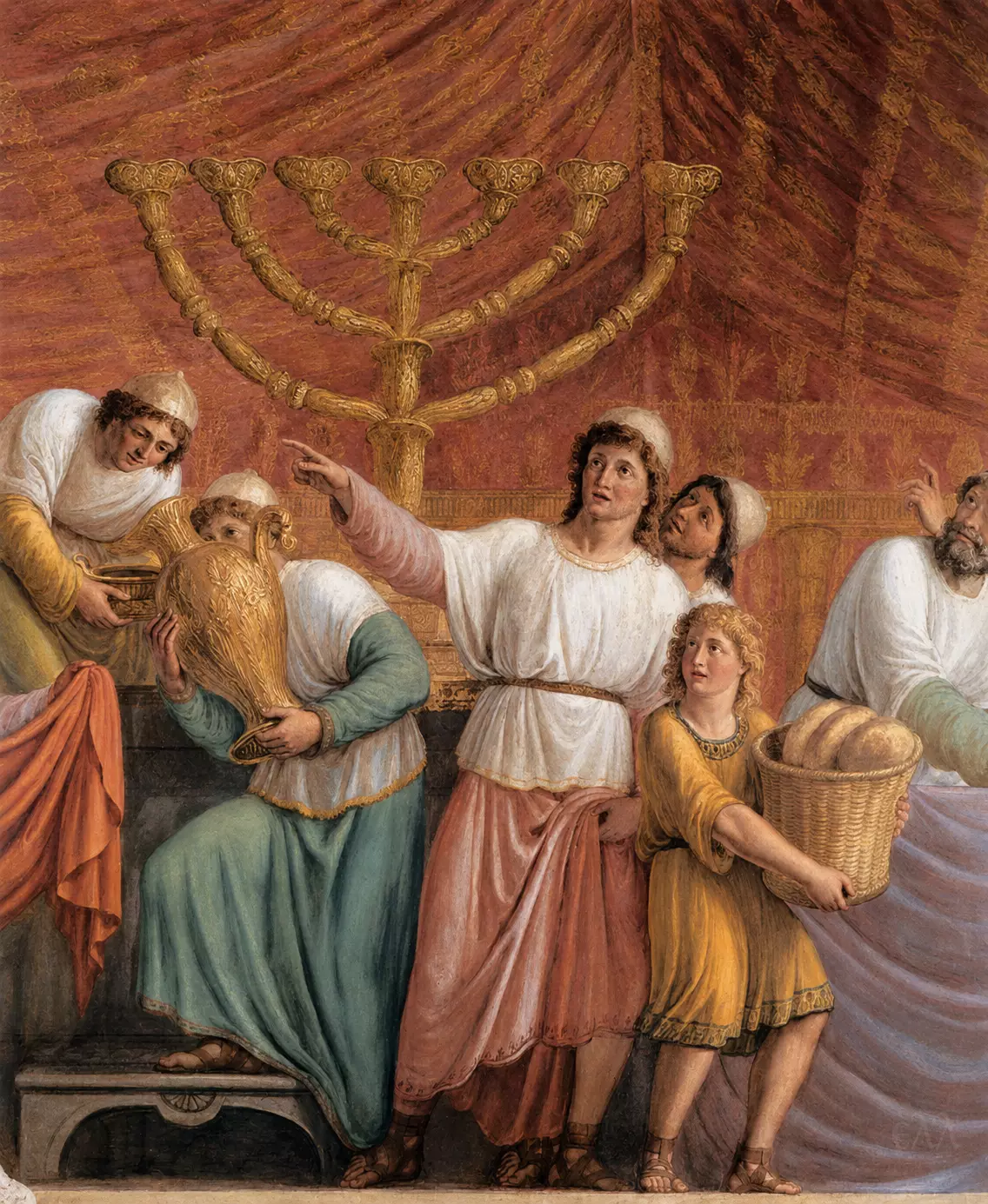
Luigi Ademollo’s The Menorah, painted in 1816 for the Room of the Ark in the Galleria Palatina at Palazzo Pitti, Florence, belongs to a decorative cycle in which biblical history is treated with the scale and visual immediacy of public spectacle. The work is a fresco, and its place within the Room of the Ark connects it to the ceremonial world of the Hebrew Scriptures. The scene concentrates on preparations for a Jewish festivity: bread and wine are being arranged for distribution, while the seven-branched golden menorah rises above the assembled figures as the dominant emblem of the composition.
Ademollo does not isolate the sacred object. He surrounds it with human movement. The great candelabrum stands high in the pictorial field, its branching arms spreading laterally against a warm reddish background, while below it a tightly packed group of attendants turns, carries, points, bends, and looks upward. This relationship between monumental symbol and restless human action determines the visual rhythm. While the menorah remains fixed, the surrounding participants continue to move. Their gestures continually redirect the eye toward the centre, especially the extended arm of the youthful figure in white, whose pointing hand creates one of the strongest diagonals in the fresco.
The composition is organized through overlapping bodies rather than deep recession. A stooping elderly man with a long beard occupies the left foreground, his large form and pale blue-green garment creating a heavy visual mass. Near him an attendant leans forward with a vessel, while another presence is partly obscured behind the elder’s shoulder. At the centre, the young man in white stands almost upright but turns his head and upper body. A smaller companion beside him carries a woven basket filled with round loaves. To the right, another bearded man appears behind the table or platform, only partly visible. The crowd is compressed, yet each principal gesture remains legible.
Luigi Ademollo The Menorah and the theatre of biblical history
The most striking formal device is scale. The menorah is enlarged until it becomes almost architectural, rising above the participants and occupying the upper centre with a branching symmetry that contrasts with the irregular arrangement below. Its metallic surface is modelled through ochre, brown, and gold-toned highlights, and the repeated knobs, stems, and cups produce a decorative rhythm. Ademollo’s emphasis on the object is iconographic, but also compositional: the menorah acts as a visual axis, gathering the dispersed actions beneath it.
Colour contributes to the same effect. The background is dominated by red, rust, ochre, and burnt earth tones, giving the scene a dense atmosphere. Against this field, the white tunic of the pointing youth becomes especially luminous. The pale green-blue of the elder’s garment and the yellow-ochre dress of the bread bearer provide lighter interruptions. These contrasts separate individuals that otherwise overlap heavily, preserving narrative clarity inside a crowded setting. The handling of drapery remains broad and descriptive, with folds used to articulate posture and movement.
The personages possess a strongly theatrical quality, although their movements remain purposeful. Ademollo distributes attention through a chain of glances. The central youth looks upward toward the object he indicates; the man behind him follows the same direction; the bread bearer turns toward the middle; the aged man at left lowers his head, creating a counter-movement. At the far right, the raised hand of the partially visible man continues the upward directional pattern. Such actions prevent the fresco from becoming a static ceremonial tableau.
Across his decorative work at Palazzo Pitti, Ademollo developed a language informed by antiquarian taste and Neoclassical discipline. Uffizi scholarship notes his engagement with ancient reliefs, the Mannerist-Michelangelesque tradition, and Lombard Neoclassical elements in his palace decorations. In The Menorah, that background can be sensed in the broad sculptural modelling of the personages, the clear profiles, and the staged distribution of bodies across a shallow pictorial space. The arrangement resembles a frieze brought into motion, particularly in the way heads, arms, vessels, and draperies form a continuous lateral sequence.
The fresco also depends on material abundance. Bread, vessels, fabric, the woven basket, the gleaming candelabrum: these elements give the biblical subject a tangible physicality. The large hamper of loaves is especially important because it brings the preparations into the foreground and balances the elevated symbolism of the menorah with an image of provision. Historical narrative becomes visible through possessions handled by ordinary worshippers.
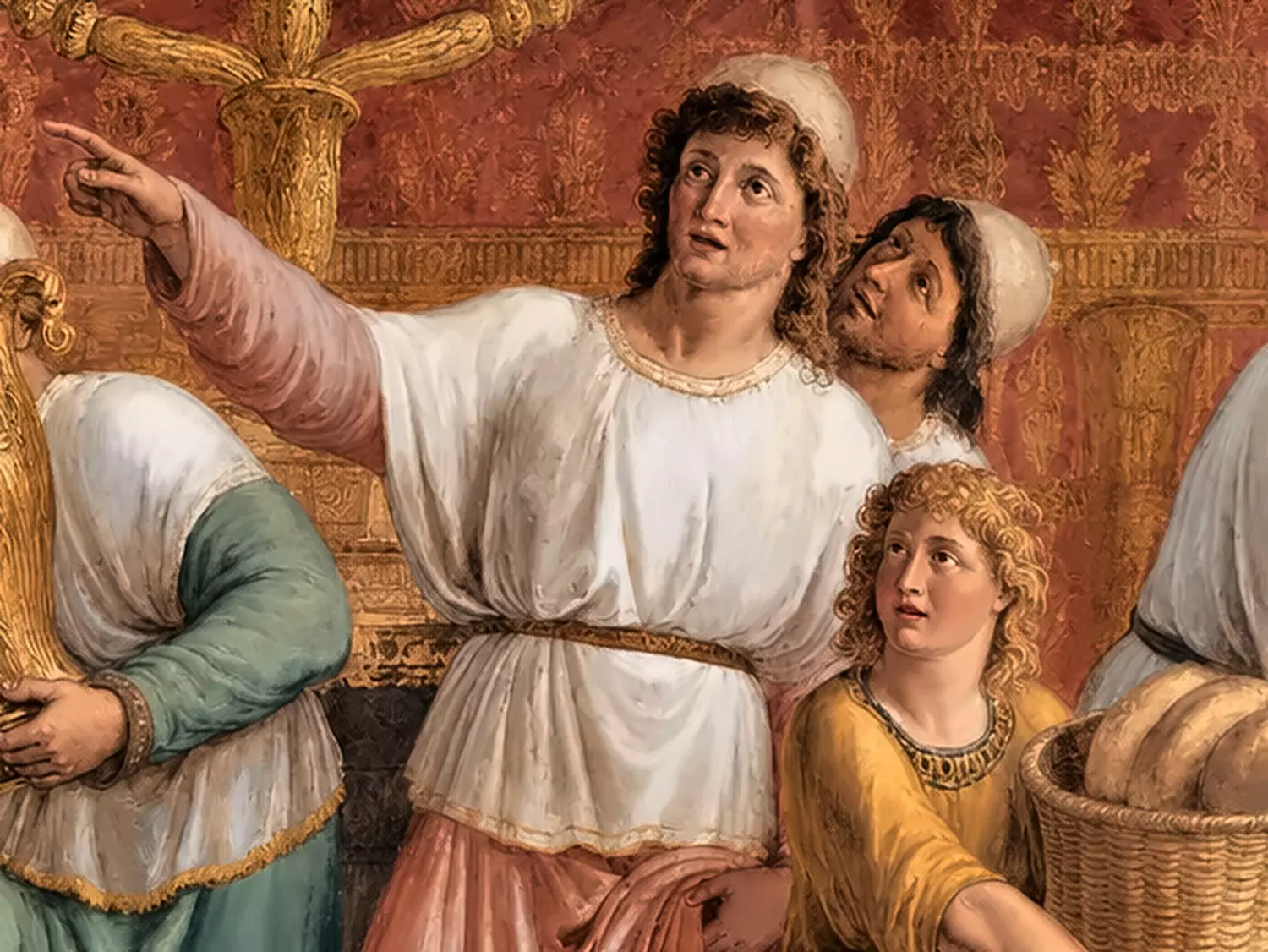
The detail view confirms how carefully the painter organized the central knot of protagonists. The white-clad youth is framed by the silver-haired man at left, the darker-haired man behind him, and the bread bearer below. His arm extends across the upper left of this group, while the vertical line of his body descends through the belt and folds of the tunic. Beside him, the hamper forms a compact cylindrical mass. Faces are individualized through differing ages, hair, beards, and expressions, though the cast remains part of a unified narrative ensemble.
Luigi Ademollo The Menorah in the Room of the Ark
Within the Room of the Ark, The Menorah functions as an episode inside a larger Old Testament environment rather than as an autonomous easel painting. Its imagery is ceremonial, its pictorial language public and expansive. The seven-branched candelabrum dominates without emptying the scene of human presence; below it, work continues, bread is carried, vessels are prepared, hands indicate what must be seen. The fresco’s final energy remains in that conjunction of emblem and action, a sacred object suspended above the practical preparations of a crowd.
(The translation was edited by K. Pappas.)