Frescoes of the Monastery of Philanthropinon / On the Island of Lake Ioannina, heavy humidity does not merely wrap the exterior shell of the katholikon. It penetrates far deeper, paradoxically saturating the structure’s historical time, evoking a captivating sensation right at the threshold. Passing through the low entrance of the church, we must recognize that we are not merely before sacred objects of worship. We must approach this entire body of depictions strictly as historical evidence. Around 1531 to 1532, the activity of an anonymous—and by all indications, likely local—painter is recorded within this space. This specific work, the frescoes covering the surfaces, bears witness to the intense influence of Cretan art, filtered through local Epirotic roots. During a period of intense social and religious ferment, the Monastery also functioned as an informal yet exceptionally active School (Spoudastirio), where knowledge was transmitted not only through texts but also through visual means. The eye needs time to adjust to the dim light. Observation begins from below, where damage to the plaster reveals the texture of the stone wall. And it is precisely this slow adaptation to the darkness that directs our perception of the space.
Hierarchical Harmony and Divine Presence
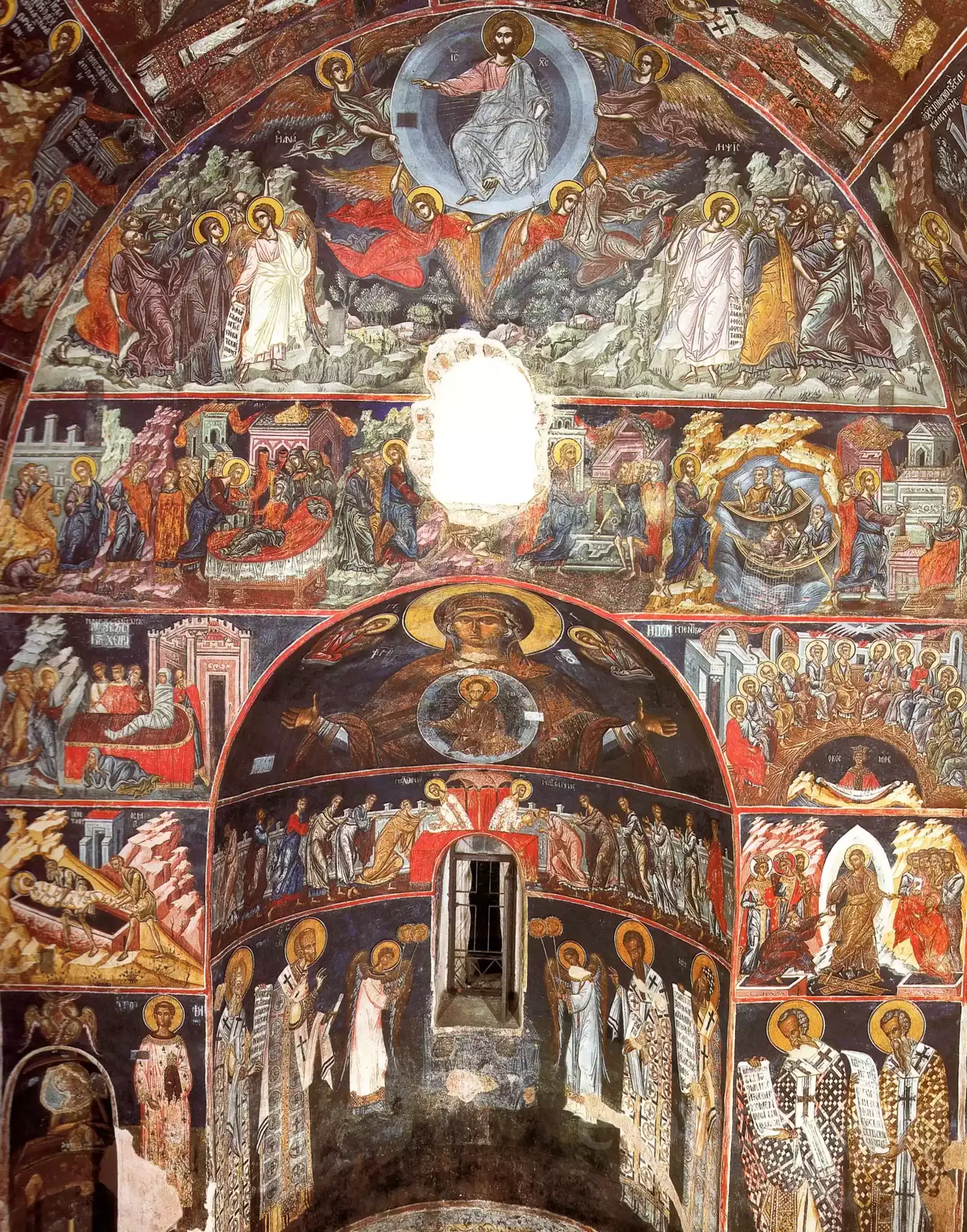
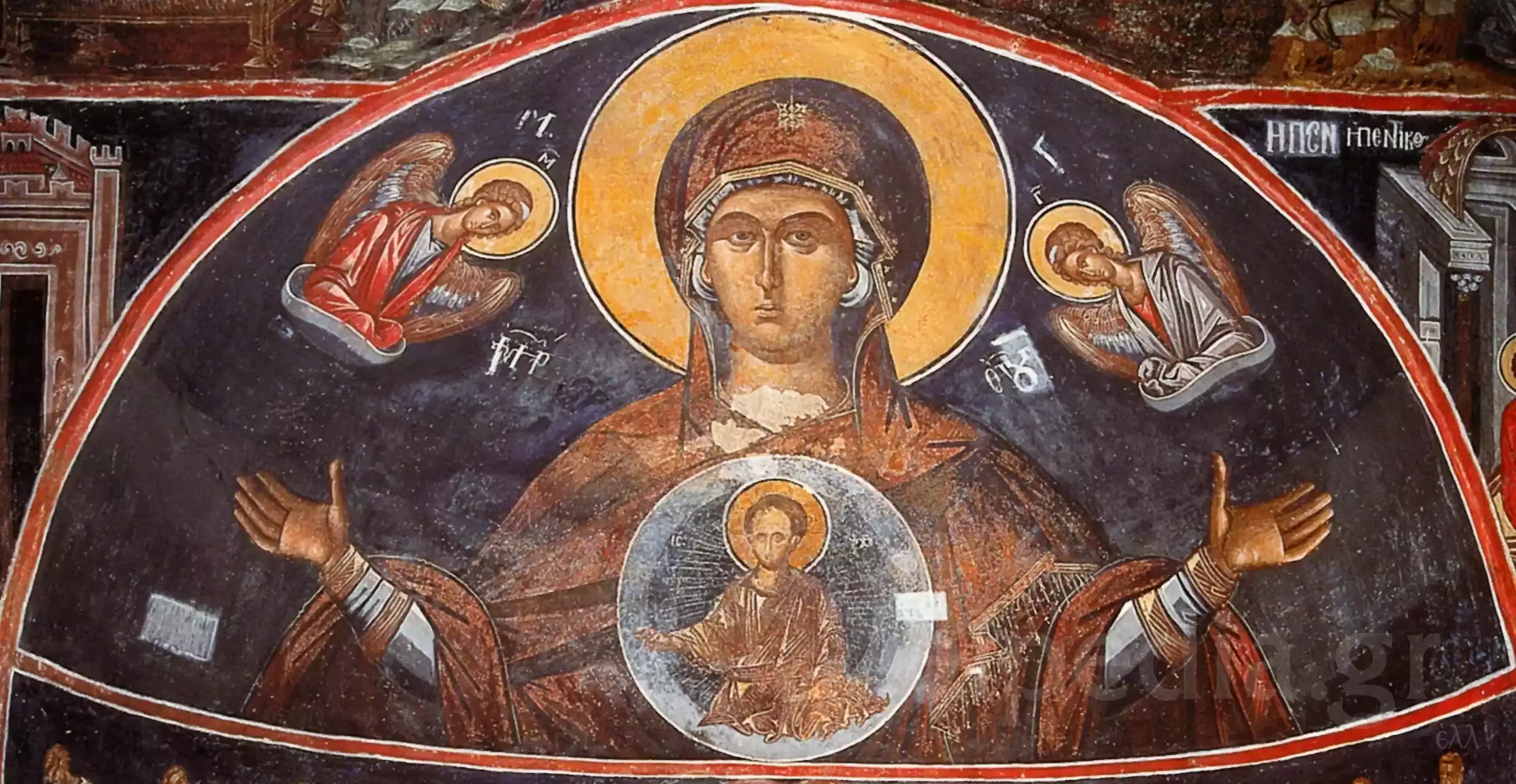
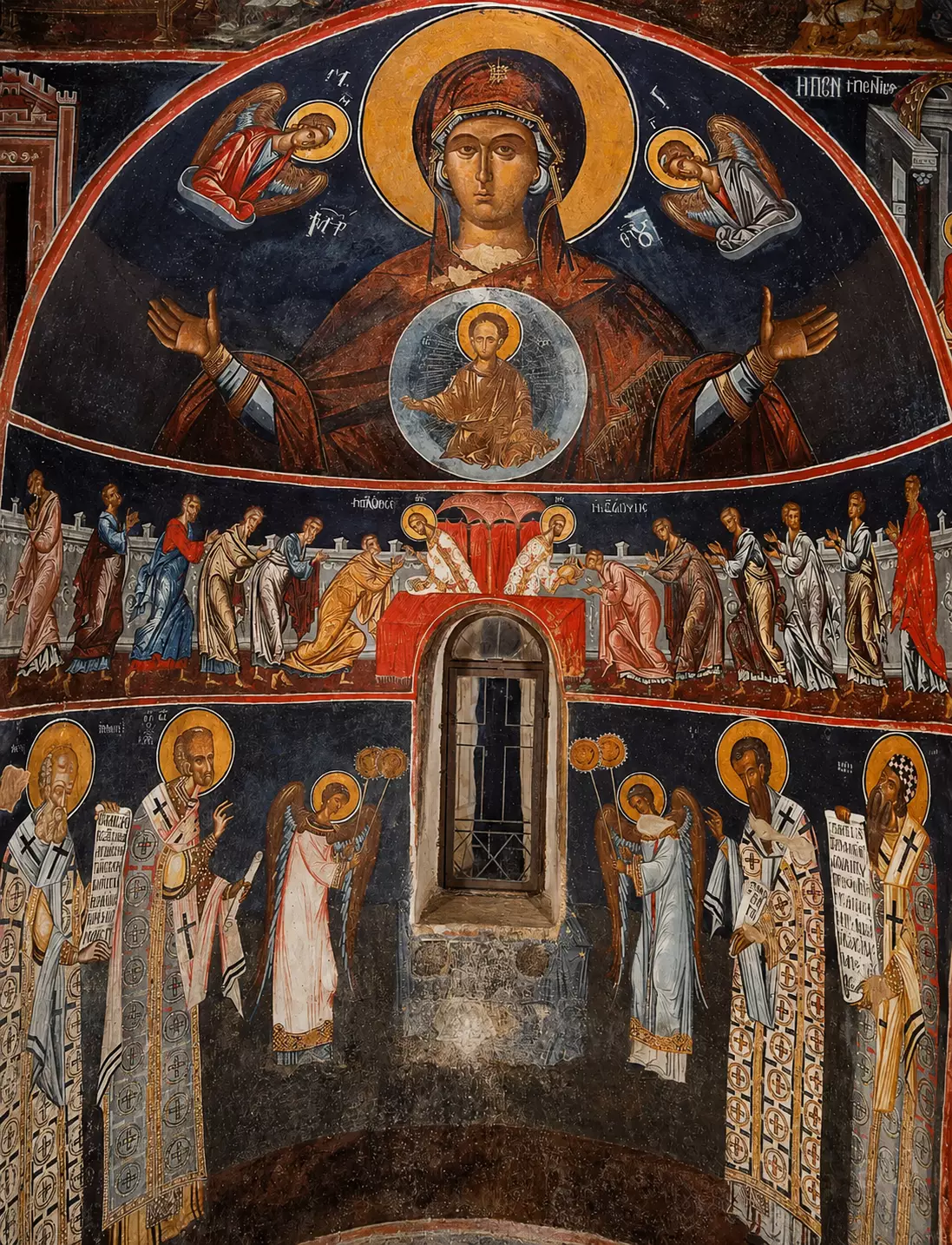
Examining the general view of the central apse, it immediately becomes clear that the layering of individual iconographic themes does not randomly follow the architectural curvature but… perhaps, attempts to subordinate it. There is a peculiar visual silence here. It is an art that does not attempt to dominate by its scale, nor does it extort an easy emotional reaction from the viewer. The craftsman of this decoration reserved the lightest, brightest layers of his palette for the upper parts of the apse. At the highest point, sovereign and simultaneously deeply introspective, the composition of the Platytera of the Heavens unfolds. The detail of this specific iconographic type refers us directly to the known typology of the Vlachernitissa. The Virgin’s hands are raised—a posture conventionally and textually defined as strictly supplicatory—although, observing the tension in her wrists, I tend to discern something different. It is rather a suspended opening, a gesture that hesitates to complete itself. At the level of her chest. Precisely there is placed the luminous medallion containing Christ, who does not bear the characteristics of a weak infant. He is rendered as the mature, pre-eternal Logos (Word), clad in golden tesserae of light, in a clear theological declaration written in ochre. On either side, the two Archangels, Michael and Gabriel, stand in a posture that is only superficially absolute inert. Their bodies lean imperceptibly toward the center. The tips of their wings vanish into the shadiest corners of the conch (quarter-sphere).
Narrative Complexity and Human Discord
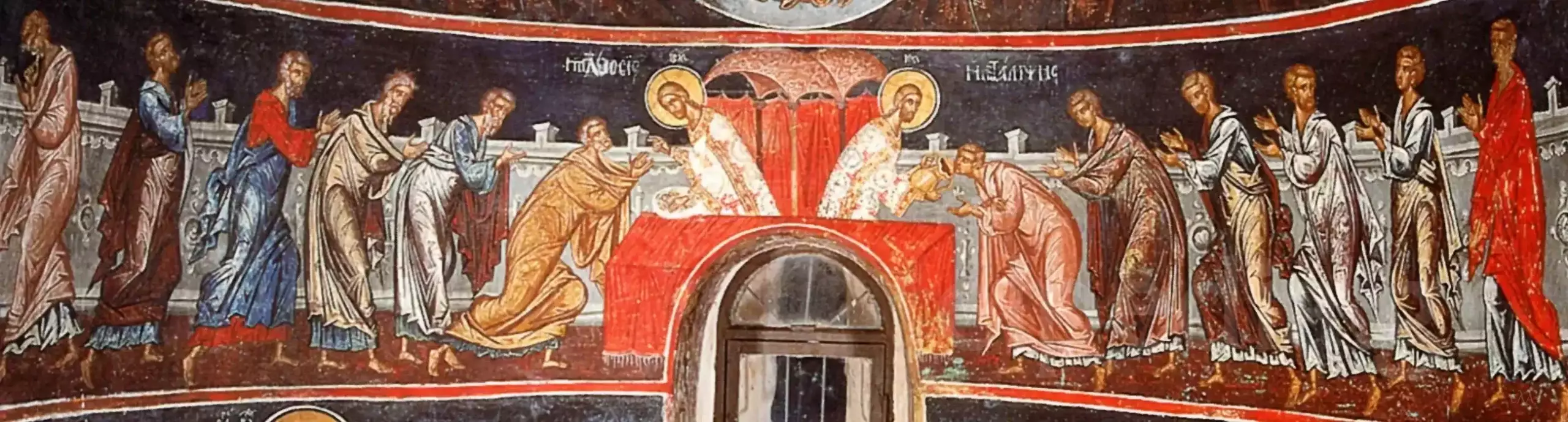
Yet how does the painter manage the austerity of the peak when descending to the more human, narrative levels? Shifting the gaze to the zone immediately below, the rhythm accelerates unexpectedly. Examination of the scene of the Communion of the Apostles reveals an almost scenographic organization of space. The action breaks into two facing half-choirs. The disciples move not as an amorphous mass, but each carries a specific physical weight, a distinct grounding upon the hypothetical baseline. Beneath the architectural volume of a ciborium—which provides a necessary illusion of depth—Christ is depicted twice. His white, pleated vestments are not merely vestimentary. They function as autonomous sources emitting light against the dark, earthy colorings of the garments worn by the Apostles. The faces of Peter and John possess the highest plastic density. On the left edge of the composition, however, lies a conscious dissonance. Judas. With his body in intense contortion, he moves away from the center of the event. His back turns emphatically toward us—a visual apostrophe (a turning away). This turning away not only hides his facial features but introduces a violent rupture into the previously undisturbed balance of the moment. The artist, without a trace of idealization, chose to record human failure within breathing distance of the holiest point of the action. His right foot hovers, half a step before exiting the frame completely.
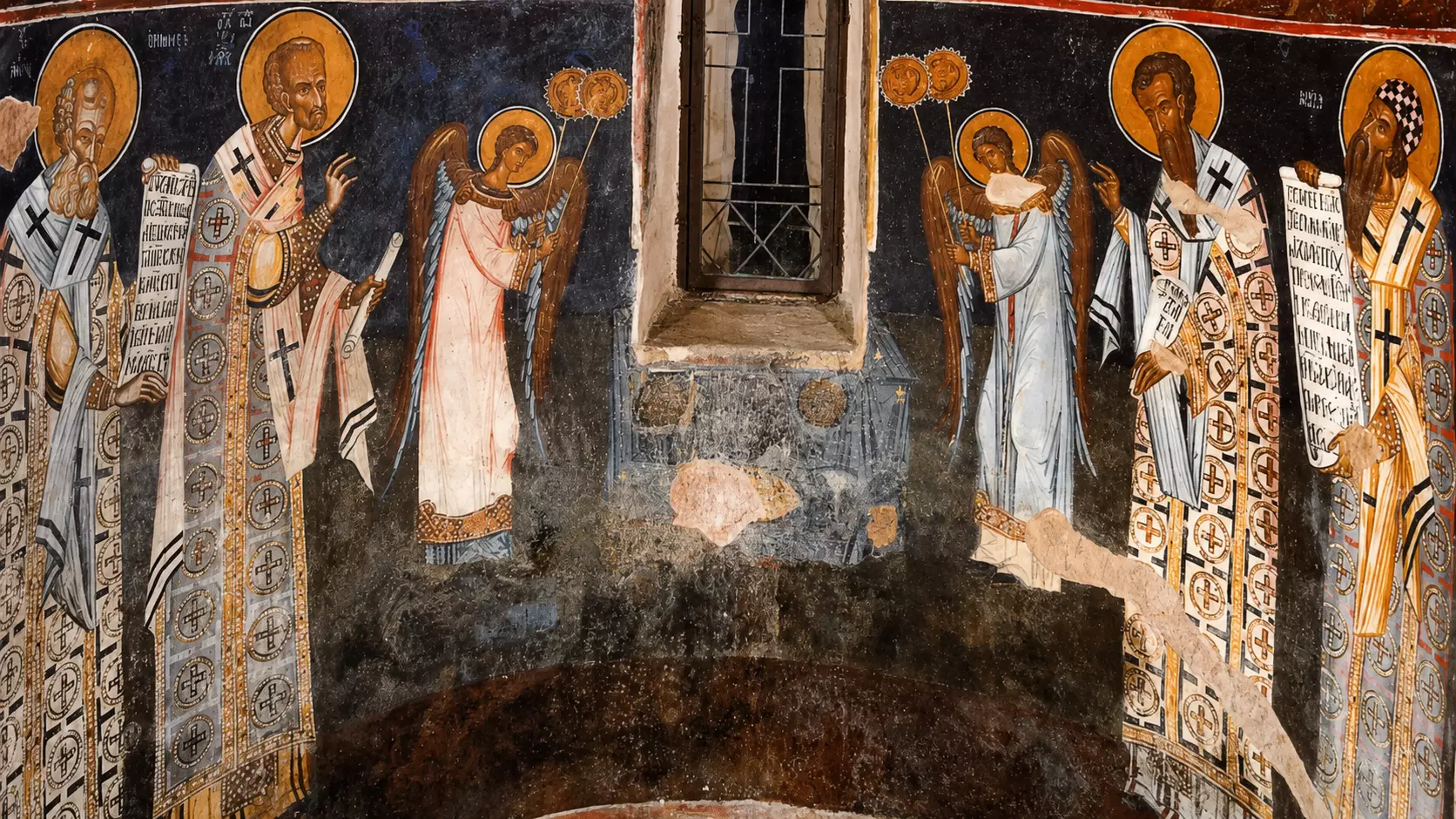
In the lowest field of vision, time appears to condense, canceling the preceding mobility. Observing the depiction of the Melismos (the Breaking of Bread), we note that the Concelebrating Hierarchs have lost all narrative inclination. They align themselves with a robust, almost brutal frontality. Large, heavy vestments, covered with enormous crosses, anchor their forms to the wall, making them immovable before the viewer. The folds no longer flutter. The scrolls they hold unfurl with sharp, absolute lines, devoid of any lyrical mood. Above the holy altar table, two angels raise their ripidia (liturgical fans), perhaps trying to define an invisible axis of protection around the sacrificial Lamb. The plaster, especially at this height, has begun to recede. Fine cracks run through the paint beneath the garments of the first Hierarch on the right.
This obsessive survival of the brush against time… is something we are likely unable to fully grasp in strictly rational terms. The colors in the Church of St. Nicholas of the Philanthropinon refused to fade, holding within themselves the harshness of an era desperately seeking stability. Art does not embellish. It reveals, sometimes harshly, the truth of a society that tried to preserve its identity by encoding it upon layers of wet plaster. And as you move away, looking back toward the apse. A piece of gold slowly fades on the halo of the left Archangel.