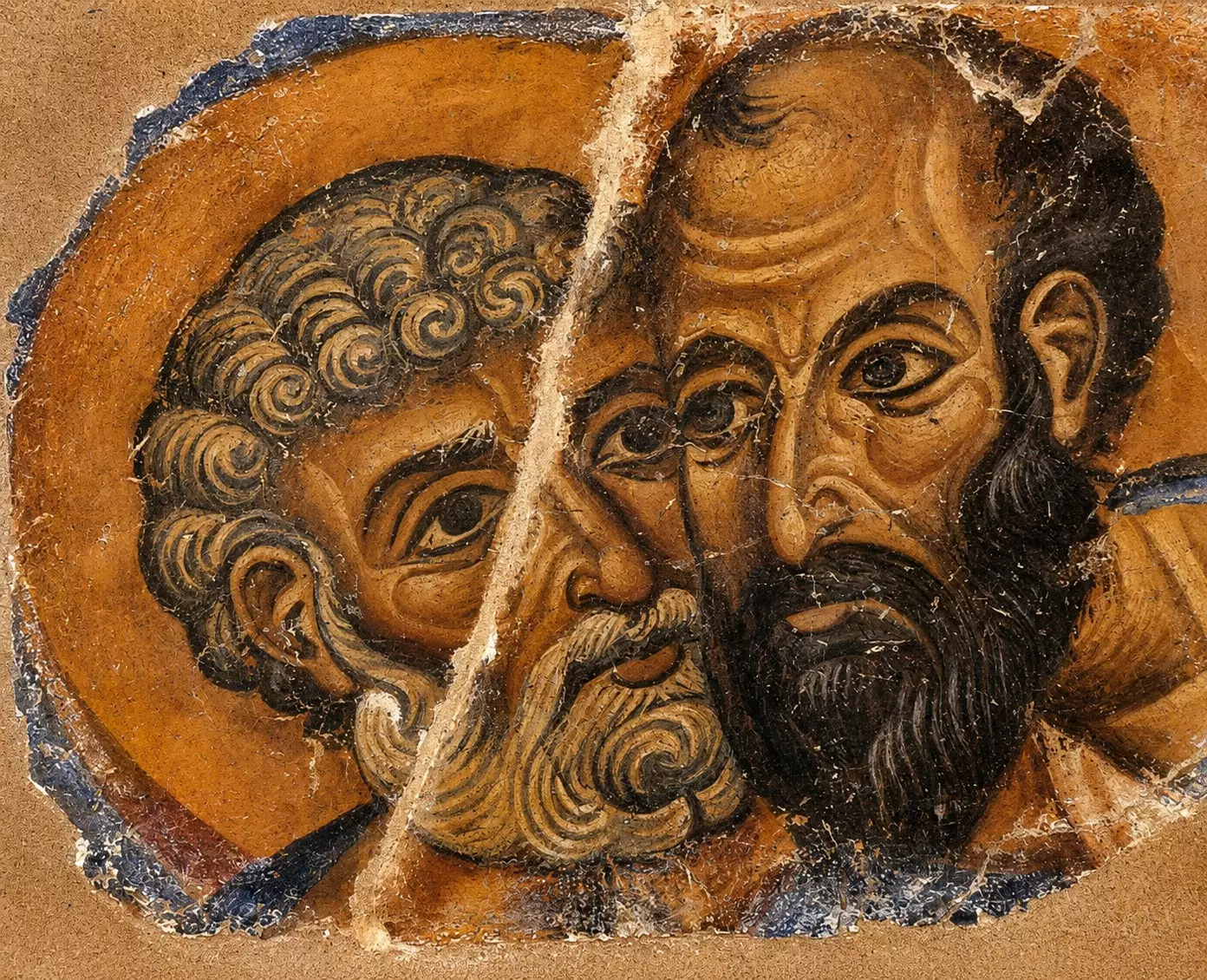
A fragment of fresco from Vatopedi Monastery, dated to the late 12th century, preserves the figures of the chief apostles Peter and Paul, painted side by side in a composition that the passage of time has split in two with a deep crack, visible at the center of the surface. The artist’s name has not survived, as is the case with most monumental art of Mount Athos before the 14th century, when painters rarely signed their work. In this damaged fragment, which probably formed part of a larger grouping of saints inside the katholikon, only the heads of the two apostles can be discerned, each framed by a halo with a pale red surface and a blue outline. Peter is shown on the left, with dense, curly hair and a beard in grayish ochre tones, gathered into small, almost spiral curls that recall his established iconographic type from the early Byzantine centuries. Paul, on the right, bears the characteristic high, bare forehead and dark, thick beard that consistently distinguish him in Orthodox tradition from his apostolic counterpart. The gaze of both is directed downward and to the side, in a pose of restraint befitting the sanctity of the image, while the pronounced wrinkles on Paul’s forehead betray the age and philosophical gravity with which Byzantine painting has always invested his figure.
The shared physiognomy of Peter and Paul
The juxtaposition of the two faces is not a random compositional choice. Peter and Paul are depicted together in countless monuments of Orthodox art, not because they were closely linked during their earthly ministry, but because the Church recognized them as the two chief apostles, the ones who, through their preaching and martyrdom, upheld the foundations of apostolic proclamation. Peter, a simple fisherman from Galilee, was the first to confess Christ’s divinity; Paul, a man of Greek learning and a zeal initially hostile to Christians, was converted on the road to Damascus and became the preeminent preacher to the nations. Both were martyred in Rome around the decade of the 60s AD, which explains why their joint depiction became so deeply rooted in Byzantine iconography that it could function almost as an independent theme, detached from any broader composition.
The art of the Byzantine fresco of Vatopedi
At the technical level, this fresco belongs to the mature Comnenian period, when monumental painting had reached a particularly high degree of expressive refinement. The shifts of light across Paul’s face, from the deeper browns of shadow to the bright ridges of the cheekbones, testify to modeling carried out with successive, carefully laid layers of color over wet plaster. Nothing appears accidental; neither the line of the eyebrows nor the depth of the gaze. The crack running vertically through the surface, while destructive to the overall image, also reveals the thickness and consistency of the successive plaster layers, a detail of great value to anyone studying the technique of Byzantine art in that period. The choice of earthy, warm tones for the flesh, in contrast to the cooler blue of the halo, creates a visual tension that heightens the vitality of the two figures, despite the enormous losses of color across the surrounding surface.
What remains today of this composition is nothing more than a fragment, yet it is enough to reveal the level of mastery of a workshop working on Mount Athos at the end of the 12th century, at a critical moment in the formation of late Comnenian painting, just before the major political upheavals of the following century altered the course of the Byzantine Empire.


