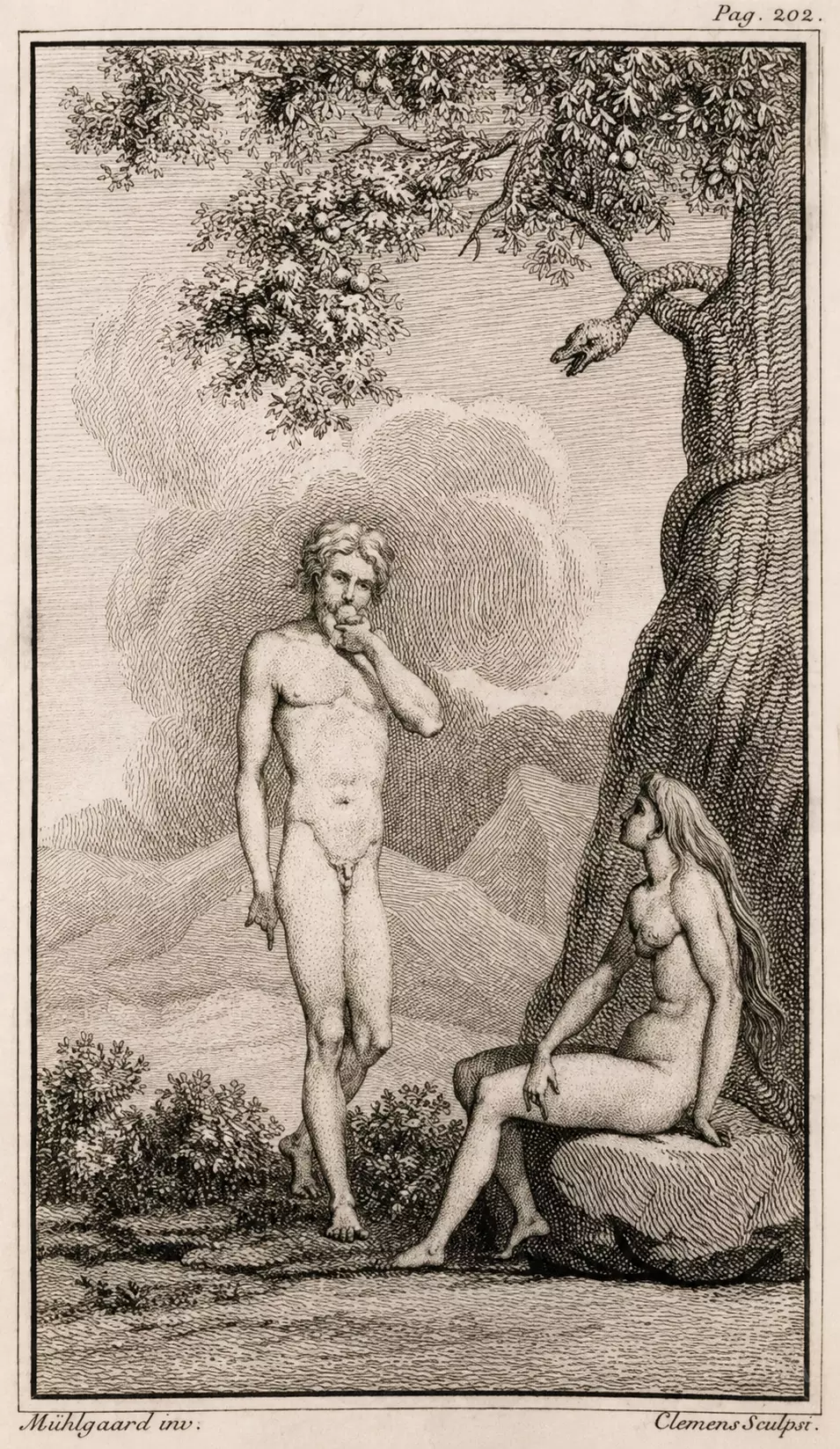
Beneath a canopy of overhanging branches, a nude man stands with one hand raised pensively toward his mouth while, at the foot of a great tree nearby, a seated woman turns her gaze upward toward a serpent coiled around the trunk. This is the design produced in 1780 by the Danish Neoclassical painter Nicolai Abildgaard for an engraved Adam and Eve, a sheet now held among the print collections of the Nationalmuseum in Stockholm. Signed in the lower margin with the customary division of labour between inventor and engraver, the print belongs to the broader tradition of late eighteenth-century book illustration, in which academically trained painters supplied compositions that professional printmakers then translated into copper.
Adam occupies the left portion of the plate, his weight settled on one leg in a stance recalling the studied contrapposto of academic life-drawing rather than any specifically doctrinal pose. Waves of hair frame a face turned slightly aside, and the hand pressed against his chin reads less as agitation than as suspended thought — the pause of a figure weighing a decision rather than one who has already surrendered to it. Low shrubs and a worn path ground him firmly in the terrestrial space of the print, even as the trees above dissolve into a delicately hatched screen of foliage and fruit.
Eve sits apart, upon a rough outcrop beneath the trunk from which the serpent descends. She twists her upper body toward the reptile rather than toward her companion, long hair falling loose across her shoulder and down her back in a manner owing as much to academic conventions of the female nude as to biblical precedent. One arm rests along a raised knee; the other trails toward the ground, a bare foot just touching the earth. The serpent, built up through a denser, more mechanical hatching than the softer modelling used for the flesh, coils twice around the tree before lowering its head toward her — the instant, evidently, just before the fruit changes hands rather than after, since the branches overhead still hang heavy with what the engraver has taken pains to render as ripe.
Nicolai Abildgaard’s Design for Adam and Eve
The lower margin preserves the two inscriptions typical of reproductive printmaking in this period: a credit attributing the invention of the composition to Abildgaard, and a separate engraver’s signature responsible for transferring that design onto the plate. The distinction is not incidental. Abildgaard worked chiefly as a painter and draughtsman, and the fine, even cross-hatching that builds volume across Adam’s torso and describes the receding ridges of the mountains beyond belongs to the engraver’s craft, following conventions of tonal gradation established well before either man’s career. A page number in the upper corner, reading Pag. 202, confirms that the sheet was not conceived as an independent print but as an illustration bound into a larger volume — most probably a biblical or devotional text current in Northern Europe at the time, though nothing on the plate itself identifies which one.
Trained first in Copenhagen and afterward in Rome, where prolonged contact with antique sculpture shaped the figural language he would use for the rest of his career, Abildgaard returned home to become, in time, professor and later director at the Royal Danish Academy of Fine Arts. The Adam and Eve design dates from the same decade in which that reputation was still being built, and it sits comfortably within the wider ambitions of Northern European Neoclassicism to reconcile antique bodily ideals with narrative subjects drawn from Scripture and literature alike.
Neoclassical Anatomy and Landscape
Both figures betray the anatomical discipline of the academies in which Abildgaard trained and later taught: idealized proportions, a musculature more studied than felt, an expression held at some distance from open sentiment even in a scene charged with consequence. The landscape, by contrast, is handled with a looser, more atmospheric touch. Layered ridges recede into cloud through parallel and cross-hatched lines of varying density, situating the narrative in a spatially convincing middle distance quite unlike the flattened backdrops of earlier religious print traditions. Academic figure and picturesque landscape meet here without entirely resolving into one idiom, which is perhaps the print’s most telling feature.
Whether the sheet was intended chiefly as moral illustration for a devotional readership, or simply as one further demonstration of Abildgaard’s command of the human form, is difficult to establish with certainty in the absence of the accompanying text. The plate itself offers only the image, the page number, and the two names recorded in its margin.