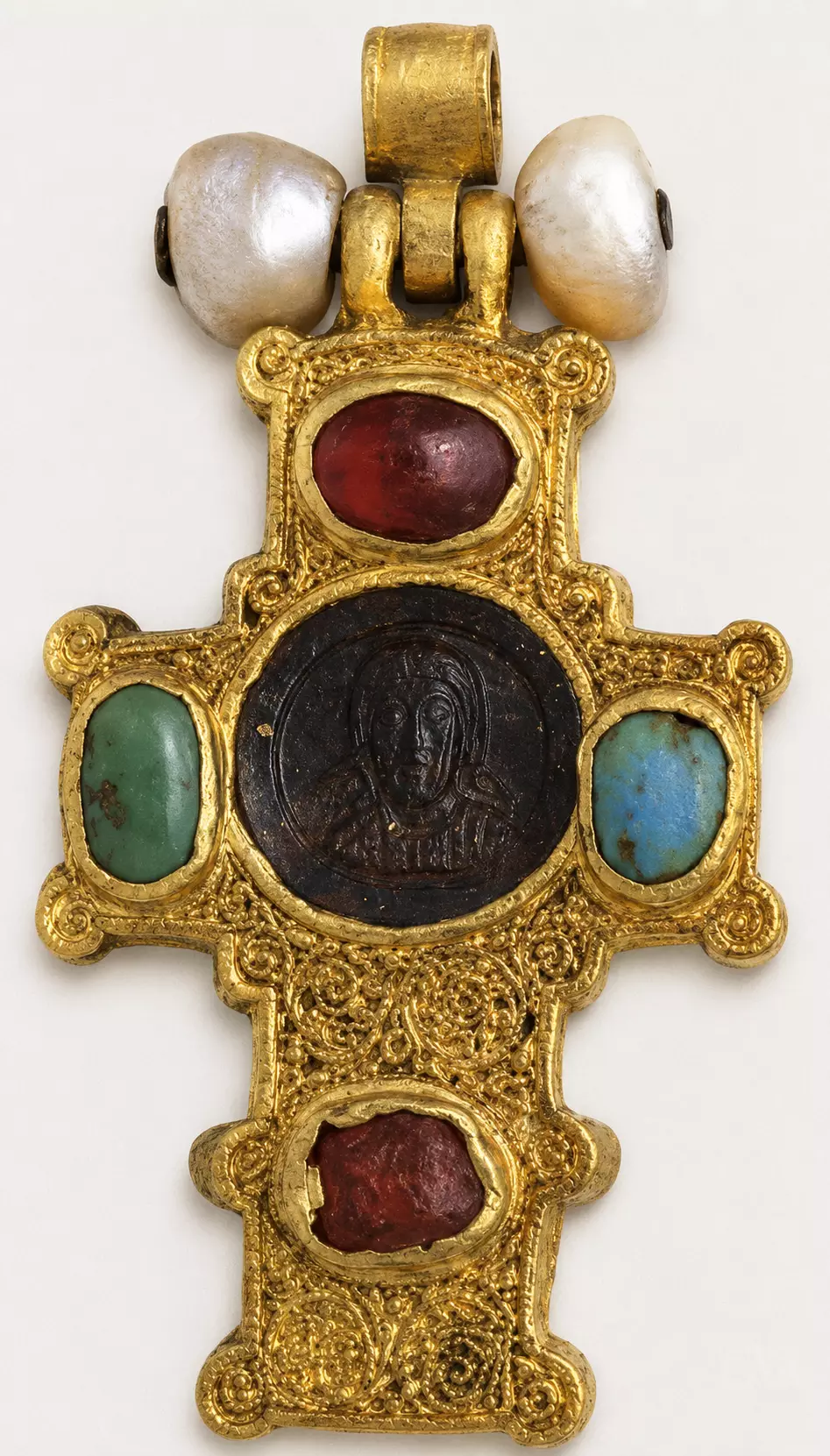
The Vatopedi pectoral cross, preserved at the Holy and Great Monastery of Vatopedi on Mount Athos, combines an earlier Byzantine gemstone carving with a sumptuous later metalwork setting. At its centre is a jasper cameo depicting Christ in bust, dated to the twelfth century, while the cross-shaped setting belongs to the fifteenth century. Gilt silver, pearls and precious stones complete the object. This difference in date suggests the deliberate preservation and reuse of an older sacred image within a later, increasingly elaborate frame.
The Vatopedi Pectoral Cross and Its Jasper Cameo
Dominating the composition, the dark circular cameo presents Christ frontally, his head and upper body emerging through shallow carved lines from the polished stone. The compact image is enclosed by a broad gilt border and surrounded by dense scrolling ornament. Four coloured stones mark the principal arms of the cross: deep red above and below, green and blue at either side. Their irregular surfaces and differing hues give the setting a material richness without disturbing its strong axial organization.
Above the cross, two large pearls flank the suspension mechanism and create a conspicuous transition between the body of the object and its attachment. Such movable suspension rings, sometimes accompanied by pearls or gemstones, occur among Byzantine enkolpia intended to be worn or suspended. The richly ornamented surface, lobed terminals and closely framed stones belong to the vocabulary of luxury ecclesiastical metalwork.
The contrast between the restrained, almost monochromatic cameo and the brilliant fifteenth-century mount is particularly striking. Around the small bust of Christ, gold, pearl white, red, green and blue form successive zones of visual emphasis, allowing a twelfth-century carved image to remain the fixed centre of a later and materially more elaborate object.