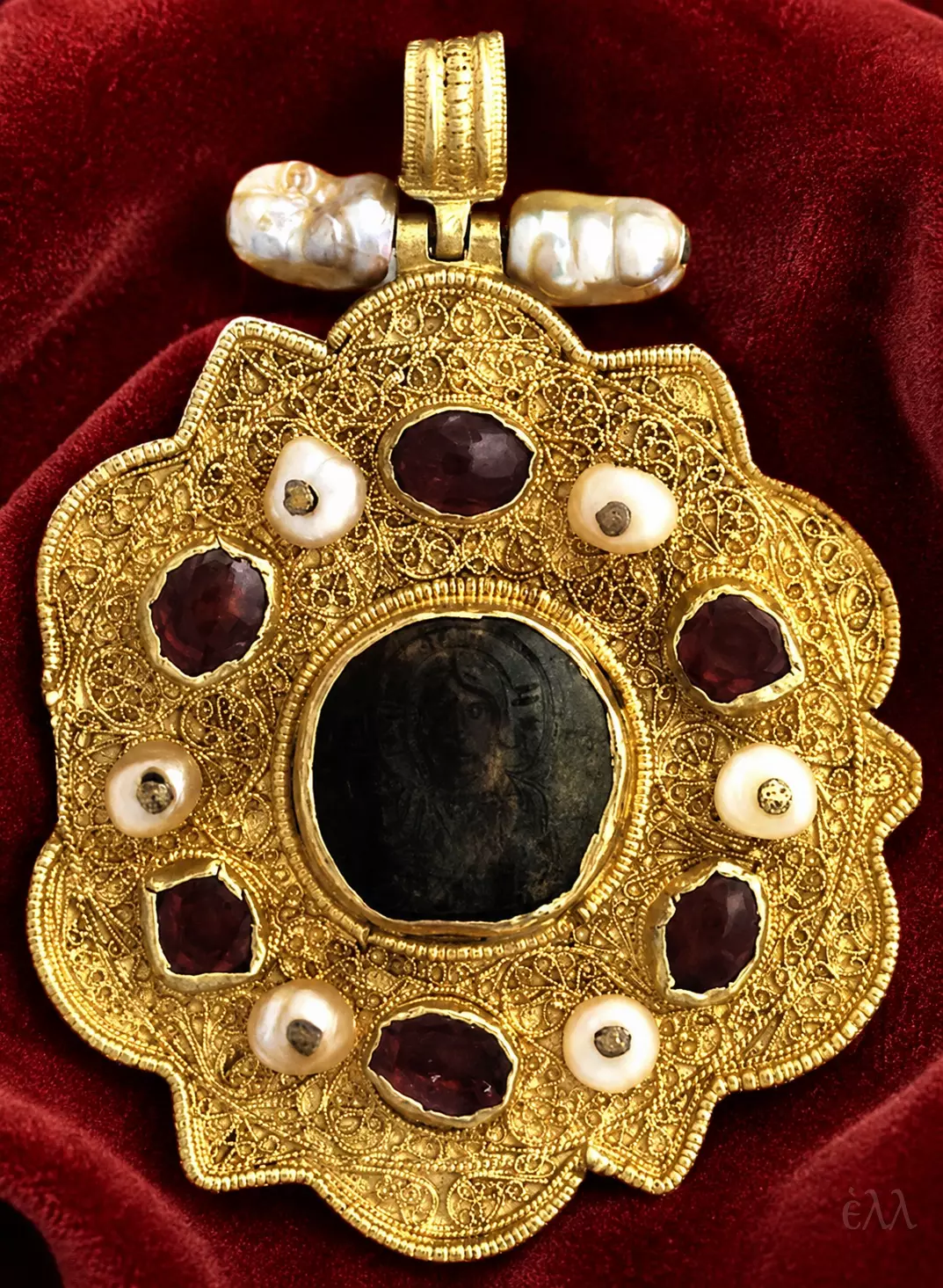
The Vatopedi Christ Pantokrator enkolpion is a small but exceptionally elaborate work of Byzantine and late medieval goldsmithing preserved at the Holy Monastery of Vatopedi on Mount Athos. At its centre is a thirteenth-century cameo carved from green jasper, representing Christ Pantokrator in bust. The older sacred image was subsequently incorporated into a richly ornamented gold mount, dated to the end of the fifteenth century and formed into a distinctive multilobed pendant.
Dark and compact, the central jasper immediately establishes the visual focus. Christ emerges from the stone in low relief, the facial modelling remaining restrained yet sufficiently articulated to distinguish the features within the deep green material. The head receives stronger relief treatment, while the cruciform halo and the abbreviated inscription IC XC are engraved, creating a subtle distinction between raised and incised work. This concentration of image and material belongs to the refined tradition of Byzantine miniature carving, in which precious or semi-precious stones could carry sacred representations on an intimate scale.
Vatopedi Christ Pantokrator Enkolpion and Its Gold Setting
Around the jasper core, the later setting expands outward through a sequence of rounded lobes. Gold filigree covers much of the surface with densely worked vegetal and scrolling patterns, interrupted at regular intervals by precious stones and pearls. Their alternating arrangement creates a strong circular rhythm around the darker cameo. Deep reddish gems supply points of saturated colour; the irregular pearls, by comparison, introduce pale highlights and variations of shape. At the upper suspension element, two larger horizontal pearls flank the attachment, making the transition from pendant to hanging fitting visually prominent.
The object therefore preserves two distinct chronological phases within a single structure: a thirteenth-century Byzantine cameo and an elaborate mounting produced approximately two centuries later. The later goldwork did not obscure the earlier carving; rather, it enlarged its physical and visual presence, enclosing the small Pantokrator within concentric ornament, gemstones and pearls. Such composite construction also demonstrates the continued value assigned to older Byzantine sacred objects, which could be preserved within new and materially costly settings.
Within the treasury of Vatopedi, the enkolpion belongs to a broader surviving group of small pendants executed in varied forms and materials. In this example, green jasper, finely worked gold, filigree, engraving, precious stones and pearls are brought together around a remarkably concentrated image: the solemn bust of Christ, enclosed at the centre of a multilobed field of late fifteenth-century ornament.