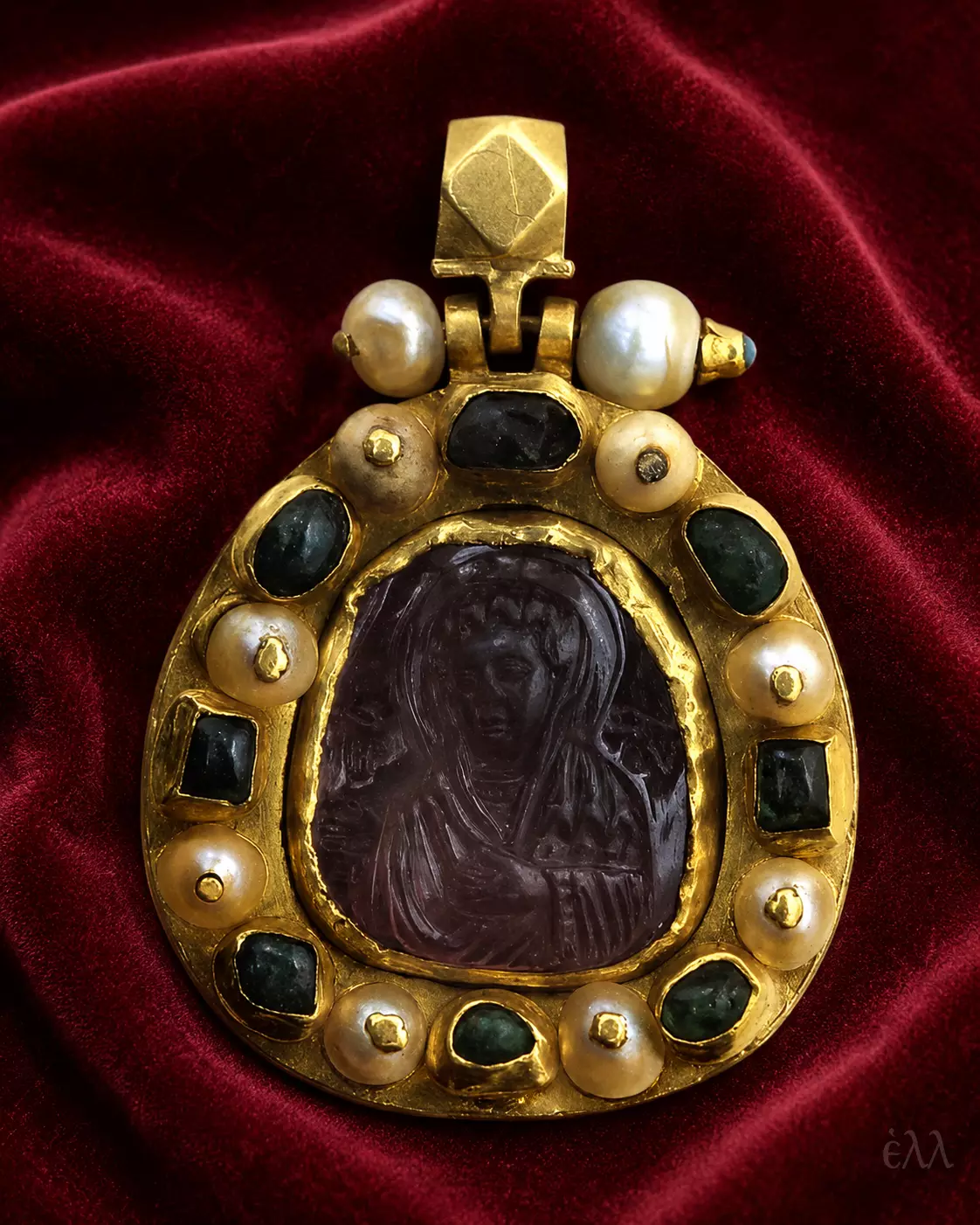
Preserved at Vatopedi Monastery on Mount Athos, this oval Hagiosoritissa Enkolpion belongs to the 12th–13th century and combines a carved gemstone with a richly ornamented silver-gilt mount. At its centre is the Theotokos Hagiosoritissa, carved in a warm, dark stone identified as probably amethyst. Pearls, green stones and traces of enamel articulate the surrounding frame, while the suspension fitting above establishes the object as a pendant intended to be worn.
Within the small cameo, the Virgin is represented without the Christ Child. Her head turns slightly and her hands rise in supplication, features associated with the Hagiosoritissa iconographic type and its intercessory character. Scholarship on the Vatopedi piece identifies the gemstone as amethyst and dates both cameo and setting to the 12th–13th century.
The Hagiosoritissa Enkolpion and Its Jeweled Setting
Around the carved image, the ornament develops through repetition: dark green stones alternate with rounded pearls and smaller raised elements across the broad gilded border. Near the suspension loop, two larger beads give additional weight to the upper part of the composition. The deep purple-brown cameo forms the visual centre, its subdued translucency contrasting with the reflective metal and paler beads.
The carving itself remains restrained. Fine linear folds define the Virgin’s maphorion, while shallow modelling brings forward the face and raised hands from the surface of the stone. On the reverse, a cross completes the two-sided iconographic programme of the enkolpion.
Research has also drawn attention to an accompanying metrical inscription referring explicitly to the amethyst, an unusual instance in which a Byzantine stone is identified within the text attached to the object.